Normal view

There are new articles available, click to refresh the page.
Today — 4 December 2025Vehicles

Redford Union School District to Deploy Five Electric School Buses

By: STN
3 December 2025 at 18:08

REDFORD, Mich. – Redford Union School District is taking a major step towards cleaner, quieter transportation with the planned deployment of five Type C zero-emission electric school buses and six Tellus chargers, at no expense to local taxpayers. The project is being delivered through a collaboration between Durham School Services, the district’s transportation provider, and Highland Electric Fleets, the leading provider of Electrification-as-a-Service (EaaS).

Redford Union is part of a growing number of school districts across Michigan introducing electric school buses to modernize their fleets and deliver long-term benefits to students and families. Electric school buses offer quieter rides, lower maintenance needs, and can help reduce fuel costs over time. The new electric buses are expected to arrive in the first quarter of 2026 and are primarily funded by the U.S. Environmental Protection Agency’s Clean School Bus Program (Round 2).

“Bringing zero-emission buses into our fleet is more than a transportation upgrade, it’s an investment in our students’ well-being and the long-term health of our community,” said Judy Nachman, Redford Union School District Interim Superintendent. “Cleaner rides mean fewer emissions, lower operating costs, and a modern system that reflects the values we want to pass on to our kids. We’re thankful to Durham School Services and Highland Electric Fleets for standing with us in this effort. Their support has been critical in moving our district toward a safer, healthier future.”

“We are excited to embark on this new EV journey with the Redford Union School District,” said John Juniker, Fleet Services Manager at Durham School Services. “This endeavor will bring about positive environmental and health benefits for the students and community and reaffirms both Durham and the school district’s commitment to being environmentally responsible leaders. Our team looks forward to working together with the school district and Highland on this EV project to build a safe, healthier future for everyone.”

Highland Electric Fleet is supporting this deployment by managing every step of the electrification process. While Highland’s contract is directly with Durham School Services, its work will ultimately benefit Redford Union’s students and the broader community. Highland is overseeing infrastructure upgrades, coordinating charger installation, and working closely with DTE Energy, the local utility provider, which is contributing make-ready funds to help power the new buses.

“Redford Union School District is making an important investment in its students and its community,” said Brian Buccella, Chief Commercial Officer at Highland Electric Fleets. “We’re proud to support the district alongside Durham School Services, helping deliver the benefits of electric transportation for students and families in Redford Union.”

By working together, Durham School Services and Highland are helping Redford Union School District modernize its fleet and provide students with a cleaner, quieter ride to school.

About Redford Union School District
Where students belong, Redford Union Schools is a public school district in Metro Detroit committed to providing excellence in a safe and challenging learning environment. The district transforms lives by offering an innovative, collaborative, tradition-rich and future-focused education to the students it serves.

About Durham School Services
As an industry-leading student transportation provider, Durham School Services and its sister brands, Stock Transportation and Petermann Bus, are dedicated to the safety of our students and People. Collectively, for more than 100 years, we have been committed to Excellence and upholding our mission of getting students to school safely, on time, and ready to learn. Through this mission and a grassroots approach to our operations, Durham School Services and its sister brands have earned recognition as a trusted transportation provider among our Customers and the Communities they serve.

About Highland Electric Fleets
Highland Electric Fleets is North America’s leading provider of Electrification-as-a-Service. Founded in 2019, Highland partners with school districts, municipalities, and fleet operators to make the transition to electric fleets simple and affordable. Highland proudly serves as the Official Electric School Bus Provider of the LA28 Olympic and Paralympic Games and Team USA. From pioneering vehicle-to-grid technology to managing some of the nation’s largest electric school bus fleets, Highland delivers reliable, cost-effective solutions that support local communities and drive the future of transportation. Learn more at www.highlandfleets.com.

The post Redford Union School District to Deploy Five Electric School Buses appeared first on School Transportation News.

Pupil Transportation Around the World: A Comparative Look at the U.S. and India

3 December 2025 at 17:13

In the U.S., pupil transportation is highly structured, professionalized and heavily regulated. The yellow school bus has become a global icon of education and with good reason. Every day, nearly 25 million American children ride them to and from school. In scale, the U.S. school bus network is the largest mass transportation system in the country — larger than all municipal transit systems combined.

Last month, Bret Brooks shared his experiences with pupil transportation in the United Kingdom as part of this ongoing series exploring how different nations move their most precious cargo: Children.

The emphasis is on safety and uniformity. School buses are designed with reinforced bodies, high-backed seats and flashing stop arms. Drivers undergo training that covers not only vehicle operation but also student management and emergency response. Transportation departments map routes with precision, ensuring children in rural areas, suburbs and congested cities alike can access education. In short, the American system reflects the resources of a nation that prioritizes regulation, logistics and consistency.

India, by contrast, presents a far more diverse and uneven picture. In major urban centers like Delhi, Mumbai and Bangalore, larger private schools often operate their own fleets of buses with professional drivers and attendants. These buses can resemble their western counterparts, and for middle- and upper-class families they provide reliable and relatively safe transportation. Yet this represents only a fraction of India’s pupil transportation reality.

In rural areas, where the majority of India’s population still lives, the journey to school is often difficult and sometimes dangerous. Many children walk long distances along narrow, unpaved roads. Others cycle, navigating crowded lanes where cars, buses, livestock and pedestrians all compete for space. In some regions, groups of children set off together for safety, with older siblings informally supervising younger ones. When school buses are available, they are often overcrowded and poorly maintained, with students packed into every available seat and standing in aisles.

Alternative transport methods are common. It’s not unusual to see motorcycles carrying three or four children in addition to the driver or auto-rickshaws crammed with a dozen students zigzagging through traffic. These solutions may raise serious safety concerns, but for many families they are the only affordable and practical means of getting children to school. In some remote areas, parents pool resources to hire small vans or jeeps, transforming them into improvised school shuttles.

The risks in India extend beyond traffic safety. Seasonal monsoons can flood roads, making routes treacherous. In certain rural districts, children face threats from wildlife or must cross rivers without bridges. The lack of consistent enforcement of regulations compounds the danger. Although rules for pupil transportation exist, compliance depends on local authorities and school budgets, leading to stark disparities between urban and rural systems.

Yet what stands out most to me in India is the resilience and determination of families and communities. Education is viewed as a vital pathway to opportunity, and parents will go to extraordinary lengths to ensure their children can attend school. I know of communities pooling funds to purchase a shared bus, parents rotating responsibility to escort groups of children on foot and entire villages organizing safe walking paths. This sense of collective responsibility and improvisation reflects the cultural emphasis on education as a shared priority, even when resources are scarce.

When comparing the two systems, the contrasts are sharp. The U.S. offers a regulated, resource-heavy model designed around prevention and consistency. Every component, from vehicle design to driver training, aims to reduce risk before it occurs. India’s model, however, is less a single system than a mosaic of solutions. Some children board modern school buses in cities, while others cling to the back of motorcycles or trek long distances through the countryside.

Both nations also reveal strengths. The U.S. demonstrates what is possible with planning, investment and regulation. India illustrates adaptability, community spirit and perseverance in the face of obstacles. The American system excels in uniform safety, while the Indian experience highlights resilience and the willingness to sacrifice for education.


Related: Paradise Lost, Paradise Gained
Related: Maine Student Struck by School Bus Dies from Injuries
Related: NHTSA Investigates Autonomous Waymo Rides After Illegal School Bus Passing


Despite the stark differences in execution, the underlying value is the same: Children must get to school safely. Parents in both countries share the same hopes of their children arriving ready to learn, protected along the way. Both also face the modern challenges of congestion, environmental concerns and the need for sustainable solutions.

In the U.S., conversations increasingly focus on electric school buses, emissions reduction, and the integration of technology. In India, the emphasis is on access, affordability and safety enforcement, particularly for rural and low-income families. Both nations are striving, in their own ways, to evolve pupil transportation systems that serve future generations.

Examining pupil transportation in the U.S. and India has deepened my appreciation for the many forms this work can take. America showcases the strength of regulation and logistics, while India reveals the determination of families and communities to overcome daily challenges.

In the end, whether it is a meticulously scheduled yellow school bus in Missouri or a child in rural India walking miles to class, the goal remains the same: Connecting students with education, and through that, with opportunity. That commitment to children’s futures unites both nations, even as their systems differ dramatically.

Next month, this series will turn to South America—specifically Colombia—where geography, safety, and social conditions shape pupil transportation in unique and challenging ways.


Brooks Bret

Bret E. Brooks is the chief operating officer for Gray Ram Tactical, LLC, a Missouri-based international training and consulting firm specializing in transportation safety and security issues. Bret is the author of several books and articles. He is also a keynote speaker and presents around the world. He can be reached directly at bretbrooks@grayramtacticaltraining.com.

The post Pupil Transportation Around the World: A Comparative Look at the U.S. and India appeared first on School Transportation News.

NASDPTS Sunsets School Bus Manufacturers Technical Council, Announces Updates

3 December 2025 at 16:11

The National Association of State Directors of Pupil Transportation Services (NASDPTS) announced two bylaw updates, including a sunsetting of the School Bus Manufacturers Technical Council (SBMTC), “as it no longer adequately represents the Supplier Council membership.”

Formed as a subsidiary of the NASDPTS Supplier Council, SBMTC had two representatives on the National Congress on School Transportation steering committee. It was as a technical advisor on issues related to school bus manufacturing and safety and provided a forum for manufacturers to address technical and governmental relations issues concerning the production and acceptability of school bus chassis and bodies. SBMTC also contributed to national safety standards, such as those developed by NCST.

No timetable was given for its dissolution.

The other approved change to the bylaws was the prevention of the NASDPTS president or president-elect from also simultaneously serving as the National Congress on School Transportation Chair or Vice Chair. NASDPTS President Mike Stier said in a letter to state directors and Supplier Council members Tuesday that this is due “to the volume of work required by both leadership positions.”

NASDPTS also updated its Board of Directors, announcing that Wyoming state director Trenton Vonburg chose not to run for re-election as secretary this year. Instead, Fred Steward, the new Colorado state director, will take on that role.

Mike Bulman, the South Carolina State Director, was elected to his second term as Southern Region Representative. Chris Kath, the Indiana state director is also going on his second term as the Central Region Representative. And Dave Christopher, the New York Association of Pupil Transportation executive director, is serving his first term as State Transportation Associations Council chair.


Related: NHTSA Rulemaking at Heart of NCST Resolutions Focused on Safety
Related: National Congress Finishes Early After 10-Year Hiatus
Related: 6 Students Killed in Danger Zone, All by School Buses
Related: Circuit Court Orders Stay of FMCSA Rule on Non-Domiciled CDL Holders
Related: NHTSA Investigates Autonomous Waymo Rides After Illegal School Bus Passing


NASDPTS also announced the 2026 Annual Conference will be held Nov. 15-17 at the Ritz-Carlton Pentagon City in Arlington, Virginia.

“Holding the NASDPTS Conference in the Washington, D.C., area affords us the opportunity to hear first-hand from our federal agency partners, but also provides an excellent venue for us to come together, as an association, to get to know one another and to discuss the issues facing the school transportation industry every day,” said NASDPTS President-Elect and Conference Chair Tyler Bryan, of Delaware. “We thank our incredibly generous sponsors as this meeting is simply not possible without them.”

The post NASDPTS Sunsets School Bus Manufacturers Technical Council, Announces Updates appeared first on School Transportation News.

Trump Admin Pushes Fuel Economy Shakeup And The Impact Could Be Huge

  • Trump administration plans to significantly reduce fuel economy standards.
  • New proposal targets an average of 34.5 mpg by the 2031 model year.
  • EV credits would be removed and crossovers reclassified as passenger cars.

President Trump has announced plans to reset the “costly and unlawful Corporate Average Fuel Economy (CAFE) standards” enacted by the previous administration.

A fact sheet put out by the White House was light on specifics, but said Trump was “returning CAFE standards to levels that can actually be met with conventional gasoline and diesel vehicles.”

They said this stands in contrast to the “unrealistic fuel economy targets” that the Biden Administration had approved, which would have “effectively resulted in an electric vehicle mandate.”

More: 50.4 MPG Is The Magic Number As New Fuel Economy Standards Announced

The White House went on to claim the previous standards were impossible to meet with available technologies for gas cars and would have “compelled widespread shifts to EVs that American consumers did not ask for, accompanied by significant cost-of-living increases.”

They went on to say the average cost of a new car would have risen by nearly $1,000 when compared to the standards announced today.

Speaking of savings, the government said the move will save Americans $109 billion over the next five years. The White House also suggested that by enabling more people to buy newer and safer vehicles, the “reset is projected to save more than 1,500 lives and prevent nearly a quarter-million serious injuries through 2050.”

Big Changes, Less Efficiency

 Trump Admin Pushes Fuel Economy Shakeup And The Impact Could Be Huge

The Department of Transportation was more forthcoming as they revealed the Freedom Means Affordable Cars proposal. It calls for resetting CAFE standards for model years 2022-2031.

The new standards would be “developed without consideration of electric vehicles and credit trading,” and would call for a modest fuel economy increase.

For passenger vehicles, the proposal calls for an increase of 0.5% annually for model years 2023 through 2026. It would then dip to a 0.35% increase for the 2027 model year and a 0.25% increase for the 2029 to 2031 model years.

For light trucks, the National Highway Traffic Safety Administration is proposing a 0.5% increase for the 2023-2026 model years. It would be followed by a 0.7% increase for 2027, and then a lower 0.25% improvement for the 2029 to 2031 model years.

 Trump Admin Pushes Fuel Economy Shakeup And The Impact Could Be Huge

What the New Math Means

While it’s hard to wrap fuel economy figures around percentages, the Department of Transportation said the proposal would result in a fleet average fuel economy rating of 34.5 mpg by the 2031 model year. CAFE credit trading would also be eliminated in the 2028 model year, significantly hurting EV companies such as Tesla.

Furthermore, the proposal would “reclassify crossovers and small SUVs as passenger automobiles instead of light trucks.” In essence, it’ll be like making vehicles on ‘easy mode.’

Once the proposal is published in the Federal Register, it will kick off a 45-day public comment period. The move will likely prove divisive, but it has become increasingly clear that Americans aren’t ready to go fully electric and the transition will be far more gradual than many proponents hoped for.

 Trump Admin Pushes Fuel Economy Shakeup And The Impact Could Be Huge

Robotaxi Rolls Through LAPD Crime Scene As Suspect Is Held At Gunpoint

  • A Waymo robotaxi rolled into an LAPD arrest as officers yelled.
  • LAPD said the incident ended quickly without disrupting the arrest.
  • Waymo called it a learning moment as its testing expands nationwide.

Autonomous driving may have come a long way in the last decade but, apparently, there’s room for improvement. Waymo, one of the leaders in the space, still has some bugs to work out – and one of them is how to handle active crime scenes.

Video from just a few days ago shows one of the firms’ robotaxis casually rolling through an intersection as police with guns drawn attempt to make a felony arrest. 

Footage of the incident popped up via content creator Alex Choi. In the video, we see the car turning left at an intersection. Just off the road in the oncoming lane is a parked truck with the driver’s door open. Just to the left of the truck, a suspect is face down on the ground with officers holding him at gunpoint. 

More: Waymo Robotaxis Racked Up 589 Parking Tickets In A Year

Strangely, the robotaxi actually slows down and appears to pause as it passes the suspect. Keep in mind that the car itself was in the line of fire at this point. The video ends after the car has left the scene, while the police move in for the arrest.

Police told NBC that the incident happened around 3:40 a.m. and that officers’ tactics were unchanged by the robotaxi’s interference. 

For its part, the company responded that the entire situation lasted just 15 seconds. “Safety is our highest priority at Waymo, both for people who choose to ride with us and with whom we share the streets,” a spokesperson said.

“When we encounter unusual events like this one, we learn from them as we continue improving road safety and operating in dynamic cities.”

The company has logged more than 100 million miles of autonomous driving as of mid-2025 and boasts a strong safety record, but it hasn’t been immune from oddities and public-relations headaches.

Earlier this year, pranksters redirected 50 Waymos to the same San Francisco intersection, gridlocking traffic. In a separate incident, five Waymo vehicles were set ablaze during protests in Los Angeles.

The plan? At dusk, 50 people went to San Francisco's longest dead-end street and all ordered a Waymo at the same time.

The world's first: WAYMO DDOS pic.twitter.com/DEDH0tdMKP

— Riley Walz (@rtwlz) October 12, 2025

Credit: Alex Choi

The Fake Sounds In Scout’s EVs Come Straight From Real American Machines

  • Scout is creating over 40 unique sounds sourced from real environments.
  • Engineers recorded a vintage Scout and grain silo for authentic audio.
  • Terra truck and Traveler SUV production begins in South Carolina in 2027.

Scout Motors is getting closer to production every day, and it’s planning to launch with a curated soundscape. Forget generic beeps, the revived American off-road brand is sending sound engineers across the country on what sounds like an audio-archeology road trip.

More: Scout Motors Says Over 80% Of Buyers Picked A Surprising Powertrain

If everything goes according to plan, the Traveler SUV and Terra pickup won’t just be made in the United States, they’ll sound like it, too.

What Does America Sound Like?

Scout Chief Design Officer, Chris Benjamin, says the brand’s UX team has been collecting natural mechanical noises and atmospheric tones to create more than 40 bespoke sounds for locks, turn signals, warning chimes, and startup sequences. 

“All of the sounds inside the vehicle, we want them to feel authentic to us and unique,” Benjamin told Autonews at the L.A. Auto Show, adding that Scout isn’t aiming for an utterly quiet, library-like cabin.

Obviously, recorded sounds are quite different from the real thing, but it’s clear that the Scout team wants to do the best it can with the modern technology on hand.

 The Fake Sounds In Scout’s EVs Come Straight From Real American Machines

The team even brought a vintage International Harvester Scout, complete with a V8, into an anechoic chamber and recorded sounds in isolation. 

The same raw mechanical noises found on that model, from the door latches to the locks to the V8 itself, will make it into the new offerings from Scout.

In a nod to the brand’s agricultural heritage, the team also visited Adairville, Kentucky. There, they found a farm and recorded industrial farming equipment inside a grain silo. Other audio layers in the car come from an acoustic guitar.

“You have a little bit of industry, a little bit of agriculture, a little bit of the original Scout in each one of the sounds,” Benjamin said.

 The Fake Sounds In Scout’s EVs Come Straight From Real American Machines

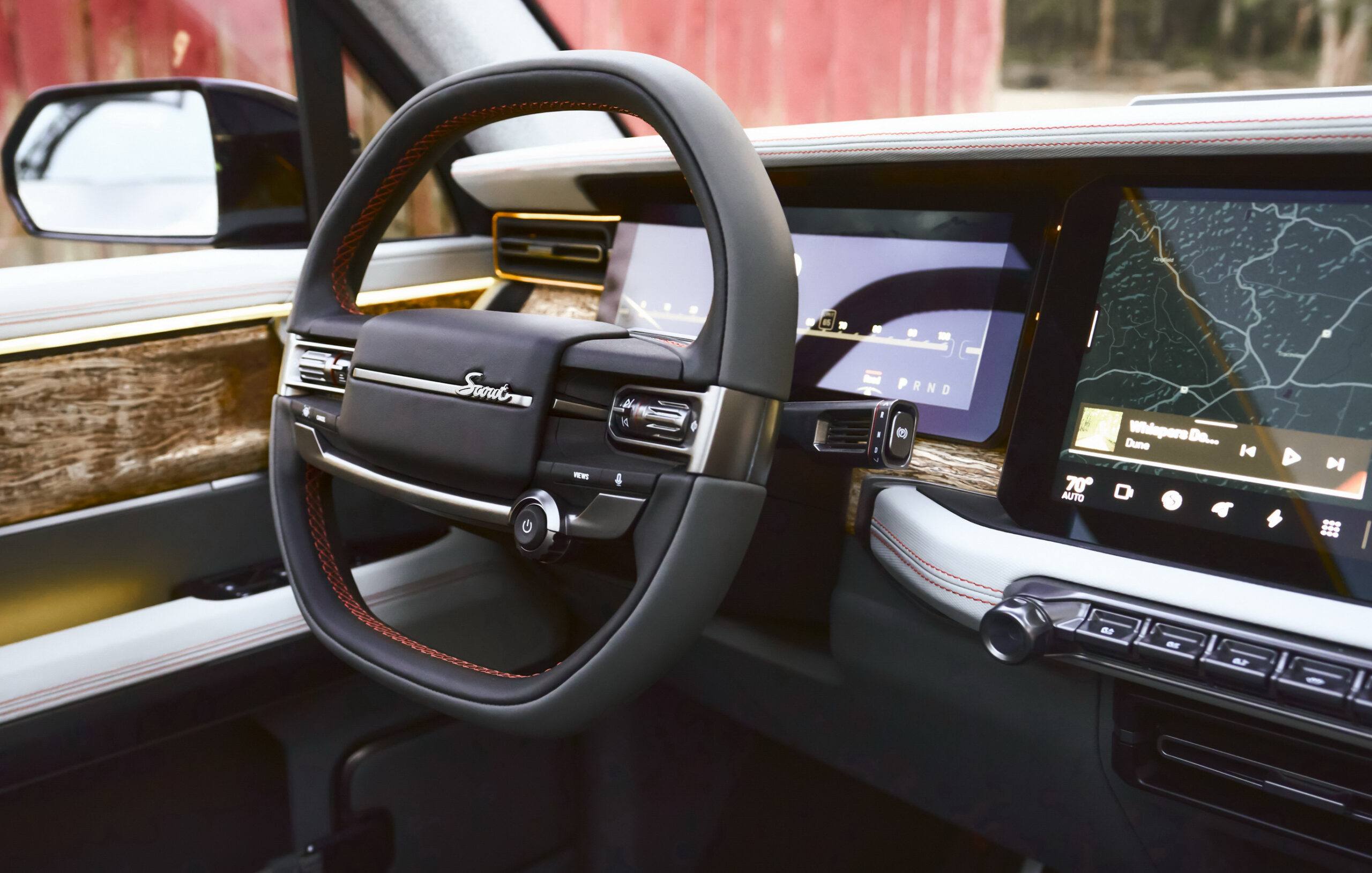
Scout says its EVs won’t chase sterile, ultra-minimalist, sci-fi EV interior cues. Yes, there’s a digital gauge cluster and a large center screen, but there will also be real knobs, real switches, and real buttons.

The tactile nature of the cabin connects to the brand’s rugged DNA, and the carefully curated sounds will reinforce it.

“We’re not creating spaceships,” Benjamin said. “We’re creating hearty, wholesome vehicles that people will love, and we want the sounds to reflect that.”

Production of the Terra and Traveler begins in South Carolina in late 2027, after a run of pilot builds in 2026. 

 The Fake Sounds In Scout’s EVs Come Straight From Real American Machines

Kia Slashed $10,000 Off Its EVs. Buyers Still Walked Away

  • Kia is on track to set another all-time sales record this year.
  • EV6 sales fell sharply from 1,887 last Nov to only 603 units.
  • Key model gains like the K5 and Sportage helped lift sales.

Car manufacturers across the US are scrambling to rekindle interest in their electric vehicles as the federal tax credit of up to $7,500 fades into the rearview mirror. The loss of that incentive has left many brands looking for new ways to attract buyers, and Kia’s approach is simple enough: slash prices.

Read: Who Needs $7,500 Tax Credit When Kia Slashes EV Prices By $10,000

The company is offering discounts worth as much as $10,000 across several models, though the numbers suggest it’s not quite having the desired effect. At least not yet.

Kia announced last month that the 2025 Niro EV, 2025 EV6, and 2026 EV9 would all be available with $10,000 in customer cash. For the Niro EV, that amounts to roughly a 24 percent markdown on the base model. Yet despite the aggressive pricing, sales remain far below the levels seen when the tax credit was still in play.

Discounts Without Traction

Last month, Kia shifted 918 examples of the three-row EV9, almost triple the number of Hyundai Ioniq 9s sold over the same period, but down significantly from the 2,155 sold in November 2024. Year-to-date deliveries are also down 30 percent from 20,066 to just 14,032.

It’s a comparable story with the EV6. Despite receiving a comprehensive facelift, sales have dropped sharply from 1,887 in November 2024 to only 603 this year. Total sales for 2025 now stand at 12,188, down 38 percent from 19,604 over the same stretch in 2024.

Kia US Sales November 2025
ModelNov 25Nov 24Diff.YTD-25YTD-24Diff.
EV99182,155-57%14,03220,066-30%
EV66031,887-68%12,18819,604-38%
K4/Forte9,32111,005-15%126,919127,867-1%
K56,4306,3781%66,64240,67264%
Soul3,2804,031-19%47,67948,747-2%
Niro5,2301,624222%28,03728,302-1%
Seltos6,2863,77866%51,97356,221-8%
Sportage15,79514,05112%165,954146,49013%
Sorento6,7238,705-23%87,43385,7222%
Telluride10,05411,568-13%111,123103,0168%
Carnival7,3624,92549%65,17244,56146%
Total72,00270,1073%777,152723,1857%
SWIPE

Kia does not break down powertrain sales of the Niro, which is sold in ICE, hybrid, and EV guises in the US. What we do know is that overall Niro sales increased dramatically from 1,624 in November 2024 to 5,230 last month.

On Track For a Sales Record

Despite the underwhelming performance of its electric lineup, Kia’s overall sales tell a different story. November saw 72,002 vehicles delivered, up three percent from 70,107 a year earlier.

The brand has now sold 777,152 vehicles in 2025 and is on course to notch its third consecutive all-time annual sales record. The gains have been driven in part by a 64 percent jump in K5 sales, a 13 percent rise in Sportage deliveries, and an 8 percent boost for the Telluride.

\\\\\\

Nio EV Splits Open Like A Can Of Tuna In A Strange Crash

  • Nio EC6 hit a concrete barrier in Shanghai and split through the rear.
  • Driver and passenger escaped without injuries after the violent impact.
  • Battery pack survived the crash and avoided any fire or thermal issues.

All too often, we read about EVs catching fire after relatively minor accidents, and in some cases, occupants were trapped inside. This story is a little different though, as a Nio EC6 was recently destroyed in a crash in China, but remarkably didn’t catch fire despite almost completely splitting in two.

This incident happened in Shanghai on Monday. It’s understood that the light pink-colored EC6 hit a concrete crash barrier side-on after cutting in front of another vehicle, causing it to clip the rear of the Nio.

Local reports suggest that the top edge of the barrow, approximately 120 mm (4.7 inches) wide, applied an extraordinary amount of pressure on the C-pillar and the area of the floor.

Read: Nio’s Mass-Market Onvo Drops Its First 3-Row SUV With More Power Than An EV9 GT

This force caused a split through the rear of the car. Remarkably, the driver and passenger of the Nio were not injured in the crash. Additionally, the battery pack wasn’t severely damaged and did not catch fire.

According to a statement released by Nio, immediately after the crash, the vehicle’s onboard safety systems reported the accident. Nio staff were alerted to the impact and quickly responded to the scene, helping the occupants receive medical treatment.

Perhaps in a thinly-veiled dig at Tesla, Nio says that the EV’s doors immediately unlocked after the collision, allowing the driver and passenger to free themselves.

\\\\

Weibo

The car manufacturer also confirmed that the EC6’s driving assistance system was not enabled at the time.

The Nio EC6 was first unveiled in late 2019 before being thoroughly updated in February 2023. The example involved in this crash was one of the facelifted models.

It’s available with either a 75 kWh or 100 kWh battery pack and sold exclusively in dual-motor guise, producing a combined 483 hp and 516 lb-ft (700 Nm) of torque.

Sources: Weibo, Nio, CarNewsChina

As EV Sales Crash Badly, Hyundai Gets Its Lifeline From Elsewhere

  • Hyundai Ioniq 5 sales fell sharply after federal tax credits ended.
  • Ioniq 6 demand also dropped significantly with sales hitting new lows.
  • Hybrids surged strongly marking their best monthly performance yet.

Hyundai is selling more hybrids in the United States than ever, a result that surely has executives reaching for the champagne. The mood, however, is muted by a sharp downturn in the company’s electric vehicle fortunes. Since the federal EV tax credit expired on September 30, demand has plunged, leaving Hyundai’s battery-powered lineup scrambling to regain its footing

How Low Can It Go?

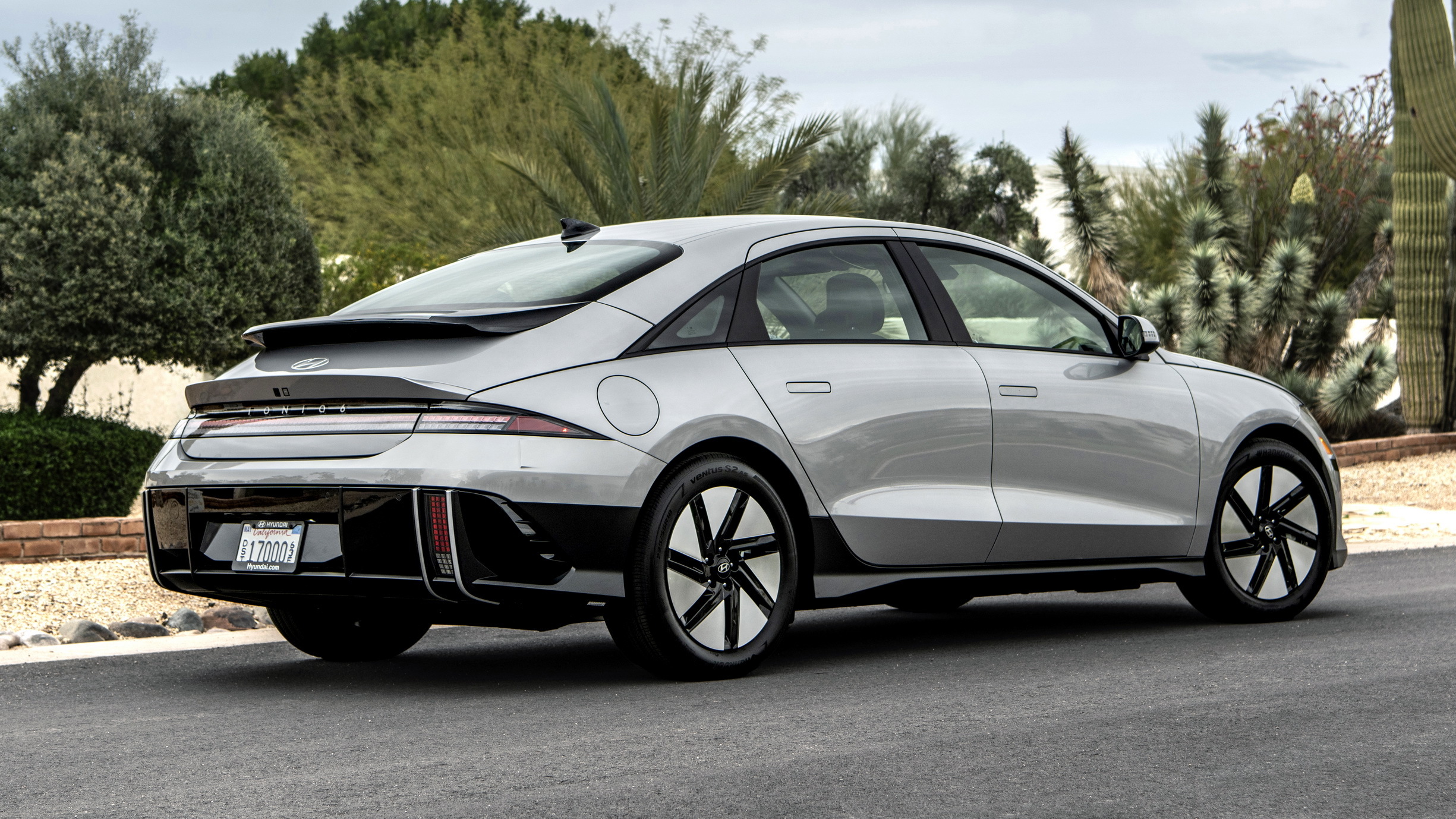
The Ioniq 5 remains Hyundai’s best-selling EV in the US, though November brought little reason to celebrate. Only 2,027 units found buyers across the country, a steep 59 percent drop from the 4,989 sold in November last year.

 As EV Sales Crash Badly, Hyundai Gets Its Lifeline From Elsewhere

There was some consolation in the fact that this figure edged up slightly from October’s 1,642 sales, but the wider picture is still uneven. Year-to-date results show a modest 12 percent improvement over 2024, totaling 44,760 cars sold.

Read: Hyundai And Kia EV Sales Collapse After Tax Credits Vanish Overnight

Things have been equally as bad for the Ioniq 6, with just 489 being sold this November, a decline of 56 percent. Cumulative sales have also slipped, from 11,055 cars in 2024 to 10,019 so far this year, marking a 9 percent decline.

The seven-seat, three-row Ioniq 9 wasn’t available last year, but it remains a relatively slow seller. A total of 315 found new homes last month, down slightly from the 317 sold in October. Year-to-date, 4,809 have been sold.

Hyundai Sales November 2025
VehicleNov-25Nov-24% Chg2025 YTD2024 YTD% Chg
Elantra10,38911,344-8%136,825125,113+9%
Ioniq 52,0274,989-59%44,76039,805+12%
Ioniq 64891,121-56%10,01911,055-9%
Ioniq 931504,8090
Kona5,7836,133-6%68,03076,326-11%
Nexo000%593-95%
Palisade9,9068,982+10%112,23799,757+13%
Santa Cruz1,5372,393-36%23,88929,991-20%
Santa Fe14,00412,376+13%127,964105,701+21%
Sonata4,0186,971-42%54,23861,701-12%
Tucson23,76220,178+18%212,037185,954+14%
Venue2,0591,521+35%27,94322,808+23%
Total Sales74,28976,008-2%822,756758,304+8%
SWIPE

Hyundai’s total November sales have fallen 2 percent from November last year to 74,289 units. So for this year, it still remains in the green, shifting 822,756 vehicles, an 8 percent rise from the 758,304 sold during the first 11 months of 2024.

Hybrids to the Rescue

The big story, though, is hybrids. Sales of electrified models jumped 42 percent, making November Hyundai’s strongest hybrid month on record. That surge has been critical in offsetting the EV slump and maintaining overall growth through the final quarter.

Among individual models, several performed particularly well. In November, The Palisade rose 10 percent to 9,906 units, Santa Fe gained 13 percent to 14,004, and Tucson continued its strong run with an 18 percent increase to 23,762. Even the pint-sized Venue grew 35 percent to 2,059 units.

The Sonata, meanwhile, took a noticeable hit in November, dropping 42 percent year-over-year to 4,018 sales, bringing its year-to-date total to 54,238, down 12 percent from the same period in 2024.

For now, Hyundai’s U.S. lineup shows a clear divide between hybrid gains and weakening EV demand. The next few months will show whether that hybrid momentum can do enough to steady the company’s position in a softening electric market.

 As EV Sales Crash Badly, Hyundai Gets Its Lifeline From Elsewhere

Rivian Turns One-Off Miami Showpiece Into A Very Pricey Limited Run

  • Rivian is putting its Miami-inspired R1S one-off into limited production.
  • Only 10 examples of the R1S Quad Miami Edition will be available.
  • At $134,990 the Miami is $13k more than a regular quad-motor R1S.

Cast your mind back to September and you might recall Rivian’s designers having a bit of fun with an R1S to celebrate the opening of a new store in South Florida. The automaker created a one-off concept SUV with a 1980s Miami-inspired paint scheme that made it look like the EV had jumped right out of Grand Theft Auto: Vice City.

Also: Insurance Offered $1,700 For This R1T Mishap, Rivian Wanted A Fortune

But that tropical fantasy is no longer a one-off. Rivian has confirmed it will build a limited run of purchasable replicas. Naturally, there’s a cost attached to owning one of these beach-party specials.

What Makes it Special?

\\\\\\\\\\

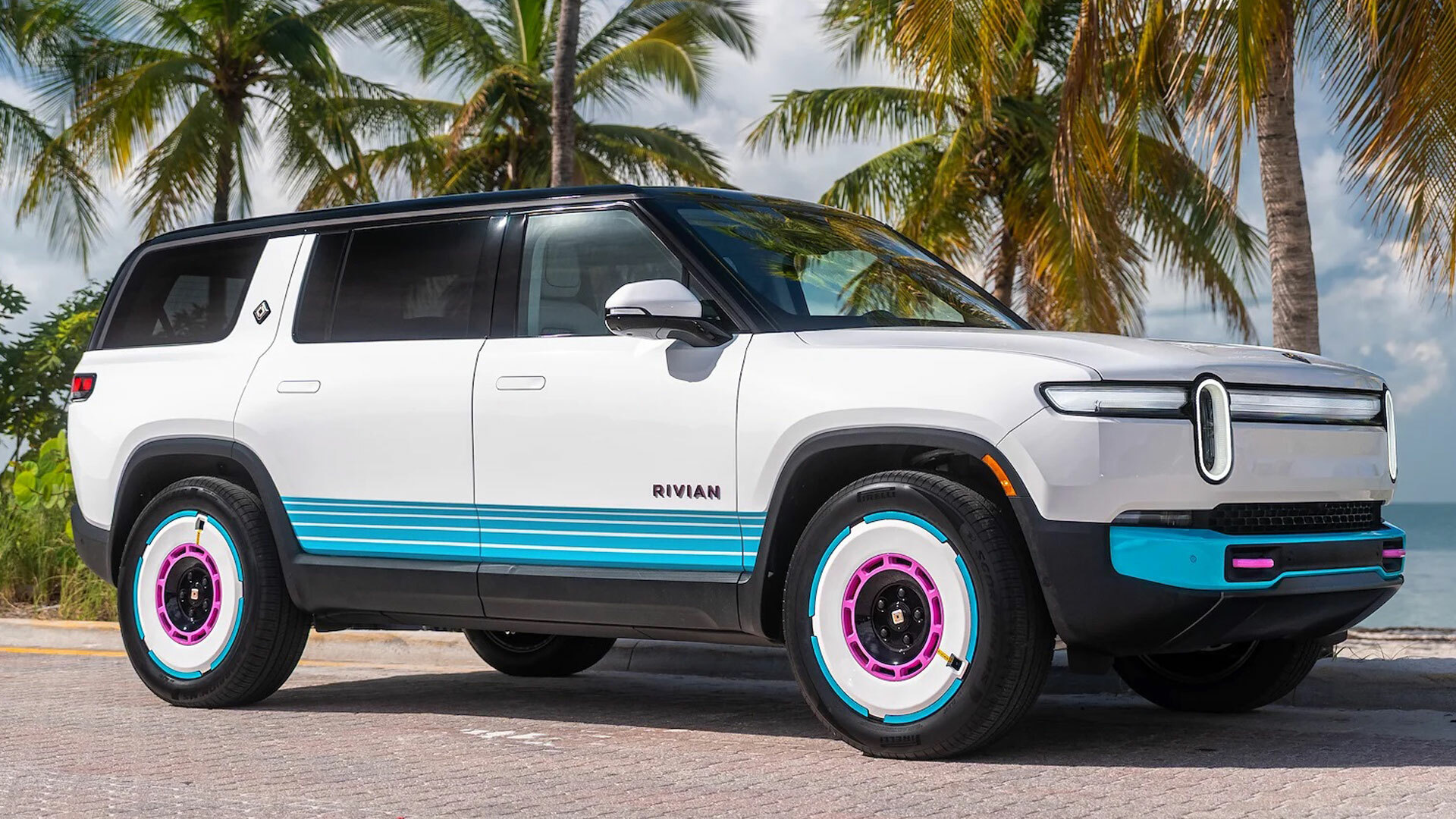
Called the R1S Quad Miami Edition, the colorful SUV is, as the name suggests, based on the top-spec, Corvette-scaring quad motor R1S, whereas the original concept was built around a three Motor R1S Tri model. But there are no changes to the life’s-a-beach visuals that you’ll either love or hate.

Only 10 examples will be built, each featuring the same Glacier White body accented by splashes of aqua and pink on the doors, 22-inch Miami Edition wheels and front bumper. While the doors stick to aqua blue stripes, the wheels get both colors, as does the nose, where a pink towing eye pokes from a blue bumper.

Even the interior doesn’t escape the Miami makeover, though if we’re honest we think Rivian seemed to lose interest once it got to the cabin. The sole flourishes appear to be a stripe of pink on the headrest and some floormats that look like they’re made from the same material as straw beach mats (hopefully they’re more substantial).

\\\\

Having four electric motors rather than three means the Miami Edition gets 1,025 hp (1,039 PS / 764 kW) instead of 850 hp (862 PS / 634 kW), dropping the zero to 60 mph (97 kmh) time from 2.9 to 2.6 seconds. Not that you’d get much opportunity to feel the difference when you’re cruising South Beach.

The Price of Standing Out

But the fun graphics will definitely turn more heads than any stock R1S Tri or Quad, and you’d hope they do given the pricing markup.

Rivian is asking $134,990 for the Miami Edition, which is $13,000 more than you’d pay for a regular R1S Quad. It’s only building 10, so it’ll probably have no trouble selling them, but do you think it’s a good deal?

 Rivian Turns One-Off Miami Showpiece Into A Very Pricey Limited Run
Rivian
Yesterday — 3 December 2025Vehicles

Lighting the Way?

2 December 2025 at 20:10

Industry professionals expressed a range of reactions in the wake of a National Congress of School Transportation vote in May that overwhelmingly rejected a provision to require LED lighting on many school bus exterior fixtures.

The vote was perplexing, some said, because LEDs are recognized as superior in visibility, energy efficiency, longer lifespan and flexibility compared to incandescent lights. With the NCST’s mission being to set safety standards, and only currently meeting every five years, delegates take the added proposals seriously. Editor’s note—The NCST Steering Committee is currently debating the frequency of NCST. A decision is expected this spring.

During the 17th NCST in Des Moines, Iowa, state transportation directors and industry professionals convened to determine new recommended specs and minimum standards across the industry. Forty-eight states were represented by a total of 265 delegates. North Dakota, New Hampshire and the District of Columbia were absent.

Proposal 25 to require LEDs on “all exterior body/chassis lighting with the exception of head/park/turn combination assemblies” failed by a vote of two in favor and 45 opposed. A Pennsylvania delegate disputed the proposal’s statement that it carried no financial impact. Delegates from several states asserted that including LEDs in specifications would beholden districts to the technology, even if future technology proves to be a better option.

Dave McDonald, executive vice president of business development and specifications compliance with Rosco Vision Systems, sat on the Body and Chassis Committee that vetted the proposal and approved it for a floor vote. He is among the committee members who think delegates who voted it down didn’t fully understand what the proposal sought to do.

He compared the LED proposal outcome to a defeated proposal for remote-controlled side mirrors, which he said are an OEM feature on 92 percent of new school buses.

“We look at remote control mirrors as being a safety necessity, not a convenience, because it only takes the driver to properly adjust them, rather than needing two people, one outside the bus adjusting it, and the driver sitting in the seat,” McDonald said. “Delegates looked at it as a state-to-state-to-state issue: ‘Don’t make it part of the national standard.’ The standard doesn’t say anything that you can’t have LED lights, but they leave it open for
the states to either adopt it or not. That was the biggest thing. The states, some of them, get very, very objectionable when it comes to being told what they have to do.”

However, McDonald said, it is important for people to understand how the NCST voting process works. “The NCST is the minimum standard … and then states can go beyond that. If it’s approved, it becomes a standard in every state that adopts the [National School Transportation Specifications and Procedures],” he said. “They can add to it, but they can’t take away from it. Some states will use it as a guideline, but they don’t fully adopt it. … But for the most part, states still control bus specifications for their particular state.”

Jim Haigh, the strategic account manager of school and transit for Safe Fleet, added that LEDs are just one type of light source. Vehicles today, he said, use incandescent lamps, quartz halogen and HID/Xenon, in addition to LEDs. “There are many other light sources currently in use and LED’s are not necessarily the most beneficial source of light for all applications,” he shared. “I believe that [delegates] didn’t want to lock themselves into one technology and prevent the use of emerging technologies in the future.”

Mike VerStrat, communications manager of Opti-Luxx, Inc., said NCST delegates are savvy enough to recognize that LED lighting is “already the de facto standard on new buses,” particularly because of the newer technology’s many advantages.

Brett Kuchciak, specification and compliance manager at First Light Safety Products in Winnipeg, Manitoba, Canada, said he and other manufacturer representatives at the NCST were “quite surprised by the big down vote,” especially because the Body and Chassis Committee thoroughly vetted various options and proposals.

“It’s interesting because a lot of people do think any decision they make at the national level is going to have a cost implication. Most of these decisions, regardless of cost implication, though, are for a justified reason, which in this case is safety,” he said.

Kuchciak said a Canadian Standards Association committee is working on standardizing LED lights under the voluntary CSA D250 standard. “Despite the NCST not going forward, we think it’s something beneficial for the safety of school buses,” he said.

McDonald and Kuchciak noted that some northern state fleet operators prefer incandescent exterior lights because their heat melts snow and ice. “It’s not something that’s widely seen as a benefit, but you’ll get the occasional shop guy who says that,” Kuchciak said. “Typically, though, something that gets hot on a school bus is not ideal. You’d rather have the safety factor of an LED light because before you leave the yard, you’re going to make sure the bus is clear and free of snow, anyway.”

VerStrat said some delegates’ hesitance to support Proposal 25, due to the belief that better technology could emerge, is “almost a sideways compliment to LEDs” because of their rapid adoption by the transportation industry. For example, fewer than eight percent of cars globally had LED headlamps in 2015, according to one industry estimate. Another survey indicated approximately 72 percent of autos were equipped with LEDs by 2023 with the number expected to rise to 75 percent by 2024.

Because the 2020 NCST was canceled, delegates really haven’t had an opportunity to address the issue until now despite their surge in use. “LEDs have rushed onto the forefront, so to speak, and I think that makes delegates say, ‘What else is coming? What’s the next thing?’” added VerStrat, noting there’s a need to give NCST delegates “a real understanding of what, if any, technologies are coming.”

McDonald, who has served on NCST writing committees since 2000, said the 2020 NCST cancellation created a log jam of proposals for consideration. While committees whittled down that backlog and this year’s delegates addressed many issues, “2030 will be an interesting one, because they’re still going to have some carryover items,” added McDonald, who retires from Rosco next month.

The creation of the emerging technologies writing committee will help in the future consideration of many issues, including innovations such as loading zone illumination.

What about some NCST delegates’ concerns that better technology will displace LEDs any time soon? “There’s not anything that you would remotely say is going to be a standard other than LEDs in the near future,” commented VerStrat. “There’s nothing that competes with the performance and reliability of LEDs right now.”

Kuchciak agreed and noted that First Light and industry peers are “trying to get the most out of the technology that’s available to make it as uniform, bright and efficient as possible.” He continued, “Technology is only going to continue to get more dialed in to provide a safer and more efficient lighting source. Constant improvements are happening in the industry. So, things are always getting better.”

Kyle Lawrence, lead mechanic for the Oakdale Joint Unified School District in California, said he wasn’t surprised the proposal was defeated because he thinks many industry professionals still undervalue the importance of lighting and visibility. Others, he added, are locked into long-held industry
beliefs. The safety value of LEDs goes beyond its increased visibility to include the reduced maintenance time that comes with its longer life. “It’s much better to have my techs spending their time on preventive maintenance that will keep the buses out of the shop. With LEDs, you’re not having a tech out there changing bulbs,” Lawrence said.

He warned against the shortsightedness of saving $30 upfront on a part only to spend an extra $300 in labor over the life of a bus to change what he deemed to be inferior lighting.

“Some bulbs can be quick, but some can be a drawn-out, two- or three-hour project because you have to keep taking off a whole bumper to change a light bulb that keeps burning out,” he said. “Our roads here at rural Oakdale are horrible, so anything that wiggles and jiggles either unscrews, falls out or decides it doesn’t want to work anymore. LEDs have a much better success rate.”

He also contrasted many LED lifetime warranties with those of incandescent bulbs. “Some of our after-market LED providers carry no-questions-asked warranties, so if we’ve got a seven-diode taillight that loses a couple diodes, we just take it off, put it back in the package, ship it to them, and they ship a new one,” Lawrence said. “If you play your cards right with the aftermarket industry, you’re only going to spend the money once.”

Most LED chips are manufactured in Asia, primarily China, and imports have been caught up in the on-again, off-again tariffs imposed by the Trump ad-
ministration to drive manufacturing to the U.S. Industry experts contend that is little to no chance that LED chips can be made in the U.S. at a competitive price.

Lawrence said LED lights are less expensive than 10 years ago, but tariffs and inflation have made them more expensive than five years ago. He said he foresees even better days ahead for the technology and the fleet management professionals who deploy it.

“It takes less energy to create light with LEDs, and I think the diodes and chips are progressively getting more reliable, have longer life and brighter
illumination,” he said. “If you’re not using LED, you’re shooting yourself in the foot and walking backwards with a limp.”


Related: NASDPTS Weber Provides EXPO Attendees with Updates from NCST
Related: NHTSA Rulemaking at Heart of NCST Resolutions Focused on Safety
Related: (STN Podcast E258) Nuances & Challenges: NCST Recap, Trade Wars, Upcoming Safety Convos
Related: National Congress Finishes Early After 10-Year Hiatus
Related: May, Should, Shall?


Looking to the future, VerStrat predicted delegates will be able to return to the drawing board and draft a “win-win” proposal on LED exterior lighting. And with incandescent bulbs being used less, will a 2030 or sooner NCST look kindly at the next LED proposal? McDonald isn’t so sure.

“It’s like the mirrors. Ninety-two percent are remote controlled, but that proposal was defeated. We may end up with 90 percent of the buses with LEDs, but that doesn’t guarantee that the states are going to vote to make that the minimum standard,” McDonald said. “The minimum standard is the incandescent bulb. … That’s what it is because some states don’t want to spend the extra money on LEDs.”

Kuchciak said the price gap between incandescent lighting and LEDs will become less of a factor as more buses roll off the assembly line with the newer technology. But he also warned against the dangers of being overly cautious about adopting new technology.

“It’s important that we look at the NCST as a minimum standard. We’re slowing down progress by being concerned with it limiting things in the future,” he said. “If we have something outlined as a minimum standard, and it goes above and beyond, that is for these states to decide if that is something that they want to pursue within their state or whether the OEMs want to go above and beyond these minimum standards. We don’t want innovations to slowed just because we think something better is going to come out.”

Editor’s Note: As reprinted from the November 2025 issue of School Transportation News. 

The post Lighting the Way? appeared first on School Transportation News.

Navigating Change: How Transfinder Transformed Student Transportation in Colorado Springs

By: STN
2 December 2025 at 08:00

Colorado Springs School District 11 (D11), serves about 23,000 students in 58 schools, including 34 elementary schools. The district has had its share of challenges, with a shift in student population and a 40 percent drop in drivers since pre-Covid days.

The changes led Kevin McCafferty to seek a partner to come alongside him in addressing these and other issues. That partner is Transfinder and its suite of award-winning solutions, including Routefinder PLUS, Viewfinder, Infofinder i, GPS Connect, and more.

He looked at other vendors in the industry, and after a rigorous RFP process, the district picked Transfinder.

Two things made Transfinder stand out:

  1. Its ability to get the district implemented in time for the fall 2025 opening; and
  2. Transfinder’s flexibility. Another vendor just provided what McCafferty described as a “dissertation” on why a request to change stop times couldn’t be made.

“I thought, ‘Well, that’s odd. I’m a customer.”

He met with the other vendor many times and would ask for the ability to change stop times and he was continually rebuffed.

He asked: “Am I the only guy asking that question?”

The vendor responded: “No, we get that a lot.”

Transfinder delivered

After implementing Transfinder’s flagship Routefinder PLUS routing solution over the summer, McCafferty said school opening was smooth.

“I thought it was smooth,” he said. “I thought it was really good.”

After nearly two decades with Colorado Springs School District 11, McCafferty has seen it all—from driving buses to leading operations as the district’s Transportation Operations Manager. With a background in electrical engineering and a passion for problem-solving, McCafferty’s journey is one of adaptability, innovation, and a deep commitment to student success.

When Kevin first joined the district, it was a strategic move to settle in Colorado Springs.

“I needed a job and wanted to live in Colorado Springs,” he recalled. Starting as a bus driver, he quickly moved into technology support and eventually into operations management, where he has spent the last dozen or so years navigating the complex world of school transportation.

Over the years, the district has undergone significant changes. Once serving 35,000 students, enrollment has dropped to under 23,000. A demographic study revealed a common urban trend: an aging population and declining birth rates.

Transportation, naturally, has been deeply affected.

“One of the things we face is we do have less kids riding but we’re still covering the same ground,” said McCafferty. With about 115 buses and only 60 percent of the pre-COVID driver workforce, the department has had to become more efficient. This meant reducing stops, increasing walking distances, and combining routes—changes that haven’t always been popular but were necessary for survival.

In addition, the district’s new superintendent introduced “peak experiences,” including more field trips and specialized programs like cybersecurity and career technical education. These initiatives, while enriching, added midday transportation demands to an already stretched system.

“We’re just trying to survive getting kids to and from school,” McCafferty said, “and now we’re adding more requirements. “

To meet these demands, the district relies on three car service contractors. But McCafferty wanted a better way to manage transportation logistics. After years of using outdated or inflexible systems, the district made a pivotal switch to Transfinder in the summer of 2025.

The transition wasn’t without apprehension. McCafferty, who was officially retired, came out of retirement to help with the transition. He wasn’t onsite when the software was being launched, but he said the rollout exceeded expectations.

“It went very smooth—much smoother than I expected,” he said. “That doesn’t usually happen.” He likes the fact that all of Transfinder’s trainings with his team are recorded and can be easily accessed anytime.

McCafferty said Tripfinder also has helped the district manage field trips and he also likes Infofinder i, which allows parents and real estate agents to easily access school boundary and transportation information.

“I don’t know if I got any calls,” he said, a stark contrast to previous years. The ability to edit maps directly in Routefinder PLUS was another game-changer. McCafferty, who had previously made over 9,000 edits to a past map – yes, 9,000 edits – said he appreciates the control and immediacy Transfinder’s Routefinder PLUS offers.

Beyond praising Transfinder’s tools, he commended Transfinder’s customer service, calling it one of the company’s strongest assets.

McCafferty said he tried Transfinder’s Live Chat “to see how quick they really are. So. I found everything was very, very good. Everybody was very responsive. You can definitely use customer service as one of your high points.”

To learn more, visit www.transfinder.com/solutions, call 800-373-3609 or email solutions@transfinder.com.

The views expressed are those of the content sponsor and do not reflect those of School Transportation News.

The post Navigating Change: How Transfinder Transformed Student Transportation in Colorado Springs appeared first on School Transportation News.

BMW Teases A Mystery Model Arriving On Christmas Eve

  • BMW slips a mysterious EV silhouette into its latest holiday video.
  • The teaser links to current electric models mentioned in the clip.
  • The shape suggests a crossover possibly related to the new iX3.

The holiday season is upon us and that means automakers have rolled out an assortment of Christmas-themed campaigns such as Lexus’ December to Remember. These are easy to overlook, so it’s surprising that BMW decided to sneak a teaser in one of them.

The video begins with an advent calendar opening to reveal an assortment of models including the 7-Series. It then zooms in on December 24 and the box opens as question marks shoot out.

More: The iX3 Is BMW’s Neue Klasse Future Now With A Surprising Price Tag

We’re then shown a darkened silhouette of a mysterious vehicle. It’s hard to tell what’s being displayed, but the accompanying text gives us some clues. In particular, it notes the video shows the iX1 xDrive30, iX2 xDrive30, i4 M50 xDrive, i5 M60 xDrive Touring, and i7 xDrive60.

All five of them are electric, so it’s safe to assume the mystery model is as well. The vehicle also appears to be a crossover that recalls the new iX3.

We’re not sure what BMW has up their sleeve, but spy photographers have already snapped pictures of the iX3 M60. It’s expected to have a sport-tuned suspension and beefier brakes. We can also expect styling tweaks inside and out.

Another possibility is the new i3. BMW has been teasing the car for months and the automaker could use Christmas Eve to share more details.

Another outside possibility is a glimpse at the upcoming iX5. It’s expected to debut next year and prototypes have already been spied on numerous occasions.

Still, the safest bet remains a new take on the iX3. In fact, when BMW introduced the iX3 50 xDrive in September, they said “further fully electric variants will follow, including a single-motor rear-wheel drive model.” The holiday clip may be the brand’s quiet way of saying that time is near.

 BMW Teases A Mystery Model Arriving On Christmas Eve

H/T to BMW Blog

New Mercedes GLC EQ Isn’t Stopping At Two Rows Anymore

  • Mercedes is testing a larger, three-row version of the GLC EQ.
  • The prototype shows a flatter roofline and extended rear doors.
  • Expect a similar interior with MBUX Superscreen and Hyperscreen.

Mercedes unveiled the GLC EQ at the Munich Motor Show this fall, but that’s not the end of the story. Quite the opposite as spy photographers have now snapped the first pictures of what appears to be a new three-row variant.

Spied parked alongside the regular model, the seven-seat crossover has a familiar design that closely echoes its smaller counterpart. However, we can see a flatter roof, updated rear doors, and a unique rear end.

More: Star-Stricken Mercedes GLC EV Has A Grille Big Enough To Swallow A BMW iX3

The latter has been extended and features a more upright rear window. The camouflage also suggests larger third-quarter glass and a reimagined D-pillar.

Besides the special touches, the model has starry headlights and plastic body cladding. We can also see a familiar grille and rear light bar with circular elements.

 New Mercedes GLC EQ Isn’t Stopping At Two Rows Anymore

Spy photographers didn’t get a look inside, but the model should have a 10.25-inch digital instrument cluster and a 14-inch infotainment system.

Buyers will also likely have the option to upgrade to the MBUX Superscreen, which adds a 14-inch front passenger display. If that isn’t enough screens, the available MBUX Hyperscreen features a 39.1-inch display that spans the width of the dashboard.

We can also expect a familiar powertrain that consists of a 94 kWh battery pack as well as a dual-motor all-wheel drive system developing 483 hp (360 kW / 490 PS) and 590 lb-ft (800 Nm) of torque.

This enables the regular model to accelerate from 0-62 mph (0-100 km/h) in 4.3 seconds, hit a top speed of 130 mph (210 km/h), and have a WLTP range of 418 miles (673 km).

The three-row crossover is believed to be designed for China. However, that’s not entirely certain as the model would make sense in a number of markets.

\\\\\\\\\

Baldauf

California EV Owners Now Risk A $490 Fine Under New Driving Rules

  • California ends solo EV access to carpool lanes after 25 years.
  • Drivers risk getting a ticket starting Dec 1 for using HOV lanes.
  • Enforcement started after a 60-day grace period for local drivers.

California has long been America’s champion of electric mobility, a place where environmental ideals and car culture somehow coexist on the same sun-baked freeway. For years, the state has rolled out incentives to get drivers into EVs, from tax credits to special lane privileges.

Chief among them was the right to glide past gridlock in carpool lanes, solo and smugly efficient. But that era has now come to a halt.

Read: California Won’t Replace $7,500 EV Tax Credit as Newsom Accuses GM of Selling Out

For more than 25 years, states have been free to decide whether EV drivers could use carpool lanes, spaces meant for vehicles carrying at least one passenger. California made its stance clear early on.

It offered qualifying motorists distinctive Clean Air Vehicle stickers, granting them unrestricted access to these faster lanes even when driving alone.

From Exemption to Enforcement

That all changed when the Trump administration declined to renew the federal authorization that supported the state’s exemption. The cutoff date was October 1, and once that law expired, so did the automatic right for solo EVs to cruise in carpool lanes.

The California Highway Patrol then gave motorists a 60-day grace period to adjust their driving habits and exit the carpool lanes. Starting from December 1, police can now issue a $490 fine.

 California EV Owners Now Risk A $490 Fine Under New Driving Rules

That’s not great news for local EV owners. Some suspect that by pulling EV drivers out of carpool lanes, which often sit empty during peak morning and afternoon hours, traffic on some of California’s highways may get even worse.

“It’s a huge, huge bummer for EV enthusiasts,” the president of the Tesla Owners of Silicon Valley club, John Stringer told The Press Democrat. “It has been one of the things we’ve been able to enjoy for years. It was one of the reasons why I bought my first EV.”

Stringer estimates that his carpool access saved him about 20 minutes each way on his daily commute, time that now returns to the general traffic pool.

In September, Rep. Mark DeSaulnier revealed that he had been lobbying in Washington, D.C., on behalf of EV drivers, trying to extend the carpool privilege for another six years through a House Resolution. Despite the effort, the proposal stalled before reaching a vote.

 California EV Owners Now Risk A $490 Fine Under New Driving Rules
Google Maps

Honda Sold 30 Preludes In Its Launch Month As Prologue EV Sales Collapsed

  • Honda’s sales dropped sharply compared to the same month last year.
  • The end of federal EV tax credits took a significant toll on the Prologue.
  • The Passport SUV was the brand’s only major sales success last month.

Honda has released its sales figures for November, and the picture isn’t pretty. The company recorded US sales of 91,582 units, a notable decline of 16.8 percent compared to the same month last year, when it delivered 110,020 vehicles.

Despite the monthly slowdown, the company’s year-to-date total of 1,190,328 vehicles still reflects a modest 1.8 percent increase over the same period in 2024.

Also: Sales Of Honda’s Only American EV Soar 963%

Among Honda’s key nameplates, most saw declines in November, with only slight variation between them. The Accord recorded 10,613 sales in November, down 9.1 percent from 2024, while the Civic moved 17,353 units, a 5.5 percent decline. The Odyssey minivan had a rougher month, slipping 17.3 percent to 5,492 units.

 Honda Sold 30 Preludes In Its Launch Month As Prologue EV Sales Collapsed

SUVs and crossovers continued to shoulder most of the brand’s sales volume, led by the CR-V at 29,421 units and the HR-V at 10,821. Both posted notable drops of 14.5 percent and 14.1 percent respectively. The Pilot followed with a 27 percent decline to 9,234 units, and the Ridgeline pickup slid 15.4 percent to 3,352.

Unsurprisingly, the steepest fall came from Honda’s electric Prologue, which was caught in the aftermath of the federal EV tax credit shake-up at the end of September. Sales cratered by 86.8 percent, plunging from 6,823 units last November to just 903 this time around.

There was a glimmer of good news as the Passport surged (again) 50 percent to 4,363 units, standing out as the lone bright spot in an otherwise gloomy report.

A Quiet Start for a Comeback Coupe

 Honda Sold 30 Preludes In Its Launch Month As Prologue EV Sales Collapsed

That brings us to Honda’s newcomer, the Prelude, which officially entered the U.S. market last month. According to manufacturer data, 30 new buyers took delivery of the hybrid coupe after it went on sale around the third week of November.

No doubt, that figure will grow as production ramps up and imports arrive, so there’s little reason to draw conclusions just yet. Still, a heritage model like this tends to move quickly once stock builds up, though Honda’s pricing might slow that momentum.

The Prelude has made big waves since Honda admitted that it was returning. For the most part, that press has been good. In Japan, it was so popular among folks in their 50s and 60s that dealers had to pause taking orders for it. Of course, not all coverage of the car is so rosy. A starting MSRP of $43,195 (including destination) put it within $1,000 of a Nissan Z, which has the same number of seats and double the horsepower.

More: Delusional Honda Dealers Marking Up New Prelude To Over $60,000

Notably, Honda only offers the Prelude in a single trim with just about every desirable option already included. Prospective buyers can add around $10,000 worth of additional accessories, special wheels, and more. That said, the big draw for the Prelude, other than its name and styling, is performance in the fuel economy department. It can achieve up to 46 mpg in the city, 41 on the highway, and 44 combined.

Honda US Sales November 2025
 Honda Sold 30 Preludes In Its Launch Month As Prologue EV Sales Collapsed

$43,195 already seems like a lot of cash for such a niche car, but get this: dealer markups are only making things worse. Late last month, we told you about some dealers asking $60,000 or more for this car. One justified it with a “Protection Package & Market Adjustment” tag for $14,995. That type of pricing is almost certainly going to keep the rollout slow for the time being.

Of course, not every dealer will price the car that way. Plenty will sell it at MSRP or near there. The real question is how many buyers in the U.S. will be willing to buy it and join the first 30 owners.

John Halas contributed to this story.

 Honda Sold 30 Preludes In Its Launch Month As Prologue EV Sales Collapsed

Ford’s Gas Mustang Nearly Outsold Its Entire EV Lineup, Which Pretty Much Says It All

  • Combustion Mustang sales almost doubled to 4,207 units in November.
  • Ford only sold 4,247 F-150 Lightnings, Mustang Mach-Es, and E-Transits.
  • EVs look healthier YTD, but they’ve dropped harder than the pony car.

Is the now 61-year-old gas-powered Mustang still relevant in 2025? American drivers clearly think so, judging by fresh sales figures. The pony car Ford has been building since the Beatles were still together is now going toe to toe with the company’s entire electric lineup in a race that’s closer than a Z28 vs Boss 302 quarter-mile grudge match.

Related: Someone Paid New Porsche 911 Money For A 1992 Mustang Still Wrapped In Plastic

According to Ford’s newly released November sales report, the gas-powered Mustang racked up 4,207 sales while Ford’s three EVs combined only reached 4,247. That is a margin of only forty cars.

Mustang sales exploded by 78.6 percent compared with the previous November’s stats, while the EVs lost almost as much ground.

What Happened to the EVs?

Mach-E plunged almost 50 percent to 3,014 units, the F 150 Lightning cratered 72 percent to just 1,006, and the poor E Transit dropped more than 80 percent to 227, figures no doubt deeply affected by the loss of federal tax credits, which expired at the end of September.

 Ford’s Gas Mustang Nearly Outsold Its Entire EV Lineup, Which Pretty Much Says It All

To be fair to the EVs, the comparison is more embarrassing in the short term than across the whole year. Year to date, Ford EVs have achieved 78,556 sales while the Mustang trails at 40,870.

Even so, the electric lineup is down 7.3 percent compared with the same period last year, while the Mustang held relatively steady, falling by a less worrying 1.6 percent.

But US drivers didn’t snub their noses at electrification entirely. Hybrid sales climbed 13.6 percent to 16,301 units in November and are up 19.4 percent to 206,497. That means Ford has sold three times as many hybrids so far during 2025 as it has EVs.

Any Bright Spots Beyond the Mustang?

 Ford’s Gas Mustang Nearly Outsold Its Entire EV Lineup, Which Pretty Much Says It All

Looking beyond the gas versus electrons drama, there were a few standout performers. Explorer lit up the SUV side with a huge 41.5 percent November gain and nearly 20,226 sales despite celebrating its sixth birthday this year.

The Ranger also punched well above its weight with a 35.8 percent jump as the midsize truck continues its comeback.

The Maverick is another star performer. Its sales are up 43.3 percent for the month and nearly 12 percent for the year. On the Lincoln side, things were less happy, with November brand sales dropping 12.3 percent, although the Navigator is up 42.9 percent in the first 11 months of 2025.

Ford and Lincoln sales 2025
Nov ’25Nov ’24% DiffYTD ’25YTD ’24% Diff
Energy type
Total Electrified Vehicles20,54825,172-18.4285,053257,69310.6
Electric Vehicles4,24710,821-60.878,55684,774-7.3
Hybrid Vehicles16,30114,35113.6206,497172,91919.4
ICE144,377141,2012.21,714,3641,629,6085.2
Total vehicles164,925166,373-0.91,999,4171,887,3015.9
Vehicle Type
SUVs64,02267,294-4.9809,278794,7871.8
Trucks96,69696,7240.01,149,2691,050,9869.4
Cars4,2072,35578.640,87041,528-1.6
Total vehicles164,925166,373-0.91,999,4171,887,3015.9
FORD BRAND
Bronco Sport9,2129,601-4.1122,380113,3408.0
Escape7,05410,344-31.8132,471133,604-0.8
Bronco11,04510,3207.0132,21697,10536.2
Mustang Mach-E3,0145,938-49.247,88244,8776.7
Edge01,661-100.03,04065,217-95.3
Explorer20,22614,29941.5198,819178,24311.5
Expedition5,3375,852-8.877,41369,24311.8
Ford SUVs55,88858,015-3.7714,221701,6291.8
F-Series60,96167,459-9.6749,471685,7779.3
Memo: F-150 Lightning (electric)1,0063,643-72.425,58328,313-9.6
Ranger6,8455,03935.862,86440,94953.5
Maverick9,8836,89943.3141,873126,76011.9
E-Series2,9743,292-9.737,76036,4943.5
Transit15,33913,08017.3147,045139,7905.2
Memo: E-Transit2271,240-81.75,09111,584-56.1
Transit Connect00N/A08,781-100.0
Heavy Trucks694955-27.310,25612,435-17.5
Ford Trucks96,69696,7240.01,149,2691,050,9869.4
Mustang4,2072,35578.640,87041,528-1.6
Ford Cars4,2072,35578.640,87041,528-1.6
Ford Brand156,791157,094-0.21,904,3601,794,1436.1
LINCOLN BRAND
Corsair1,8932,147-11.823,89624,571-2.7
Nautilus2,3053,292-30.030,58032,447-5.8
Aviator2,5372,4792.321,18822,565-6.1
Navigator1,3991,3612.819,39313,57542.9
Lincoln SUVs8,1349,279-12.395,05793,1582.0
Lincoln Brand8,1349,279-12.395,05793,1582.01
SWIPE

Ford

Stellantis Furious At Influencers Who Tore Apart Recon Interior To Mock Its Build Quality

  • Influencers tore apart a Jeep Recon interior at the LA Auto Show.
  • Stellantis called the act destructive, citing a pre-production model.
  • The viral TikTok drew over 1.1 million views and 2,300 comments.

Stellantis has publicly condemned two influencers after a viral video showed them dismantling parts of the new fully-electric Jeep Recon during the 2025 Los Angeles Auto Show. The clip, which spread quickly across social media, reopened the debate over how pre-production prototypes ought to be treated at auto shows.

The automaker explained that the show car mocked for its poor build quality was a hand-assembled pre-production prototype, not the finished model, describing the creators’ actions as “destructive.”

Online Outrage or Honest Critique?

The viral video, posted by an LA-based channel called “The Middle Lane,” has drawn more than 1.1 million views and 2,300 comments on TikTok since November 22. It reportedly appeared on YouTube and Instagram as well, though it has since been removed from both platforms.

More: Jeep’s $65,000 Recon Is Surprisingly Fast, But Can It Outrun The EV Slowdown?

The creators blasted the build quality of the latest Jeep, saying they expected better fit and finish for a vehicle with an MSRP of $65,000. They are shown removing and then reattaching plastic pieces from the Recon’s interior, including trim around the center console and above the digital instrument cluster.

They also zoom in on uneven gaps between materials on the door panels and wiggle the infotainment screen and passenger grab handle, saying they were simulating “off-road use.”

@themiddlelanes Jeep Recon Moab build quality… #laautoshow #tiktokcartalkcontest #electriccar #buildquality ♬ original sound – The Middle Lane

Stellantis Responds

In response, Stellantis released a statement: “The vehicle in question is a preproduction show car, built exclusively for reveals and events to highlight the design inspiration for the final product. These prototype units are typically hand-built and not intended to demonstrate final production, durability, quality, or integrity of materials.”

More: Jeep’s Latest Special Edition Honors A Classic Military Truck

Kaileen Connelly, Senior Vice President of North America Communications at Stellantis, added in an email to the Detroit Free Press: “The actions taken to disassemble the all-new Jeep Recon on display at the LA Auto Show were both destructive and unprofessional.”

What the Creators Say

The Detroit Free Press later spoke with Luke Miani, founder of “The Middle Lane,” who said they were surprised by the video’s reach and the conversation it triggered. According to Miani, their intention had simply been to share “thoughts on many different cars.”

Addressing Stellantis’ statement, he explained, “I want to push back on the claims of ‘destructive’ conduct as the video clearly shows the clips holding certain interior parts together were loose and the parts easily pop out by hand without damage.”

He added that he looks forward to seeing the production version of the Recon, hoping that “the build quality is indeed improved.”

\\\\\\\\\\\\

How the Public Reacted

Reaction online has been mixed. Some commenters expressed disappointment with what they perceived as poor craftsmanship, placing blame on Stellantis. Others defended the automaker, noting that the vehicle was a pre-production demo unit brought to LA for the show and never intended for close physical inspection.

The story also gained traction on Reddit, where many users criticized the influencers for “unprofessionalism,” while others argued that automakers should be more discerning about who gets access to display cars.

One self-identified “interior trim engineer” commented that building pre-production models is “way different” from production, describing a process where “employees are working on a table with a drill and some screws” long before an assembly line is operational.

The electric 2026 Jeep Recon is scheduled to enter production in early 2026 at Stellantis’ Toluca plant in Mexico. Initial deliveries in North America are expected shortly after, with global rollout planned for the final quarter of the year. The first version, a Moab trim exclusive to the US and Canada, will start at $65,000, with more affordable variants to follow

\\\\\\\\\\\\

Europe Might Not Be Ready For What China’s Most Luxurious Brand Plans Next

  • Hongqi plans 15 hybrid and EV models across 25 European markets.
  • The brand is scouting sites for local factories in multiple regions.
  • FAW-owned Hongqi sold just 771 vehicles in Europe through October.

Hongqi cars may be a common sight across China, but beyond its home market, the brand remains something of a mystery to most car buyers. That may soon change. China’s oldest and most luxurious automaker has set its sights on a sweeping European expansion, planning to introduce 15 electric and hybrid models and bring them to 25 markets by 2028.

Read: China’s Most Luxurious Brand Is Coming For Europe With 15 New Models And It’s A Red Flag

Like many of its Chinese peers, Hongqi sees global growth as essential, and Europe is high on the list. The brand’s plans, however, face a complicated landscape. The European Union has imposed heavy tariffs on Chinese-built electric vehicles, raising both costs and stakes.

In response, Hongqi is said to be exploring local production. Potential manufacturing sites are reportedly under consideration in southern Europe, eastern Europe, and the Nordic region. Building cars within the EU could soften tariff impacts and make logistics smoother, especially as the company works to establish itself in a new market.

\\\\\\\\\\\

Hongqi, a division of state-owned FAW, has sold just 771 vehicles in Europe through October, a modest figure compared with its home market reach. That number, though, may serve more as a baseline than a limit.

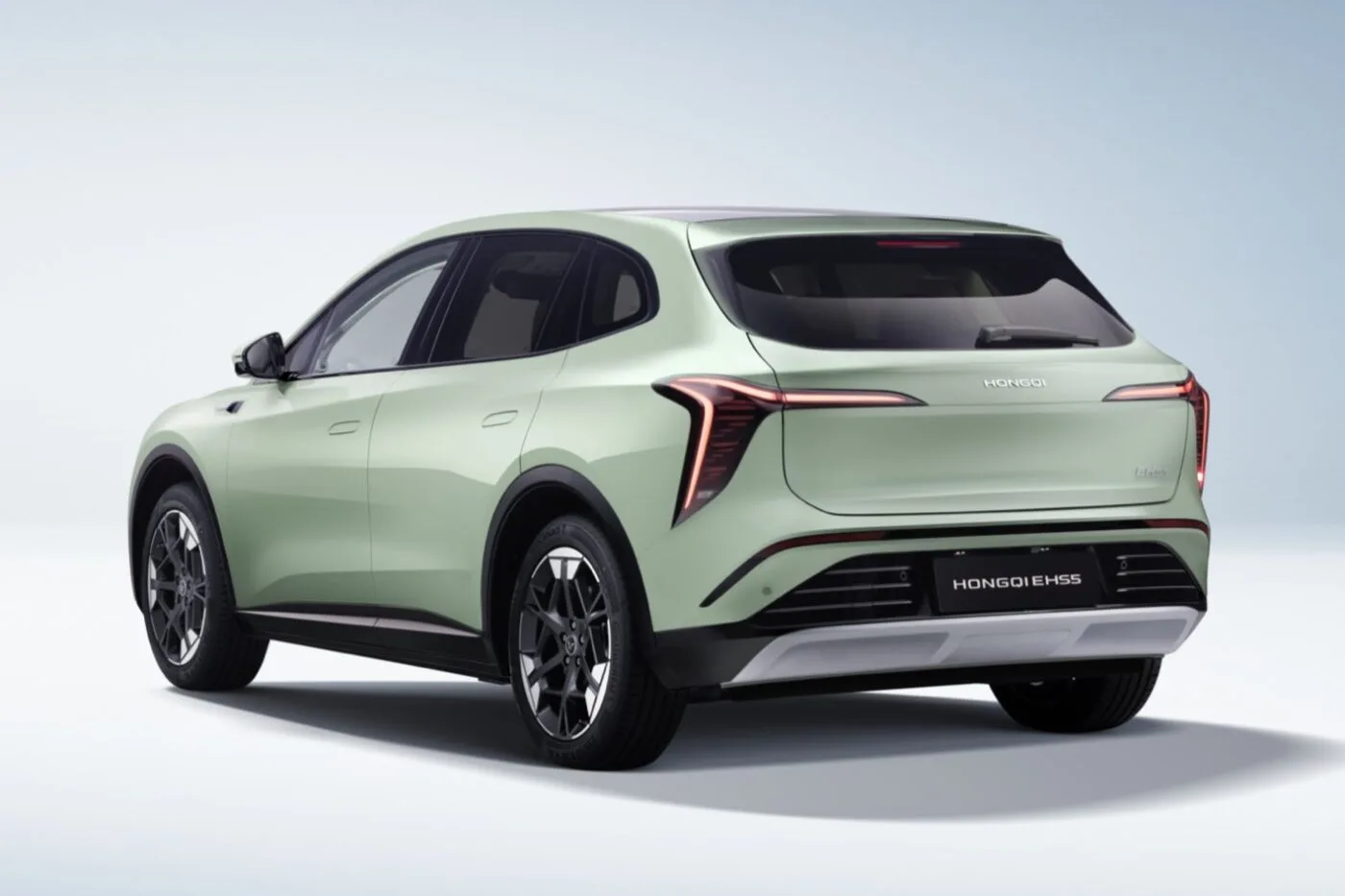
Its most significant newcomer is the EHS5, a mid-size electric SUV first shown at the Munich Motor Show. The model runs on an 85 kWh lithium-ion battery and offers a range of 342 miles (550 km).

European specifications haven’t yet been finalized, but in China the EHS5 comes in two versions: a 339 hp rear-wheel-drive model and a 610 hp all-wheel-drive setup. Until now, the EHS7 has been Hongqi’s top seller in Europe, but the new SUV could change that balance.

 Europe Might Not Be Ready For What China’s Most Luxurious Brand Plans Next
Hongqi EHS5

Pricing will be key to Hongqi’s success in Europe. Fellow Chinese brands, like MG, Chery, and BYD, have been steadily growing their sales across the region thanks to cut-price models.

FAW’s design chief, Giles Taylor, told Auto News that Hongqi’s government ties give it access to technology “at prices that you just wouldn’t believe.” That cost structure could be a powerful advantage.

“We can then leverage that pricing power whether it’s in domestic market or in Europe,” he said. “Do you really want to spend €5 for a Starbucks coffee when there’s a new little startup brand around the corner selling coffee for €1.50?”

\\\\\\\

Sources: Auto News

Before yesterdayVehicles

Maine Student Struck by School Bus Dies from Injuries

1 December 2025 at 21:27

An RSU-13 school bus driver is on administrative leave following a collision with a student pedestrian who had just exited from his school bus and later died. The incident remains under investigation.

On Nov. 21 at around 2:20 p.m., Rockland Police and Rockland Maine Fire & Rescue EMS responded to a vehicle-pedestrian crash at an intersection. The Rockland Main Police Department noted that the incident involved an RSU-13 student who was struck by a school bus. The student was life-flighted to the hospital with life-threatening injuries. The student, identified by local media as 12-year-old Brayden Callahan, died Friday.

STN reached out to the Rockland Police Department for more information but had yet to hear back at his writing. Local media reported preliminary information from the police indicated that school bus driver Jeffery Colburn, 65, did not see the student. Articles add that Callahan had just exited the bus and was entering the crosswalk when Colburn pulled into the street.

Video footage reportedly shows that the crossing arm was not deployed at the time, the driver was leaning too far to the right in his seat, and that the bus first ran over Callaha  with the front passenger-side tire, then again with the two rear passenger-side tires.

RSU-13 Superintendent John McDonald said in a letter to parents Sunday the school bus that struck Callahan has been decommissioned and a substitute driver was assigned to pick up students on that particular route.

“We have been working with the [Maine] Department of Education on a plan to have a replacement bus in our fleet up and running soon, and we appreciate their quick response in supporting us in this effort,” McDonald said, adding that counselors were available on the route and at school.

Rockland Police Chief Carroll added in a Facebook post that the investigation will be time-consuming due to the nature of the crash and the number of passengers on board who witnessed the incident.


Related: WATCH: Maine District Highlights Drivers for Love the Bus Month
Related: 6 Students Killed in Danger Zone, All by School Buses
Related: Louisiana Boy Waiting for School Bus Allegedly Killed by Impaired Grandmother
Related: 4-Year-Old Girl Killed After Being Struck by School Bus in New York


“I also want to address the negativity, blaming and other rumors that inflame the emotions of everyone, doesn’t help with this process,” he wrote. “This is a time to grieve and support the family that has suffered a great loss. This is not the time to distract with other non-related things that have nothing to do with this tragedy itself.

“Let the investigation tell the story. Again, I assure you, we will complete a thorough investigation and provide a true series of events that lead to this horrific event,” he continued. “Recognize that we are all suffering. But in the end, let’s keep Brayden’s family in your prayers.”

This is a developing story. STN will provide an update as more information becomes available.

The post Maine Student Struck by School Bus Dies from Injuries appeared first on School Transportation News.

❌
❌