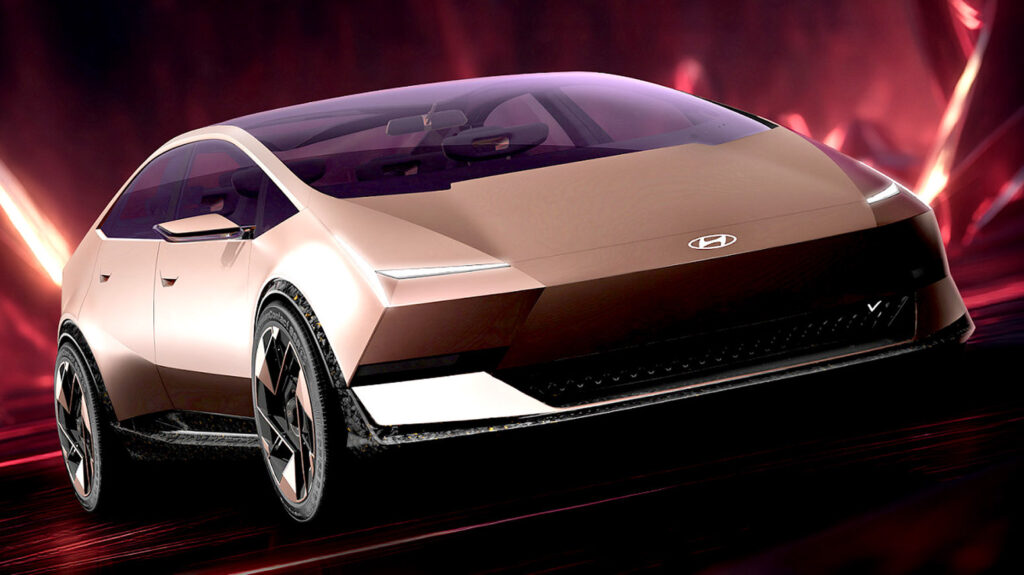
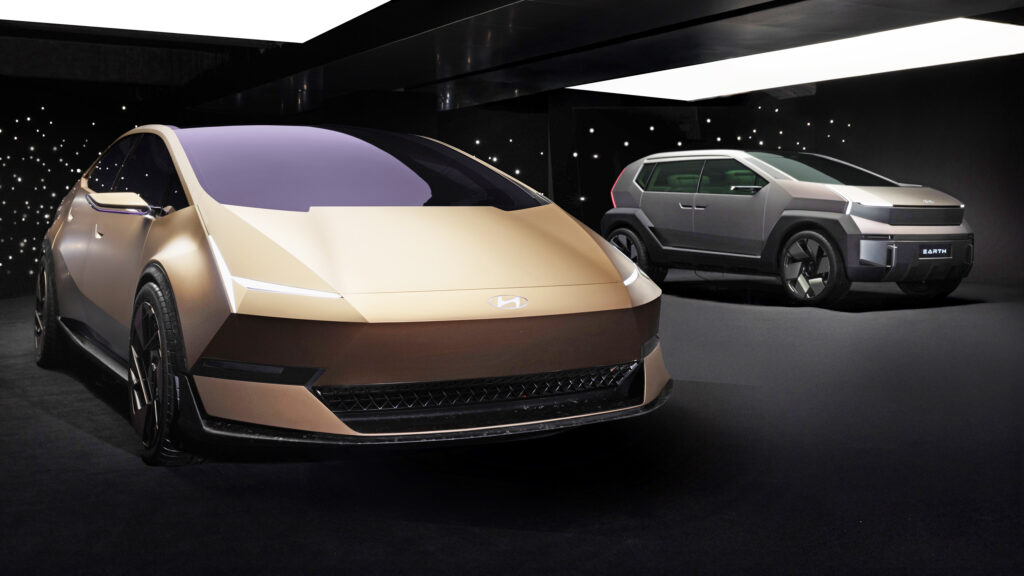
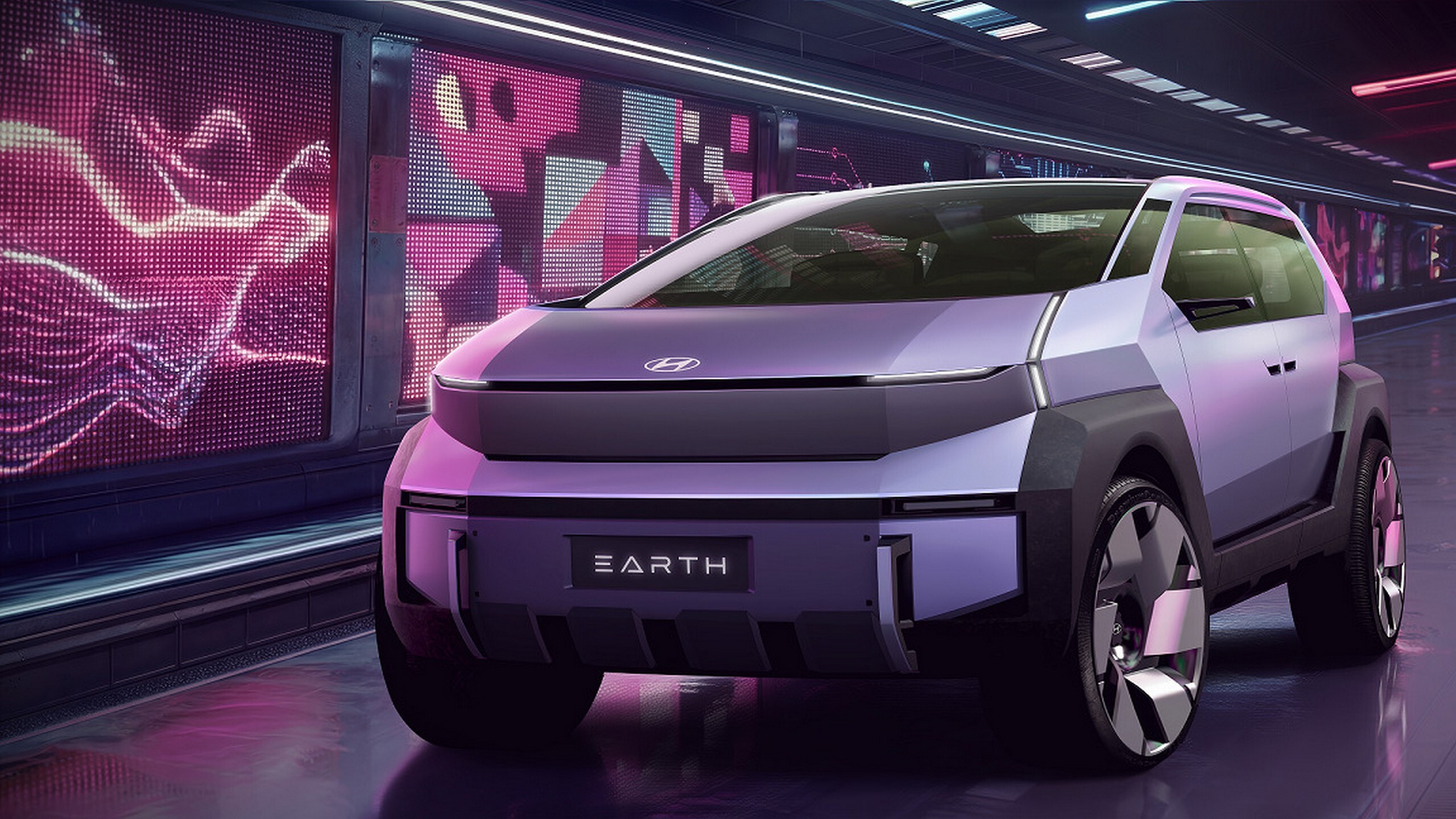
Hyundai has unveiled two Ioniq concepts, badged the Venus and Earth.
The Venus is a high-riding sedan that looks nothing like the Ioniq 5.
Both concept cars feature radical interiors to inspire production models.
China’s EV market has become a proving ground where global brands often rethink their playbook from the ground up. The Ioniq brand has served as Hyundai’s premium series of EVs in Western markets for several years. Now Hyundai is bringing Ioniq to China, but not with any existing models. Instead, it has revealed two concepts ahead of the Auto China show in Beijing.
All future Ioniq models bound for China will follow a new naming convention, one that swaps numbers for planets as Hyundai reshapes its electric lineup for the market. With this in mind, its first two concepts are dubbed the Venus and the Earth, the former a sharp looking sedan that strongly recalls a Lamborghini four-door, while the latter takes the form of an SUV.
According to Hyundai, the Ioniq series will “evolve beyond a product lineup into a broader mobility ecosystem tailored to local customers” as it develops.
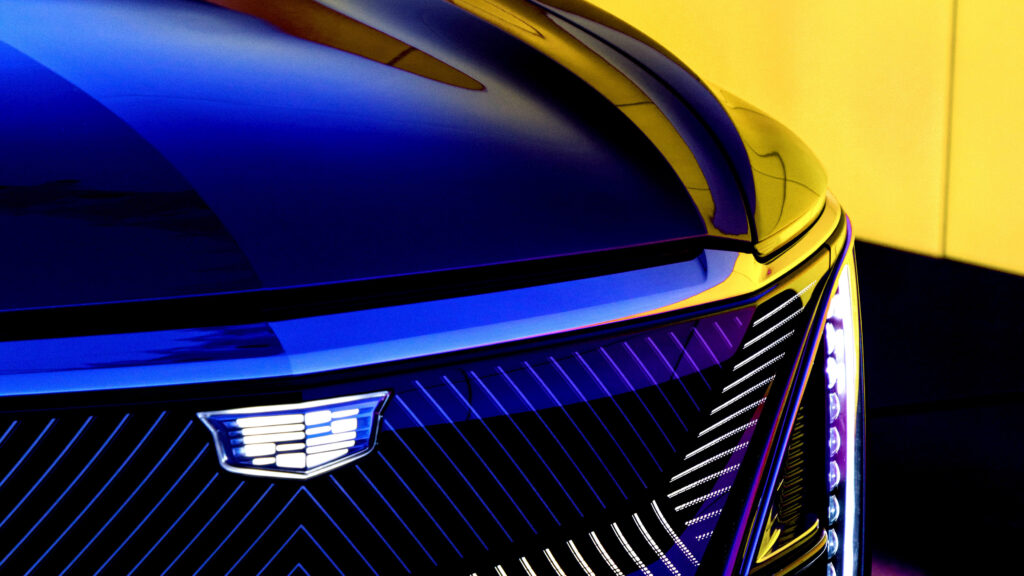
Hyundai says the Venus and Earth serve as design ‘barometers’ for future production models. The Venus has been presented in a shade of Radiant Gold and looks unlike any other Ioniq model we’ve seen. Like an Ioniq 5, it sits quite high and has an aggressive front end with slim LEDs and a gaping grille.
The cabin is also quite intriguing, featuring a slew of gold accents and a panoramic screen for the infotainment system and the front passenger, similar to the current Hyundai Elexio built in China. Just how much of this concept’s interior will influence future production models remains to be seen, but it certainly makes a statement.
No Ordinary Hyundai
Hyundai’s Earth SUV is even more dramatic. Sharing some similarities to recent Kia concepts, it has a bold front fascia and a rugged design, painted in a shade Hyundai calls Aurora Shield. A peek inside the cabin reveals suicide rear doors, a tablet-like central touchscreen, and special seats with air-filled modules.
“Starting with the two concept cars unveiled today, we will continue to present products that reflect deep insight into Chinese customers and our genuine commitment to this market,” Beijing Hyundai Motor Company president Li Fenggang said.
“Built on IONIQ’s uncompromising principles of world-class safety and quality, we will soon introduce production models that seamlessly combine the smart driving and smart cabin experiences that Chinese consumers demand.”
Hyundai has yet to announce when the first of its China-only Ioniq models will be launched, but they shouldn’t be too far off.
Hyundai has unveiled two Ioniq concepts, badged the Venus and Earth.
The Venus is a high-riding sedan that looks nothing like the Ioniq 5.
Both concept cars feature radical interiors to inspire production models.
The Ioniq brand has served as Hyundai’s premium series of EVs in Western markets for several years. Now, Hyundai is launching Ioniq in China, but it’s not doing so with any existing models. Instead, it has presented two concepts ahead of the Auto China show in Beijing.
All future Ioniq models sold by Hyundai in China will be named after planets. With this in mind, its first two concepts are dubbed the Venus and the Earth, the first of which is a sleek sedan while the latter is an SUV. Hyundai has declared that its Ioniq series will “evolve beyond a product lineup into a broader mobility ecosystem tailored to local customers” as it develops.
Hyundai says the Venus and Earth serve as design ‘barometers’ for future production models. The Venus has been presented in a shade of Radiant Gold and looks unlike any other Ioniq model we’ve seen. Like an Ioniq 5, it sits quite high and has an aggressive front end with slim LEDs and a gaping grille.
The cabin is also quite intriguing, featuring a slew of gold accents and a panoramic screen for the infotainment system and the front passenger, similar to the current Hyundai Elexio built in China. Just how much of this concept’s interior will influence future production models remains to be seen, but it certainly makes a statement.
No Ordinary Hyundai
Hyundai’s Earth SUV is even more dramatic. Sharing some similarities to recent Kia concepts, it has a bold front fascia and a rugged design, painted in a shade Hyundai calls Aurora Shield. A peek inside the cabin reveals suicide rear doors, a tablet-like central touchscreen, and special seats with air-filled modules.
“Starting with the two concept cars unveiled today, we will continue to present products that reflect deep insight into Chinese customers and our genuine commitment to this market,” Beijing Hyundai Motor Company president Li Fenggang said. “Built on IONIQ’s uncompromising principles of world-class safety and quality, we will soon introduce production models that seamlessly combine the smart driving and smart cabin experiences that Chinese consumers demand.”
Hyundai has yet to announce when the first of its China-only Ioniq models will be launched, but they shouldn’t be too far off.
age, responding to incidents, and managing schedules. AI moves those responsibilities toward decision-making and oversight. Staff are now evaluating AI-generated routes instead of building them from scratch. They are reviewing flagged video clips rather than scrubbing through entire recordings. They are using predictive diagnostic alerts instead of reacting to a bus breakdown.
Some automakers ignored hybrids to bet big on EVs.
That bet went bad and could get worse as gas prices soar.
Toyota and Hyundai stand to benefit from diverse lineup.
A few years ago, automakers faced a tough choice. They could eschew hybrids and plug-in hybrids to go all-in on EVs, or adopt a more balanced, but expensive approach that saw them invest in multiple technologies.
A number of companies went the electric route and that ended up costing them greatly as adoption was slower than they anticipated. If that wasn’t bad enough, the United States eliminated the federal tax credit and governments rolled back overly ambitious green agendas.
This has pushed automakers to cancel EVs and abandon plans to go electric-only. Companies have posted huge losses and now they’re suddenly playing catch-up with rivals that took a more nuanced approach.
Expensive Gas Is Going To Make Things Even Worse
Since some companies were betting on a quick transition to EVs, a number of them don’t have many hybrids or plug-in hybrids to offer customers. That’s bad news in an era where the national average price of a gallon of gasoline is above $4 and climbs to nearly $6 in some states.
The only hybrid GM has in America is the $108,600 Corvette E-Ray and that’s a huge problem. Consumers in the market for a compact crossover might look at an Equinox, which returns up to 26 mpg city, 29 mpg highway, and 27 mpg combined. That’s not terrible, but the Toyota RAV4 gets 47 mpg city, 40 mpg highway, and 43 mpg combined. This is a huge difference, especially in an era of sky high gas prices.
Hyundai and Kia also offer hybrid competitors in the form of the Tucson and Sportage. The former offers up to 38 mpg across the board, while the latter returns up to 41 mpg city, 44 mpg highway, and 42 mpg combined. It’s also worth noting all three competitors offer plug-in hybrid variants, while GM doesn’t offer a single one in the United States.
General Motors isn’t the only automaker that bet big on EVs and lived to regret it. Ford has a limited hybrid lineup that consists of the Maverick and F-150. The Escape, which offered hybrid and plug-in hybrid options, was recently killed off, while the Explorer Hybrid is limited to police and the Pope.
Hybrid Sales Are Skyrocketing
While the war in Iran is barely more than a month old, hybrid sales are booming. Kia recently revealed sales of hybrids soared 73% to set a new quarterly record.
Last month was also Hyundai’s best ever March for hybrid sales. The company noted hybrids saw a huge jump in the first quarter as the Elantra Hybrid was up 141%, while the Sonata Hybrid soared 107%. The Santa Fe Hybrid also got a 47% boost as consumers embraced efficiency.
While Toyota sales fell 6.9% in the first quarter, high gas prices could help to reverse that trend as the company offers a dizzying array of hybrids. Seventeen, to be exact, according to our last count. This includes the Camry, Corolla, Crown, Corolla Cross, and Prius, as well as the Crown Signia, Highlander, Grand Highlander, Land Cruiser, RAV4, 4Runner, Tacoma, Tundra, Sequoia, and Sienna. Two of those, the Prius and RAV4, are also offered as plug-in hybrids.
That’s a huge lineup, especially compared to Ford, GM, and Stellantis. The latter recently killed off plug-in hybrids and only offers the new Cherokee Hybrid in America. However, range-extended variants of the Ram 1500 and Grand Wagoneer are coming.
While EVs do offer some cover to these companies during periods of high gas prices, consumers have been clear: most want hybrids, not fully electric vehicles.
Jay Rothman, president of the University of Wisconsin system, says that the Board of Regents is trying to oust him from his position. Rothman speaks during the UW Board of Regents meeting hosted at Union South at the University of Wisconsin–Madison on Feb. 9, 2023. (Photo by Althea Dotzour / UW–Madison)
Universities of Wisconsin President Jay Rothman says that the Board of Regents is trying to oust him from his position — and he is refusing to go as he says he has not been given any clear reasons for their loss of confidence in him.
In a letter first obtained by the Associated Press dated March 26, Rothman said he met with Regent President Amy Bogost and Regent Vice President Kyle Weatherly in a meeting they requested. Rothman wrote that he was “surprised” that during the meeting they “indicated for the first time and without any prior discussion or notice that an unidentified majority of the Board of Regents had lost confidence in my leadership despite all that my team and I along with our universities have accomplished to move the Universities of Wisconsin forward.”
Rothman, who was an attorney in Milwaukee and CEO of the law firm Foley and Lardner, was hired by the UW Board of Regents in January 2022. He was chosen after the UW system did not have a permanent leader for two years.
In the letter, Rothman said Bogost and Weatherly did not give reasons for the regents’ conclusion or the lack of confidence in him, but that “each Regent has his or her own perspective on the matter.”
“You did not provide any tangible reasons for the Board’s determination. It also appears that whatever conclusions were reached, the concerns were vetted without the benefit of any recent in-person or even virtual meeting of the entire Board,” Rothman wrote. “From a Board governance and leadership perspective, I find that to be extraordinarily difficult for the Board to defend; as a person who reports directly to the Board, I am profoundly disappointed.
Rothman wrote that he was given three options for his departure: announcing his resignation and retirement in the near future with an effective date at the end of this calendar year, which he said was the Board’s preferred path; resigning at any time with 120 days notice and the Board terminating his employment if he didn’t resign.
Bogost said in a statement that the Board “is responsible for the leadership of the Universities of Wisconsin and is having discussions about its future.”
“We don’t comment on personnel matters,” Bogost said.
In his letter, Rothman provided a list of 37 accomplishments throughout his tenure. The list includes obtaining the largest increase in funding from the state Legislature in the last 20 years; engaging with “third-party advisors to evaluate and assist the universities in addressing financial headwinds and improving operational efficiencies”; implementing a direct admissions program for eligible in-state high school students; continuing the tuition promise program by securing private funding; and rebranding the system from the UW System to the Universities of Wisconsin.
“If the foregoing list is not sufficient evidence of my leadership in driving bold and transformative change, I really do not know what is. Since to date you have not provided any substantive reason or reasons for the Board’s finding of no confidence in my leadership, I am not prepared, as a matter of principle, to submit my resignation. In light of the current circumstances, I do not believe my resignation at this time is in the best interests of either the Universities of Wisconsin or the state of Wisconsin,” Rothman wrote.
During his tenure, Rothman has overseen the closure or dramatic downsizing of at least eight UW branch campuses and has also sought to work with the Republican-led Legislature, which has often appeared hostile towards the UW system.
In 2023, Rothman negotiated a deal on university system diversity, equity and inclusion programs (DEI) and funding with Assembly Speaker Robin Vos (R-Rochester) and Senate Majority Leader Devin LeMahieu (R-Oostburg), both of whom are now retiring from the Legislature. Under the deal, which was initially rejected by regents, Rothman got funding for building projects and staff cost-of-living adjustments — which lawmakers had already approved but were holding back as a bargaining chip — while Republicans got cuts to UW DEI initiatives.
In 2024, Rothman also responded to student pro-Palestinian protests by defending the actions of police officers on campus and saying encampments would be gone eventually.
While Rothman appears confident in his achievements, not all UW stakeholders have been happy with his leadership. AFT-Wisconsin President Jon Shelton said in a statement that even without the details of the reported “loss of confidence,” the union supports the Board’s action.
“President Rothman’s tenure has been defined by his unwillingness to listen to the stakeholders that truly define our campuses: on everything from our faculty, staff, and students’ commitments to diversity, equity, and inclusion to UW System Administration’s disastrous efforts to impose a general education curriculum on our campuses instead of simply implementing a universal credit transfer policy last December as required by Act 15,” Shelton said.
“We are encouraged by the Board’s recent actions,” Shelton added. “We will gladly work with them moving forward to ensure any UW system president fights to uphold the values that has made the UW System great.”
Rothman wrote that there are also to-do list items that make it a bad time for him to leave, including finding new chancellors for UW-Madison and UW-Eau Claire as well as establishing priorities for the next state budget.
“I understand that, as you indicated on Saturday, the Board may act to terminate my employment, which the Board is empowered to do,” Rothman wrote. “If, however, the full Board would like to discuss this matter with me in either an open or closed session, I would welcome the opportunity to participate in such a meeting.”
In a second letter to Regents Ashok Rai and Jack Salzwedel dated April 1, Rothman wrote that in a separate conversation, they also provided no reason for the request for his departure.
“Similar to Regent President Bogost, you indicated that you could not offer any reason at this time. In fact, you said that topic would be discussed at the upcoming meeting of the Board,” Rothman wrote.
“Unfortunately, I am left to conclude that any basis for a Board finding of no confidence in my leadership will be, at best, an after-the-fact rationalization of a decision that clearly has already been made without the benefit of any recent meeting of the Regents and despite all the successes and transformative accomplishments during my tenure as President,” Rothman wrote in the letter to Rai and Salwedel. “I am not prepared, as a matter of principle, to submit my resignation at this time.”
Hyundai teases Earth and Venus concepts as part of its Ioniq sub-brand.
The EVs show slim LEDs, futuristic proportions, and sharply cut surfaces.
A countdown on Hyundai China’s website points to an April 10 debut.
Hyundai is setting the stage for the next phase of its Ioniq sub-brand, previewing what’s to come with a pair of new concepts. The EVs, dubbed Earth and Venus, introduce an evolved design language that will likely carry over to future production models.
The automaker’s official website in China now features a countdown to a “Hyundai Ioniq Brand Launch Event” scheduled for April 10. A teaser video shows a meteorite impact revealing a gold-colored crystal, one face shaped like the letter “i.” Whether this becomes the new Ioniq emblem remains unclear.
Hyundai has also released shadowy teasers of the upcoming concepts across its global social media channels, describing them as “a cosmic statement, engineered for humans.”
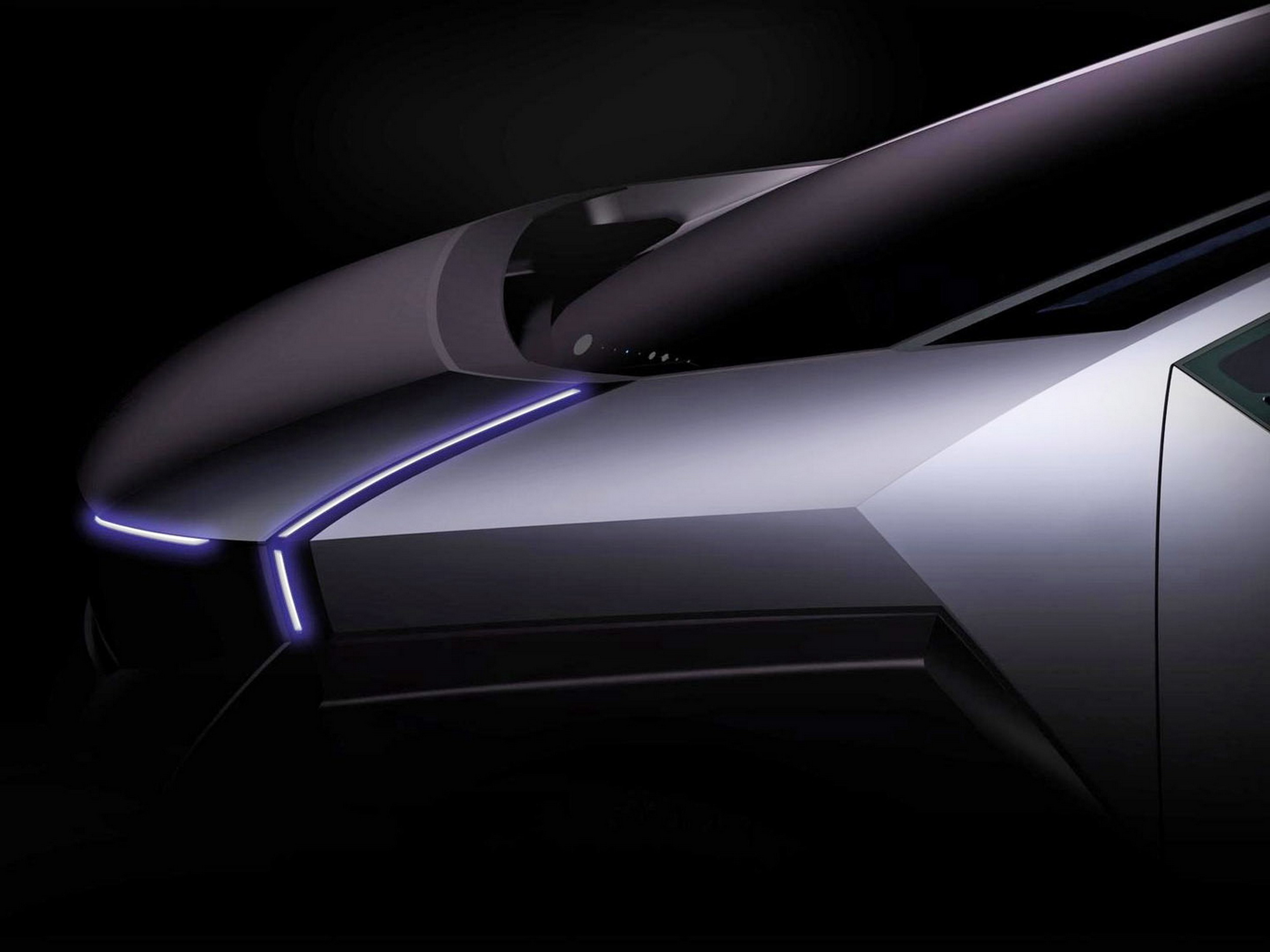
The Earth is finished in silver and features Y-shaped LEDs reminiscent of the Lamborghini V12 Vision Gran Turismo Concept from 2019. Its short hood, steeply raked windscreen, boxy wheel arches, and flat surfacing give it a distinctly Cybertruck-like presence. Unfortunately, only a small portion of the profile is visible, so the overall bodystyle remains unclear.
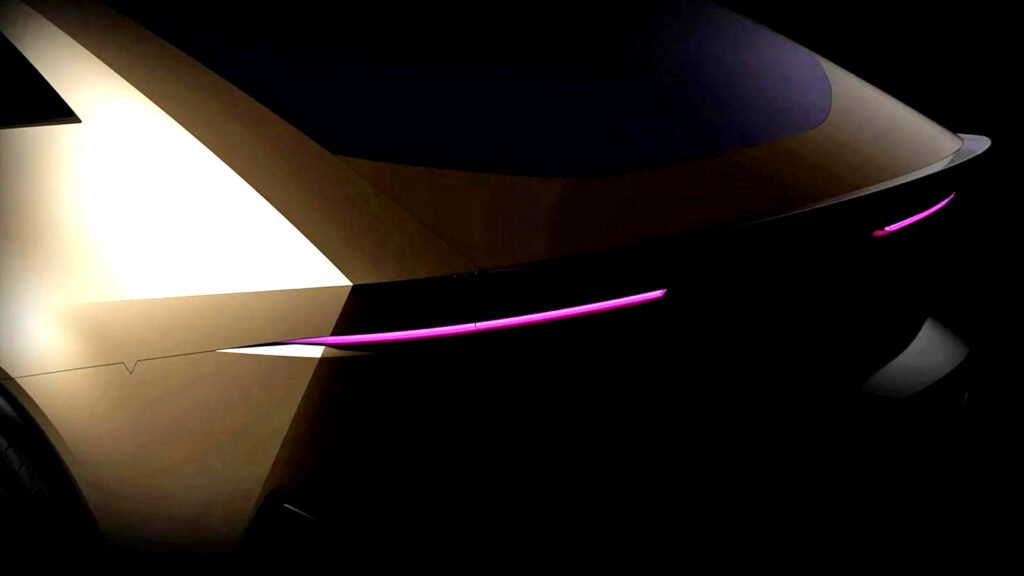
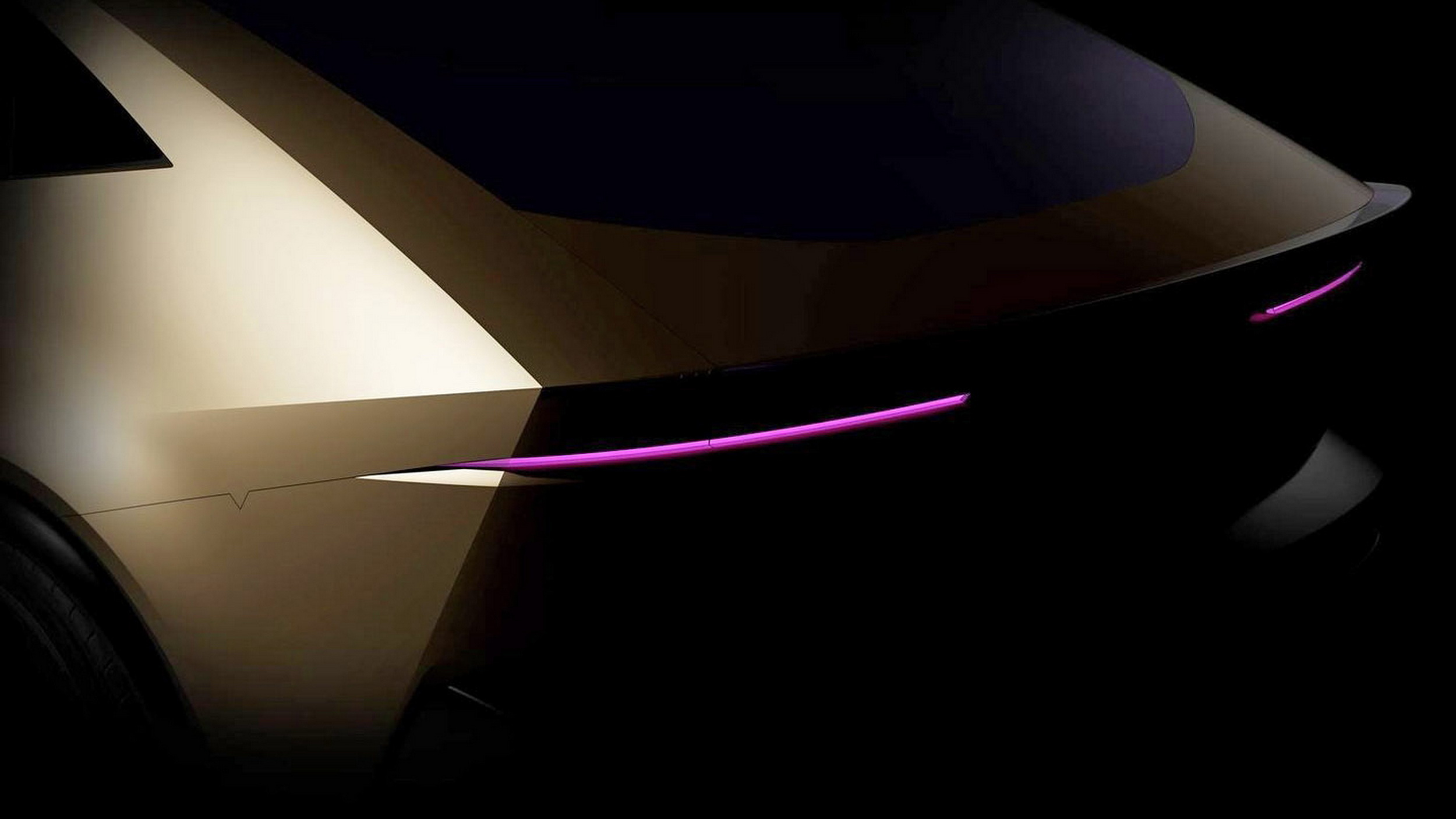
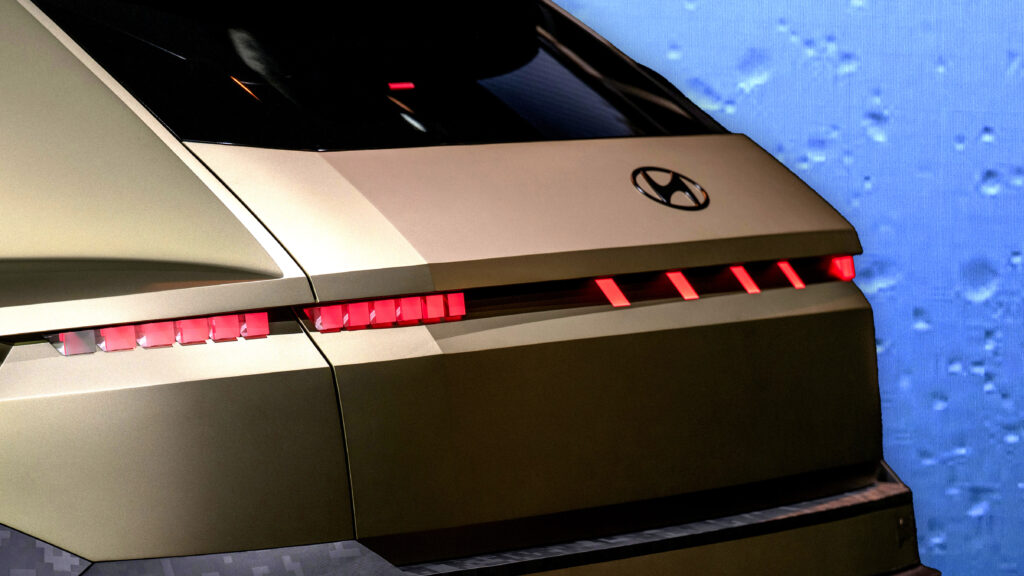
The Venus appears in a gold finish, with the teaser focusing on its rear. It leans into sharper, more angular surfacing, paired with a fastback-style tail, ultra-slim LEDs, and a ducktail spoiler. There are also glimpses of a pronounced bumper and round wheel arches.
It will be interesting to see whether the Earth and Venus are simply futuristic styling exercises or early previews of where Hyundai’s electric lineup is headed alongside the Ioniq 3, 5, 6, and 9.
The timing of the announcement, along with its ties to China, suggests the concepts could make their first public appearance at the Beijing Auto Show on April 24. Hyundai may also choose to reveal the designs earlier at its April 10 event.
Setting aside its global and China-focused ambitions, Hyundai is planning an aggressive product push in North America, with 36 new or refreshed models due over the next five years. That rollout includes a rugged SUV and a body-on-frame pickup previewed by the Boulder concept at the New York Auto Show.
BMW’s iX3 took home two trophies at the 2026 World Car Awards.
Lucid’s Gravity SUV beat the Cadillac Vistiq for a major global title.
Gas-powered cars didn’t win a single category at this year’s event.
Electric vehicles have dominated the World Car Awards as they’ve won every single category this year. This is hardly surprising as many of the finalists were EVs, but it likely won’t alleviate criticism.
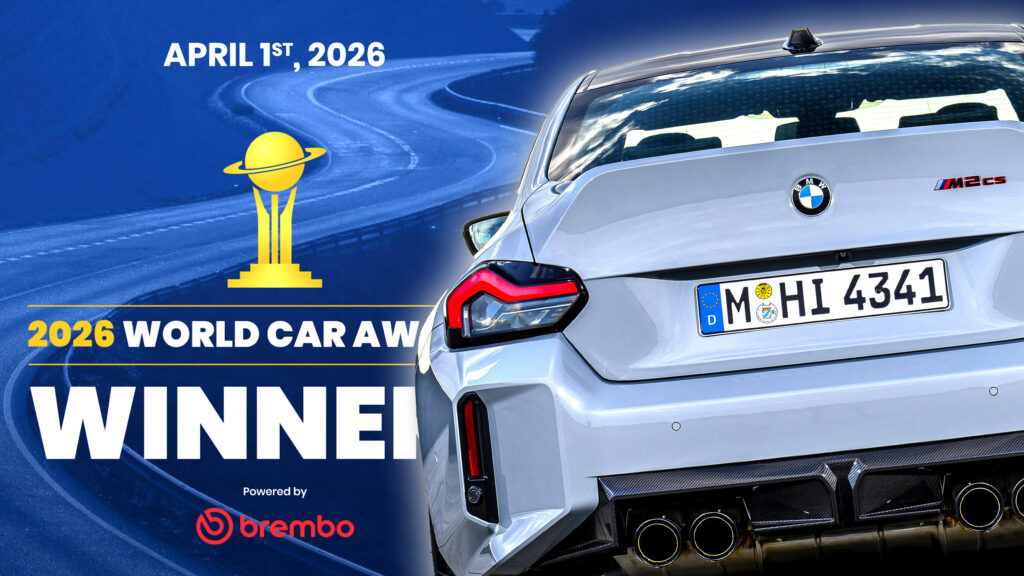
Top honors went to the BMW iX3 which was named 2026 World Car of the Year as well as World Electric Vehicle. In the former category, it beat out the redesigned Hyundai Palisade and Nissan Leaf. The Leaf was also up for being named World Electric Vehicle, but it and the Mercedes CLA lost to the German crossover.
Speaking of luxury brands, the Lucid Gravity was named World Luxury Car. The electric crossover, which offers up to 450 miles (724 km) of range, bested the Cadillac Vistiq and Volvo ES90.
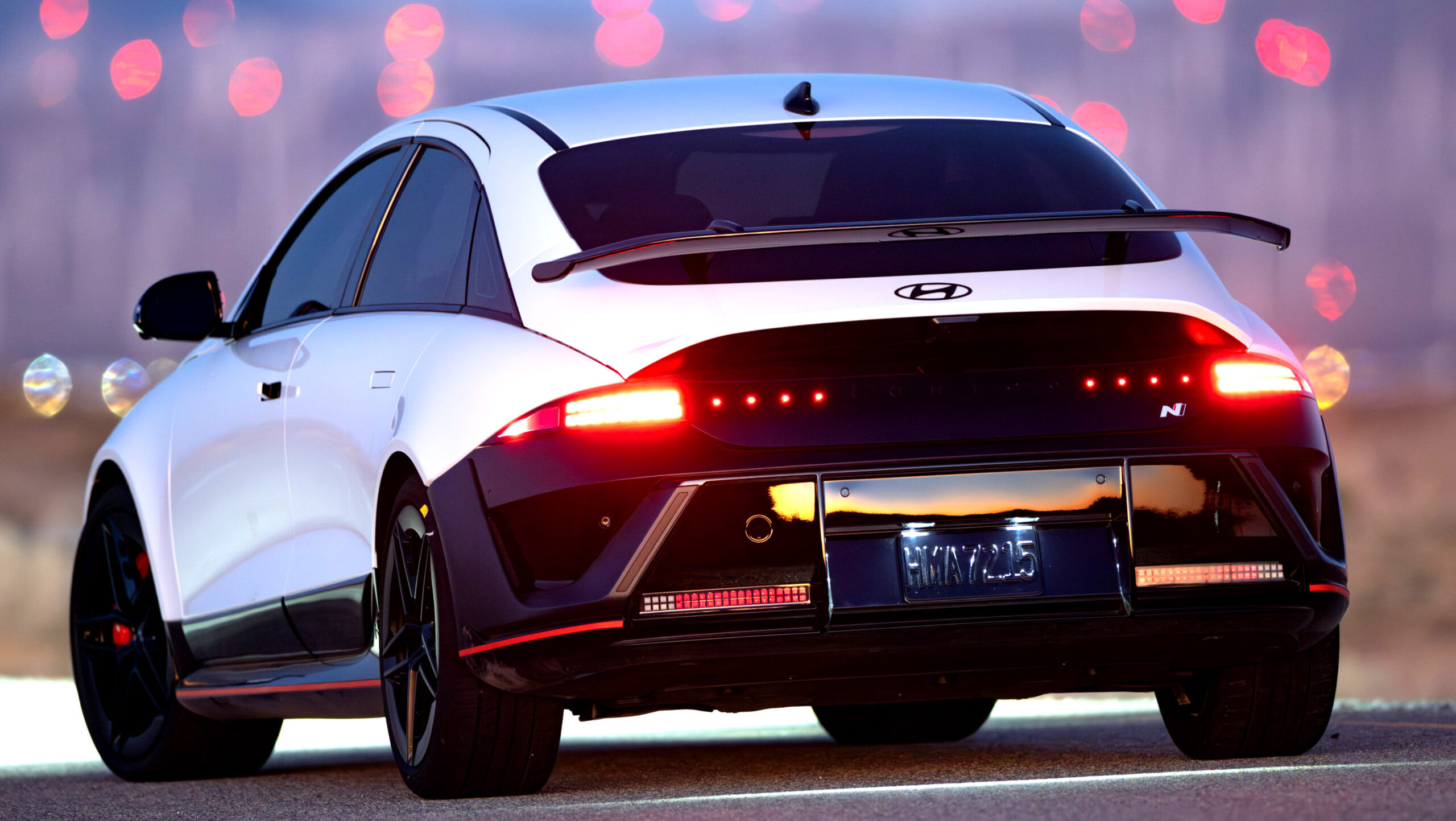
That brings us to the most controversial award, which is World Performance Car. Here, the Hyundai Ioniq 6 N beat the BMW M2 CS and Chevrolet Corvette E-Ray.
While a 641 hp (478 kW / 650 PS) Hyundai is certainly impressive, is it really more of a performance car than a 523 hp (390 kW / 530 PS) coupe that accelerates from 0-60 mph (0-96 km/h) in 3.7 seconds and laps the Nordschleife in 7:25.534? The E-Ray, on the other hand, has all-wheel drive, an EV-only mode, and a combined output of 655 hp (488 kW / 664 PS).
Since you’re probably still stewing over that, we’ll finish up with the two categories little care about. World Urban Car went to the Nio Firefly, which beat out the Hyundai Venue as well as the Baojun Yep Plus / Chevrolet Spark EUV.
There’s also World Car Design of the Year, which was apparently decided by Mr. Magoo. The Mazda 6e / EZ-6 took home the prize as it won over the Kia PV5 and Volvo ES90. None of them are particularly pretty, but the 6e isn’t too shabby and the finalists were chosen by a design panel of people you’ve probably never heard of before.
Transportation directors are responsible for one of the most complex and important operations in a school district. Every morning, hundreds of vehicles need to be tracked, dozens of alerts need to be reviewed, and any incident that happened the day before needs to be investigated and documented. If your team is doing most of that work manually, you’re not alone. But you may be spending more time managing data than acting on it.
Modern fleet management technology is changing what’s possible for school transportation operations. Especially platforms, like VisionCloud, that combine AI-powered analytics with integrated video and telematics. Here’s a look at three areas where the right tools can give your team meaningful time back, while also raising the safety bar.
1. Finding Footage Shouldn’t Take Half Your Morning
When an incident is reported, one of the first things an administrator needs is video. In many operations, that means manually retrieving and searching through separate server and device archives, toggling between different playback modes, and scrolling through hours of footage to find the relevant clip.
Advanced video management systems eliminate that hunt. A unified playback interface combines server-stored and device-stored footage in a single view, with color-coded timelines that immediately show where alarm events, high-definition clips, and standard footage are located. Smart date search calendars and searching by location display video availability at a glance, and screenshot preview navigation lets staff scan footage quickly without downloading full clips. What used to take 30 minutes can now take three.
2. Let AI Reveal the Risks You Don’t Have Time to Detect
Most operations generate far more safety data than any director has time to analyze. AI-powered event detection changes that. Rather than waiting for a complaint or a serious incident, systems that automatically detect and upload driver behavior give administrators a real-time picture of risk across the fleet.
Pairing an intelligent video management system with advanced AI hardware helps drivers respond to risks in real time while giving transportation directors the insight needed to improve training and reduce incidents. Solutions like the SafeDrive-AI 2 windshield DVR combine a road-facing ADAS camera with a 1080p driver-facing lens, using AI to detect lane departure, collision risks, fatigue, and distraction while issuing real-time alerts. When integrated with a platform like VisionCloud, these events are automatically uploaded and surfaced for review, providing immediate, actionable visibility without manual effort.
AI safety analysis modules go further by identifying patterns across the fleet: the most frequently triggered alarm types, the highest-risk vehicles, and the drivers who would benefit most from coaching. You’re not just collecting safety data, now you’re acting on it.
3. Reports That Deliver Themselves
Operational reporting is essential, but manually generating reports on driver mileage, vehicle idling, fuel consumption, fleet health, and driver attendance takes time that most transportation offices don’t have to spare.
Platforms with customized scheduled report delivery can push the right data to the right people automatically. Paired with a comprehensive dashboard that surfaces fleet-wide KPIs and rolling trend data at a glance, the result is a department that stays informed without being buried in data pulls.
Efficiency and Safety Are the Same Goal
When a transportation team spends less time on administrative tasks, they spend more time on what matters: making sure students get to school and back home safely. AI-powered fleet management platforms aren’t just productivity tools, they are safety infrastructure.
As fleets grow and staffing pressures continue, the operations best positioned to deliver consistent, safe service will be the ones that have built smarter systems that work as hard as the people running them.
Choosing the right technology can transform how your organization operates. Download Safety Vision’s free VisionCloud platform comparison report for a detailed, feature-by-feature guide built for transportation directors.
Japan cut subsidies for the Chinese EV maker to just 150,000 yen.
New rules now favor EVs using locally produced battery packs.
Toyota and Nissan models still qualify for far higher incentives.
Electric vehicles make up less than 2 percent of new car sales in Japan, yet that didn’t stop Chinese EV giant BYD from unveiling an all-electric Kei car last year, aiming to make inroads into the local market. However, the company has just been dealt a serious blow.
It has been revealed that the Japanese government has slashed subsidies for BYD by more than half, reducing them to just 150,000 yen, or about $936. Previously, incentives for BYD models ranged between 350,000 yen ($2,000) and 400,000 yen ($2,500).
The reason is quite simple. Japan is revising its EV subsidy scheme to benefit vehicles that use locally manufactured battery packs. Obviously, BYD’s cars use Chinese-made batteries. Thus, it seems more like a measure to protect the Japanese car industry from the burgeoning Chinese brand, which was the world’s sixth-largest car manufacturer last year.
Japanese EVs Get A Big Boost
BYD Racco
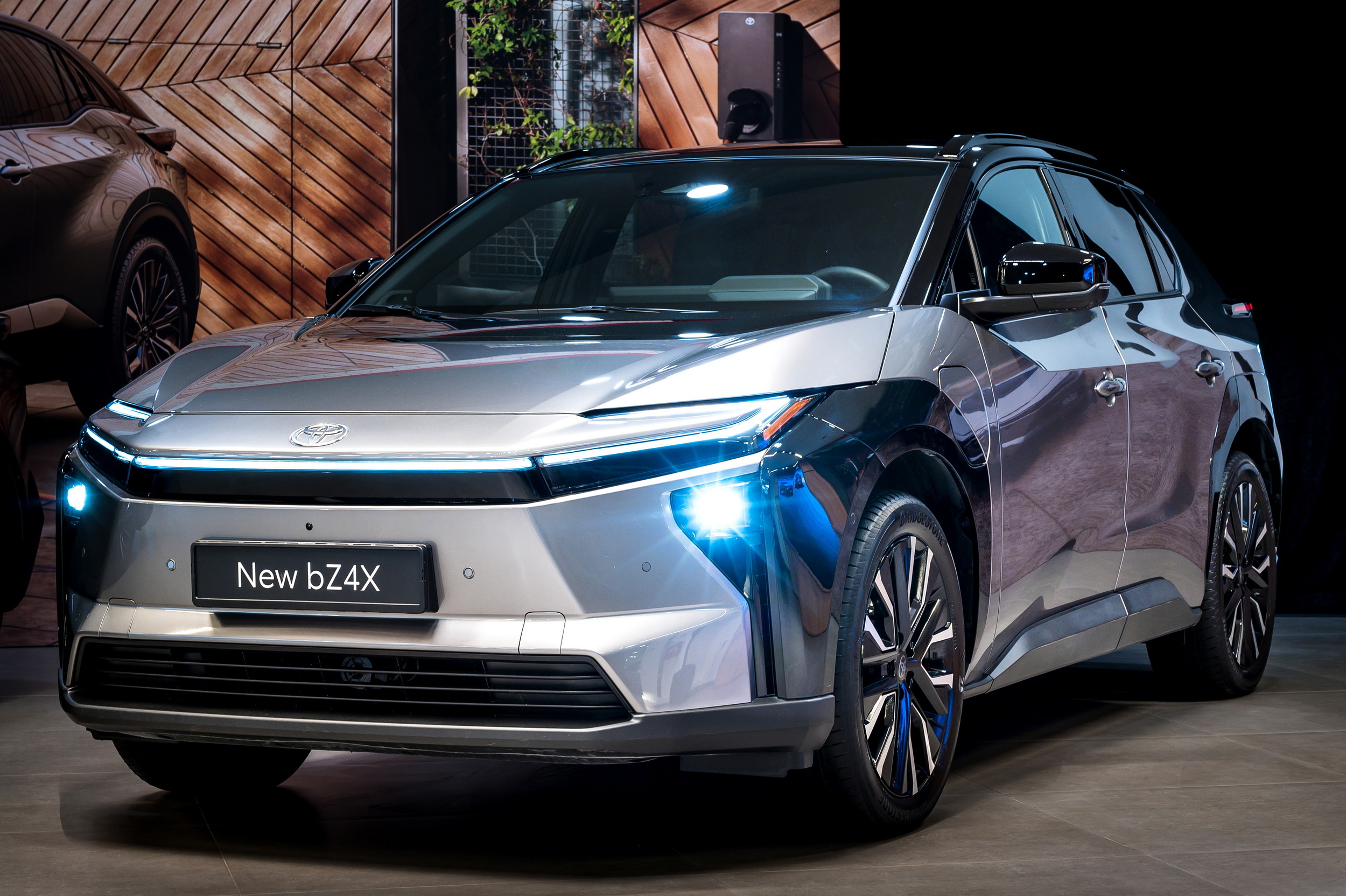
As part of a change to the subsidy program, the Toyota bZ4X will continue to be offered with the highest possible subsidy of 1.3 million yen ($8,100). The Nissan Ariya had been available with a 1.29 million yen ($8,075) subsidy, although this will be cut to 1 million yen ($6,200) in 2027.
Interestingly, it’s not just Japanese brands that get generous government assistance. Earlier this month, Tesla’s subsidies were increased by 400,000 to 1.27 million yen ($7,900), likely due to the fact that it uses Panasonic batteries. Audi also saw a recent increase of 320,000 yen ($2,000) up to just over 1 million yen ($6,200) for its EVs. Similarly, subsidies for some of Hyundai’s EVs have been boosted this month.
As noted by Nikkei Asia, not all of these subsidy increases will remain in effect. From next January, subsidies for brands including Audi and Hyundai will be cut, although their extent remains unclear. Prior to the most recent round of cuts, BYD said it was already at a disadvantage.
“We’re at an overwhelming disadvantage,” the boss of its Japan unit, Atsuki Tofukuji said. “The gap [with companies like Toyota Motor] has grown to up to nearly 1 million yen. We can’t compete with 350,000 yen.”
Hyundai will launch 36 vehicles in North America through 2030.
This includes new and updated models as well as derivatives.
There will be new XRT and N variants, and range-extended EVs.
Hyundai CEO José Muñoz used the company’s annual shareholders meeting to reveal an accelerated North American growth strategy. It calls for launching 36 all-new or “significantly enhanced” vehicles in Canada, Mexico, and the United States between 2026 and 2030.
The automaker didn’t go into many specifics, but confirmed we can expect commercial vehicles as well as cars, trucks, and SUVs. There will also be a mix of “core models and expanded trims” as well as new XRT and N variants.
While Hyundai has bet heavily on EVs, they’re not putting all their eggs in one basket. Quite the opposite as they promised a “broad mix” of powertrains that will include gas and hybrid options as well as battery and range-extended EVs. This is designed to meet “evolving customer demands across the region,” which is codeword for slower than expected electric vehicle adoption.
Muñoz alluded to this as he said, “By expanding our product portfolio and offering a wider range of powertrains in North America, we’re giving customers more choice while continuing to strengthen our long‑term investment in U.S. manufacturing, jobs, and the broader automotive ecosystem.”
Speaking of the latter, Hyundai aims to have more than 80% of vehicles sold in the United States assembled domestically by 2030. The automaker also wants to increase U.S. parts content from around 60% to 80% by the end of the decade.
What’s Coming?
The automaker was tight-lipped on what to expect, but spy photographers have already snapped an assortment of upcoming models including the redesigned Tucson and Elantra. The company is also working on a facelifted Santa Fe, while a larger truck is expected to replace the Santa Cruz.
On top of those models, Hyundai and General Motors have teamed up to jointly develop five new vehicles including an electric commercial van for North America.
Learn more about our upcoming April magazine, inflation and fuel prices, internet for school buses, record revenue for Zum, district efforts amid ICE enforcement, and a driver dressing to impress.
Michael Signer, chief policy and legal officer for EverDriven, discusses the evolution of alternative student transportation from safety and regulatory perspectives to help school districts meet student needs alongside yellow buses.
The Hyundai Casper Electric Lounge is the new flagship trim of the micro-SUV.
Exclusive 17-inch alloy wheels and new colors distinguish the exterior design.
The cabin gets genuine leather upholstery and plenty of standard equipment.
Hyundai’s smallest EV is getting a taste of the finer things. The automaker is taking its most compact electric vehicle upmarket with the debut of the Lounge trim for the Casper Electric in South Korea, also known as the Inster in export markets. The new micro-SUV trim serves as a premium alternative to the rugged Cross model, sitting at the top of the range.
On the outside, the Lounge is distinguished by a new grille pattern, an exclusive Glow Mint paint option, a lighter Medium Metallic Paint finish for the plastic cladding, and a set of 17-inch futuristic-looking alloy wheels. Like the Cross, it now comes standard with full-LED headlights and taillights.
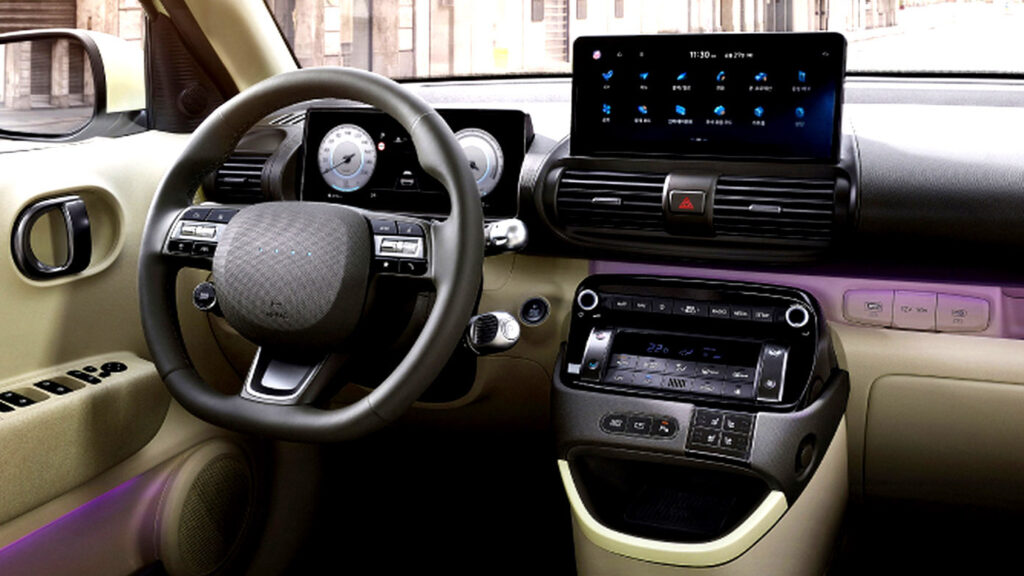
The interior is where the Lounge truly sets itself apart from its siblings. The headline feature is genuine leather upholstery, which remains genuinely rare in this segment. Hyundai has also fitted knit-material headliner and sun visors, along with Kevlar cone speakers for improved sound quality.
Hyundai Casper Electric Lounge
The 10.25-inch infotainment display and matching digital instrument cluster are both standard, as is Level 2 ADAS. A sunroof and wireless charging pad are optional extras. Hyundai also offers a range of accessories including interior storage solutions, pet-friendly items, roof racks, a retractable awning, and an inflatable mattress.
Powertrain And Pricing
Mechanically, the Casper Electric Lounge uses the more potent 113 hp (84.5 kW / 115 PS) electric motor paired with the larger 49 kWh battery pack. Driving range is rated at 295 km (183 miles), which is 10 km (6 miles) more than the Cross but 20 km (12 miles) fewer than the Inspiration, a gap attributed to the different wheel size.
Hyundai Casper Electric
Predictably, the Casper Electric Lounge is the most expensive version of the urban EV on sale in Korea. It is priced at ₩36,410,000 ($24,500), or ₩1,260,000 ($850) more than the Cross. According to the Korean Car Blog, however, the effective price drops closer to ₩20 million (around $13,400) once EV subsidies in Seoul are factored in.
The automaker also continues to offer an gas-powered Casper in Korea, featuring a 180 mm (7.1 inches) shorter wheelbase than the Casper Electric. It is available with naturally aspirated and turbocharged versions of a 1.0-liter three-cylinder engine, though it misses out on the Lounge and Cross grades offered on its fully electric sibling
LOS ANGELES, Calif.—HopSkipDrive, the leader in safe, fast, and simple supplemental student transportation, today released its seventh annual Safety Report. The data reveals that in 2025, 99.7% of rides were completed without a safety concern of any kind—a consistent benchmark maintained even as the company doubled its partner network to serve over 2,000 school districts, government agencies, and nonprofits nationwide.
To date, HopSkipDrive remains the first and only company in the student transportation industry to proactively publish comprehensive safety data annually, reporting on not just collisions or accidents but on all safety incidents, including interpersonal and behavioral concerns. The 2025 report reveals a 99.99% accident-free record and a 0.000% critical safety incident rate—benchmarks supported by a track record of over 130 million safe miles driven since the company’s founding.
This vast experience includes a deep commitment to specialized populations, having safely facilitated nearly 3 million rides for youth in foster care and 1.7 million rides for students with IEPs. These results, driven by more than 50 proactive safety products, features and initiatives—underscore a safety-first approach that extends to millions more rides for students in Career and Technical Education, General Education, after-school activities, and extracurriculars. This record is made possible by HopSkipDrive’s industry-leading technology, rigorous regulatory oversight, and direct relationships with CareDrivers, which together enable the sector’s most responsive turnaround times and a sophisticated, data-driven standard of care.
“Safety has never been a secondary checklist item for us. The need for safe transportation is a core reason HopSkipDrive exists,” said Joanna McFarland, CEO and Co-founder. “Since day one, we’ve led the industry by staying ahead of the curve, constantly innovating the specialized care we provide to the children and families who depend on us. In 2025, we demonstrated our ability to significantly scale our impact while maintaining a near-perfect safety record. This data reflects the tireless work of our team and CareDrivers, who lead with a simple, personal standard: ‘What would it take to put our own children in this car?’
This results-driven culture ensures that as we get bigger, we also get better, safer, and more inclusive. But we’re never done when it comes to safety. Every mile driven is an opportunity to improve and innovate and ensure every child arrives at school safe and ready to learn.”
Key product developments from 2025
To maintain this record while scaling, HopSkipDrive introduced several key product developments in 2025:
● Achieved SOC 2 Type II compliance, making HopSkipDrive the first and only supplemental student transportation platform to achieve this high-level security attestation for data and privacy.
● Nationwide specialty transportation expansion, which scales wheelchair-accessible vehicle (WAV) and Rider Assistant support to districts across the country.
● Specialized driver education, featuring a neurodiversity-focused curriculum developed with child development experts to support students with diverse sensory and behavioral needs.
● Qualitative video screening, a new addition to the 15-point CareDriver certification process designed to evaluate situational judgment and empathy.
● Enhanced “Must Be Met” protocols, which provide a vital safety net by requiring specific verification for safe student handoffs to authorized adults.
● Caregiver Great Start Program, a proactive outreach initiative designed to ensure 100% of eligible families are equipped with safety protocols and ride-tracking features before their first trip.
● Dedicated rider supportline, providing students with direct text or call access to the Safe Ride Support team for autonomy and peace of mind.
● Advanced CareDriver qualifications, a verified in-app system ensuring rides requiring specialized training or equipment are only matched with expert CareDrivers.
Key roadmaps and launches in 2026
As we move into 2026, HopSkipDrive continues to evolve its platform with marquee offerings focused on inclusive technology and enhanced oversight through advanced recording.
● Track My Ride is a new feature that allows riders to monitor their own journeys via secure, masked SMS links. By providing real-time visibility without requiring a smartphone app, we’ve ensured inclusive access for students using wearables, smartwatches, or school- or government-issued devices.
● Ride Recording: In-App enhances our safety offering by providing a secure, integrated audio and visual recording system within the CareDriver app to complement our existing hardware-powered dashcams. This approach allows for encrypted oversight that is automatically wiped from driver devices after the ride to ensure student privacy. It also enables network-wide across all HopSkipDrive markets, which will include 100% of rides this Fall.
Safety is more than just data points; it’s about understanding the unique needs of the children in HopSkipDrive rides. Our Safety Advisory Council provides us with an externally led expert framework that informs our end-to-end safety protocols. By integrating child development and mental health expertise, we ensure our operational standards are grounded in a human-centric understanding of student well-being, providing a level of care that technology alone cannot achieve.
The complete 2025 Safety Report demonstrates HopSkipDrive’s ongoing commitment to transparency and continuous improvement. In the coming weeks, the company will introduce additional 2026 initiatives, further raising the bar for safety standards across the industry.
About HopSkipDrive
HopSkipDrive is the leader in safe, fast, and simple supplemental student transportation. Modernizing the $30 billion school transportation industry through its care-centered transportation marketplace which supplements school buses by connecting kids to highly-vetted caregivers on wheels, such as grandparents, babysitters, and nurses in local communities.
HopSkipDrive also offers its industry-leading transportation intelligence platform, RouteWise AI, to address critical challenges, including budget cuts, bus driver shortages, and reaching climate goals. With this technology, HopSkipDrive has supported over 14,500 schools and over 2,000 school districts, government agencies, and nonprofit partners. Since its founding in 2014 by three working mothers, HopSkipDrive has surpassed more than 100 million safe miles driven. This record includes nearly 3 million foster and McKinney-Vento rides and 1.7 million Individualized Education Program (IEP) rides, alongside millions of additional trips for General Education, Career and Technical Education (CTE) programs, and extracurricular activities.
EV registrations fell sharply in January as market momentum faded.
Cadillac ranked as the No. 2 EV brand behind Tesla with modest growth.
Gas and hybrid vehicles gained market share as EV demand softened.
Newly-released sales figures from the United States is starting to reveal just how much electric vehicle demand leaned on the federal EV tax credit that was discarded on September 30 last year. With that incentive now gone, the early numbers suggest the market is already feeling the adjustment, and it has not been a subtle one.
Data from S&P Global Mobility shared by Auto News show that 59,802 new EVs were registered in January, a massive 41 percent drop from a year earlier. Out of nearly 1.2 million vehicles registered that month, that leaves fully electric models with just a 5.1 percent share of the market, down from 8.3 percent a year earlier.
Meanwhile, gasoline vehicles quietly expanded their hold, rising 2.3 percentage points to claim 76.6 percent of registrations. Hybrids also edged upward, gaining 1 point to reach a 14.7 percent share.
Tesla still sits comfortably at the top of the US EV market, which will surprise absolutely no one. In January alone, 32,123 new Teslas were registered. Even so, Tesla is not immune to the slowdown, with registrations down 26 percent from a year earlier. Despite that drop, its share of the EV market jumped 11 percent to 53.7 percent.
Cadillac ranked a distant second with 3,189 registrations, more than ten times behind Tesla. However, the brand was one of the few to post growth, with registrations rising 8.1 percent year over year. Its share of the EV market also increased by 2.3 percent to 5.3 percent.
Many other carmakers have also seen their EV sales fall off a cliff. For example, there were 3,027 new Hyundai EVs registered in January, down 23 percent from the year prior. This decline was led by the Ioniq 5, which saw its deliveries slide 22 percent to 2,101 vehicles.
Ford’s EV registrations also dropped 67 percent to 2,772, while Chevrolet’s fell 55 percent to 2,658. Toyota, however, reported a 25 percent increase, although its EV registrations totaled just 2,529, meaning it still trails many competitors.
According to iSeeCars executive analyst Karl Brauer, “there’s going to be a shakeout to the new reality with no federal EV incentives, which was the carrot, and no greenhouse gas penalties, which was the stick.”
Auto News notes that EV registrations have declined year over year every month since the tax credit was scrapped on September 30. S&P Global Mobility analyst Tom Libby says the drop was “expected,” adding, “it’s a reset, and it’s going to be a very slow process moving forward.”
The spotlight on autonomous vehicle safety intensified in late 2025, when multiple Waymo robotaxis were caught illegally passing stopped school buses in Austin, Texas.
Footage from Austin Independent School District revealed at least 24 such violations since the start of the school year through the middle of January, with vehicles
ignoring flashing red lights and extended stop arms while children boarded or exited. Despite a software recall in December affecting over 3,000 vehicles, incidents persisted. Investigations by both the National Highway Traffic Safety Administration (NHTSA) and the National Transportation Safety Board (NTSB) followed suit last month.
Austin ISD asked Waymo to pause operations during school hours, but the company declined, citing ongoing improvements. Director of Transportation Kris Hafezizadeh will discuss the situation next month at STN EXPO East.
This saga underscores persistent challenges in AI-driven perception systems, where even advanced neural networks struggle with contextual cues like school zones, raising alarms among educators, parents and regulators about the risks to vulnerable road users.
Power disruptions have also exposed vulnerabilities in autonomous fleets. During San Francisco’s 2025 outages, hundreds of Waymo vehicles halted abruptly, creating gridlock and highlighting dependency on stable infrastructure. Similar events in other cities have fueled debates on redundancy measures, such as onboard backup power and enhanced telematics for real-time rerouting.
As technology matures, industry experts anticipate 2026 will bring more resilient systems, with AI algorithms trained on diverse failure scenarios to minimize disruptions. Optimism persists that real-world testing will refine these tools, but incidents like these remind us that innovation must prioritize safety, especially around
schools and school buses.
The consumer automotive market is evolving rapidly, with autonomous driving features projected to become standard in over 20 percent of new vehicles this year, according to industry forecasts. Tesla’s Full Self-Driving (FSD) supervised software, for instance, has seen significant patches in 2025 and early 2026, particularly for school bus interactions. Updates have improved detection of flashing lights and stop signs, with user videos demonstrating reliable stopping and waiting behaviors.
However, NHTSA’s ongoing probes into FSD including an October evaluation of traffic law violations covering nearly 2.9 million vehicles, reveals lingering issues like occasional failures in reduced visibility. Adversarial tests by The Dawn Project staged demos showing a Tesla Model Y ignoring bus signals and striking child dummies. Tesla extended its response deadline to this month amid scrutiny of over 8,000 potential incidents. A 2023 North Carolina case, where a 17-year-old was struck by a Tesla after exiting a bus, echoes these concerns. While software fixes addressed the bug, it illustrates how AI must evolve to anticipate unpredictable child movements.
As self-driving cars proliferate in urban areas, school bus drivers face added complexity. Children in loading zones demand split-second recognition yet early AV
systems have faltered. By this year, expect wider adoption of Level 3 and 4 autonomy, where minimal human input is needed in defined conditions, promising fewer crashes
through precise sensor fusion.
NHTSA’s early 2025 estimates show overall traffic fatalities dropping: 27,365 deaths in the first nine months, a 6.4 percent decline from 2024, with the rate per 100 million vehicle miles traveled falling to 1.10. The first half of 2025 saw 17,140 fatalities, down 8.2 percent, even as miles driven rose. While distracted driving specifics for 2025 remain preliminary, trends suggest AVs could further reduce human-error crashes, though flaws in software like those in Tesla and Waymo highlight the need for rigorous validation.
Emerging trends are transforming school transportation itself. AI and telematics are shifting from reactive to proactive safety, with predictive maintenance using data
analytics to forecast bus failures, reducing breakdowns. High-definition cameras, integrated with AI software, provide 360-degree views, detecting illegal passers and
alerting authorities. Automation extends to digital forms for route planning and incident reporting, streamlining operations via cloud platforms that unify GPS/Telematics, video and RFID for student tracking.
The growth of vehicle-to-everything (V2X) communication potentially enables school buses to signal AVs directly, which could prevent illegal passes.
The school transportation industry must adapt to these innovations to safeguard students. From apps providing real-time ETA alerts to parents, to HD cameras deterring
misconduct inside buses, technology enhances efficiency and accountability.
As we share roads with evolving AVs, collaboration between manufacturers, regulators and districts is crucial. Staying ahead of the curve ensures we don’t lag in safety, after all, the families our industry serves count on us daily to innovate for the best interest of kids.
Editor’s Note: As reprinted from the February 2026 issue of School Transportation News.
DETROIT, Mich. – Questar Auto Technologies’ predictive Total Fleet Health Management solution is now available on the Geotab Marketplace,a network of fleet-focused solutions for companies looking to increase productivity and compliance while lowering operating costs.
Questar’s AI-driven Total Fleet Health Management solution helps fleet operators to detect vehicle issues earlier, plan repairs proactively, and reduce unplanned downtime through predictive and prescriptive health insights.
Questar is one of the only fleet health solutions that shows the estimated cost of early intervention along with the estimated downstream cost of inaction; thereby helping fleets make confident, economics-driven maintenance decisions.
From easy implementation to higher revenues
Through a cloud-to-cloud integration with Geotab – which means there is no additional hardware to contend with — Questar analyzes vehicle telemetry, engine fault data, maintenance history, and environmental context to identify emerging issues before they become failures.
The Questar platform provides early-warning alerts (up to 30 days in advance), repair recommendations, and actionable insights tailored to each vehicle.
By combining Geotab high-quality data with Questar’s advanced analytics and industry-specific, patented AI Foundation models, fleet operators gain a proactive, data-driven approach to maintenance that drives measurable operational and financial impact. Vehicles stay on the road longer, generating more revenue.
“Fleets are looking for solutions that fit naturally into their existing technology environments,” says Aaron Howell, Vice President of Sales for Questar North America. “Through the Geotab Marketplace, fleets across North America can now access Questar’s advanced features.”
About Questar Auto Technologies:
Questar is a pioneer in vehicle health management, offering a comprehensive solution that includes both predictive and prescriptive VHM. Questar enables Tier 1 suppliers, OEMs, leasing companies, service providers and enterprise fleets to cut downtime, reduce maintenance costs, and maximize revenue through advanced AI-driven analytics. https://questarauto.com
All schools and districts that applied for funding for eligible safety features ranging from seatbelts to collision avoidance to additional lighting through the $10 million Ohio School Bus Safety Grant received an award.
An Ohio Department of Education spokesperson confirmed that it received 371 applications from schools, districts and county boards of developmental disabilities for the School Bus Safety Grant. Of those applications, 56 requested funds for “Occupant restraining devices that conform to the school bus seat belt requirements of 49 C.F.R. 571.”
The other authorized safety features are external school bus cameras, fully eliminated stop arms, crossing arms, illuminated school bus signs, lane departure warning systems, collision avoidance systems, and electronic stability control.
The school bus safety grant program was created in response to recommendations made by the Ohio School Bus Safety Working Group, which Gov. Mike DeWine convened to review all aspects of student transportation, following an August 2024 school bus crash that resulted in a student fatality.
Among its 17 recommendations made in January 2024, which did not include the use of lap/shoulder seatbelts — a main reason Gov. DeWine called together the working group — were strategies for improving bus safety features, driver training and emergency response.
Safety rant funding may be used for the repair, replacement or addition of the eight authorized safety features on school buses in active service or for safety enhancements on new school bus purchases.
Indian Hill EVSD in Ohio, applied for the safety grant. Diane Spurlock, transportation director, said they asked for collision avoidance systems and lane departure warning system.
“The program we selected is an AI camera that can notify the driver if either of the instances occurs while they are on the road,” she said. “The main reason is that we recently had an incident happen with a driver where this could have kept it from happening thus ensuring a safer drive. A secondary reason is that our current cameras are getting outdated quickly and I hope this opens the door to purchase more products from this company.”
Additionally, Indian Hill applied for the ground wash lights “because our district does not have street lights and some streets are very narrow. We have added the LED lights near the back tires but believe the ground wash lights will be especially helpful for turnarounds,” she continued.
Gov. DeWine, the Ohio Department of Education and Workforce Director Stephen D. Dackin announced via a press release that, “the grants will help ensure safer travel for Ohio students through safety upgrades to existing buses and the addition of advanced safety features on new buses.”
“Whether students are in the classroom or on the school bus, we owe it to parents and families to do everything we can to keep them safe,” said DeWine. “We’re raising the bar for student safety on Ohio’s buses, and these grant awards demonstrate our dedication to making school transportation safer.”
Dackin added, “Student safety is our top priority, and Ohio is investing in critical safety improvements to equip school buses with proven technology that keeps children safe.”
SAN DIEGO, Calif. -Netradyne, a leader in AI-powered fleet safety and performance solutions, today announced the launch of Video LiveSearch, an industry-first technology that leverages real-time natural language search powered by on-device edge AI intelligence. Video LiveSearch enables fleet managers to proactively search across every vehicle in real-time and instantly uncover the most meaningful video to pull.
Delivering Faster Situational Awareness
Until now, fleets have had to rely on incidents being reported by other teams, wait through cloud processing delays, manually triangulate the vehicle and timeframes of interest to download, and then sift through hours of downloaded footage—slowing investigations and limiting fleets to a reactive approach to fleet safety and performance. Video LiveSearch provides a step-change improvement by enabling fleets to shift from a reactive to a proactive operational approach:
Empowering their teams to proactively improve safety and performance with virtually instant line-of-sight into where to look, instead of waiting for reports or digging through timelines. Enabling real-time, on-device search using a simple, natural language prompt for road-facing camera views across every vehicle in the fleet. Surfacing the most relevant before-during-after video clips, instead of guessing or manually triangulating video timestamps. “Video LiveSearch is the fleet industry’s first on device, real-time search capability—giving fleets faster situational awareness to proactively understand what’s happening across their operations,” said Avneesh Agrawal, CEO and co-founder of Netradyne. “Fleet operators can instantly find the exact moments of interest across their entire fleet in real time, enabling faster action and safer, more efficient operations. Using natural language and AI-powered search, fleets can proactively identify risks and inefficiencies across their operations, such as school bus stop-arm compliance, commercial proof of service, cracked-windshield maintenance, or claims support.”
Powered by On-Device Edge AI
Video LiveSearch is possible because of Netradyne’s advanced edge intelligence that brings together:
Real-Time Reasoning at the Edge
Netradyne creates searchable video for virtually 100% of road-facing drive time directly on the vehicle—so Video LiveSearch doesn’t have to wait on cloud downloads to start finding relevant video.
Every free-text search returns the top matches in seconds, whether across a single vehicle or the entire fleet, giving teams near-instant discovery of which clips to pull. Instead of chasing details like vehicle, date, or trip and hoping a video request hits the mark, fleets can immediately see the best matches and download only the footage they need.
Context-Aware Search that Learns Real-World Patterns
Netradyne’s edge intelligence learns patterns in real-world road scenes and driving behavior, enabling LiveSearch to instantly match a simple search prompt to the most relevant video footage and return the right clips to pull for before–during–after context.
“The enabling hardware for Video LiveSearch, the D-810 device, turns every vehicle into an intelligent multi-modal sensor for your fleet operations,” said David Julian, CTO and co-founder of Netradyne. “Video LiveSearch leverages that intelligence to deliver rapid insights, giving fleets the power to quickly search for what’s happening around their vehicles, drivers, and passengers in real time. This represents a foundational step in our Physical AI platform, where our technology continuously interprets the physical world to power both rapid discovery and precision operations.”
Two-Speed AI: Discover Fast, Operationalize with Precision
Netradyne views Video LiveSearch as a core pillar of its Two-Speed AI strategy.
Exploration: Broad semantic search enables rapid discovery without waiting on product development cycles. Operationalization: High-precision, domain-optimized models power real-time coaching and safety-critical workflows.
Video LiveSearch accelerates discovery while informing where deeper AI investment delivers the greatest operational impact.
Responsible AI by Design
Video LiveSearch embeds responsible AI governance directly into its architecture. An AI front-end screening layer evaluates natural-language prompts before they reach the edge reasoning engine, automatically rejecting requests outside approved operational intent—such as identifying individuals or tracking license plates.
This approach ensures Video LiveSearch remains focused on safety and operational use cases, preserves driver trust, and prevents misuse by design rather than policy.
Pioneering Physical AI for Fleets
Video LiveSearch represents a foundational step in Netradyne’s broader Physical AI vision, where AI continuously interprets multimodal data on the vehicle to understand the driver, vehicle, driving environment, and trip as an integrated system. By making this context instantly searchable, Video LiveSearch transforms how fleets gain situational awareness and take action across their operations.
About Netradyne:
Netradyne provides AI-powered technologies for smarter fleets and safer roads. An award-winning industry leader in fleet safety and video telematics solutions, Netradyne empowers thousands of commercial fleet customers across North America, Europe, and Asia to enhance their driver performance, reduce risk, and optimize operations. Netradyne sets the standard among fleet operating companies for enhancing and sustaining road safety. Using AI-vision technology to analyze 1.3+ trillion minutes and 27+ billion miles, Netradyne offers an industry-first driver and fleet scoring system that recognizes and rewards safe, efficient driving behaviors. Founded in 2015, Netradyne is headquartered in San Diego with offices in San Francisco, Nashville, and Bangalore.
It’s a new calendar year but school transportation leaders face the same challenges. As Albert Einstein famously said, “In the middle of every difficulty lies opportunity.”
This month’s articles highlight key areas where leaders can make impactful changes to improve safety, efficiency and equity for all students, especially those riders with
disabilities.
While all important, Linda Bluth’s column on addressing sexual assault on school transportation vehicles especially strikes a chord. The topic must be the most horrifying for student transporters to discuss, aside from a fatality. We know from research that students with disabilities are at a significantly higher risk of being targeted for sexual assault than their non-disabled peers. Bluth shares that one constant over her storied career has been the number of sexual assault cases she has been asked to serve as an expert witness on.
She underscores the urgent need for proactive measures to protect students by calling for an industry task force to address this sensitive yet essential topic, to confront it head-on and ensure the safety and well-being of students.
Ask yourself, what policies does your transportation department and school district have in place regarding sexual assaults occurring on or around school buses or other school transportation vehicles. Bluth writes it is vital to create clear, school board-approved policies that define and address sexual assault as well as bullying and harassment on school transportation vehicles. Training all transportation personnel and students on these policies is vital.
Supervision must also be enhanced. A growing trend is more attendants on routes to assist school bus drivers with behavior management. High-back seats, Bluth says, create a barrier to seeing what students are doing. I hear that concern often from readers, an unintended consequence of NHTSA’s 2009 update to FMVSS 222 that increased the minimum seatback height to 24 inches.
Providing adequate adult supervision on all vehicles used for school transportation is paramount to the safety of all students.
Technology is supplementing these efforts with state-of-the art video camera systems. Increasingly, AI-enhanced software is showing the promise of even predicting or identifying the risk of potential assaults, but these solutions are in their infancy. Never mind the expense. First and foremost, student transporters must have policies for regularly reviewing footage. Most camera systems come with alerts to notify supervisors
of incidents. But there remains no consistent solution better than, if you “see something, say something.”
Train your school bus drivers, monitors and other staff to trust their intuitions. If something feels “off” during a route, it probably is. Foster a culture where transportation personnel and students feel safe reporting inappropriate behavior without fear of retaliation.
There is plenty to think about when reading this month’s issue, which also looks at the importance of modern routing software, AI-powered tools and data-driven solutions to address driver shortages and training, route optimization, and Medicaid reimbursement challenges. Alternative vehicles also continue to gain ground in transporting students to and from school.
With them comes the need to train their drivers on proper child safety restraint and wheelchair securement. At the half-way point of the school year, consider how your operations are poised to tackle all these issues. As school transportation leaders, the responsibility to ensure the safety and well-being of students is paramount. By addressing critical safety issues, embracing technology, and fostering collaboration, we can drive meaningful change in the industry.
Let’s turn these insights into action, ensuring that every student’s journey is safe, efficient and supportive of their educational success.
Editor’s Note: As reprinted from the January 2026 issue of School Transportation News.

 Login
Login