EV owner satisfaction has reached an all-time high.
Best models come from Tesla, BMW, and Cadillac.
Most EV owners would consider getting another one.
Electric vehicles have come a long way in the past few years, and the progress is finally showing up where it matters most: in owner satisfaction. According to the latest data, these steady gains in technology and infrastructure are translating into record-high approval from drivers.
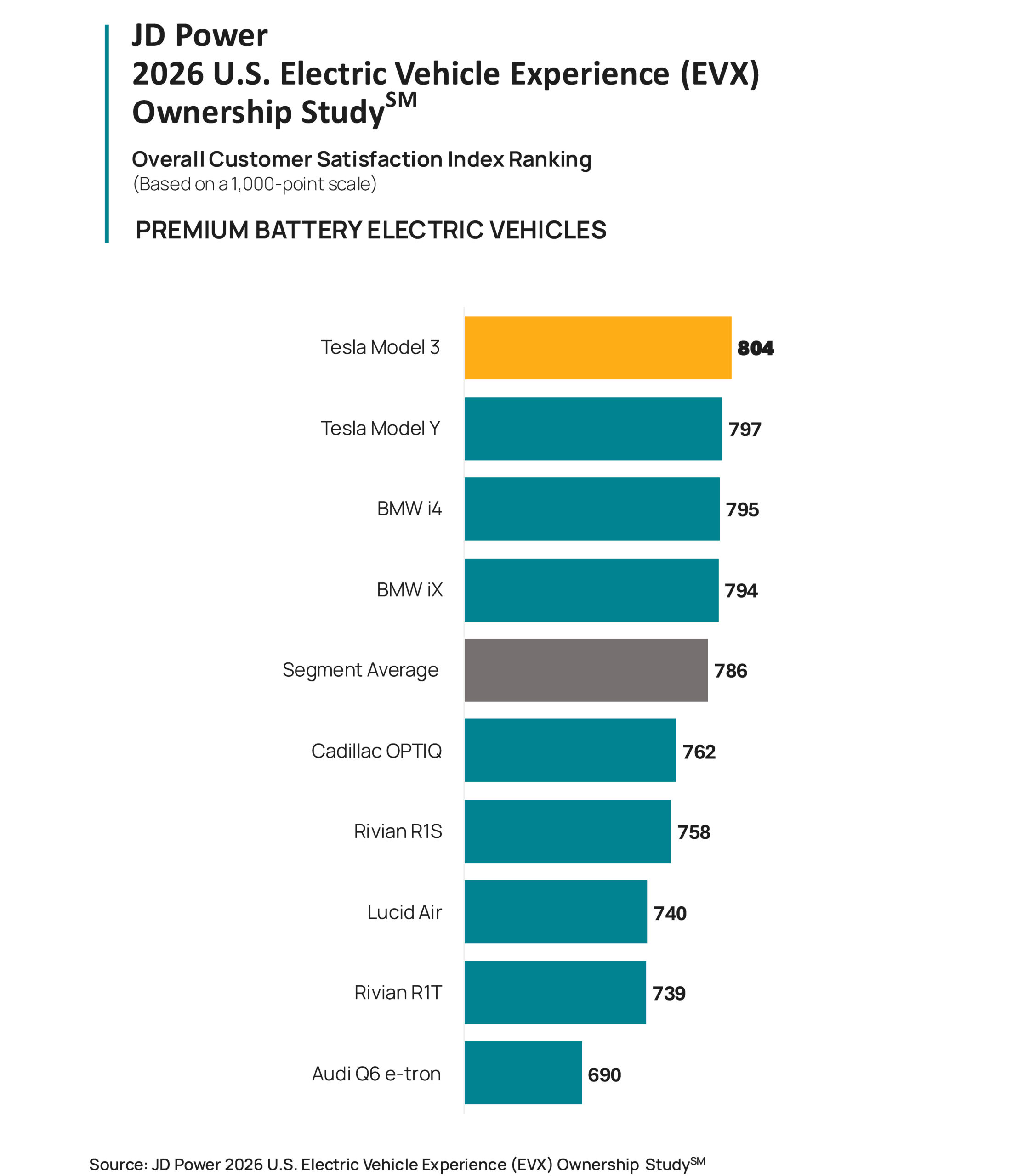
That’s the verdict from JD Power’s 2026 U.S. Electric Vehicle Experience Ownership Study, which found premium EV satisfaction climbed from 756 points last year to 789 in 2026. Mainstream EVs also improved two points to hit 727 out of 1,000.
The highest rated premium EVs were the Tesla Model 3 (804), Tesla Model Y (797), and BMW i4 (795). On the flip side, the new Audi Q6 e-tron came in dead last at 690. It placed well below the Lucid Air (740) and Rivian R1T (739).
Segment Standouts And Stragglers
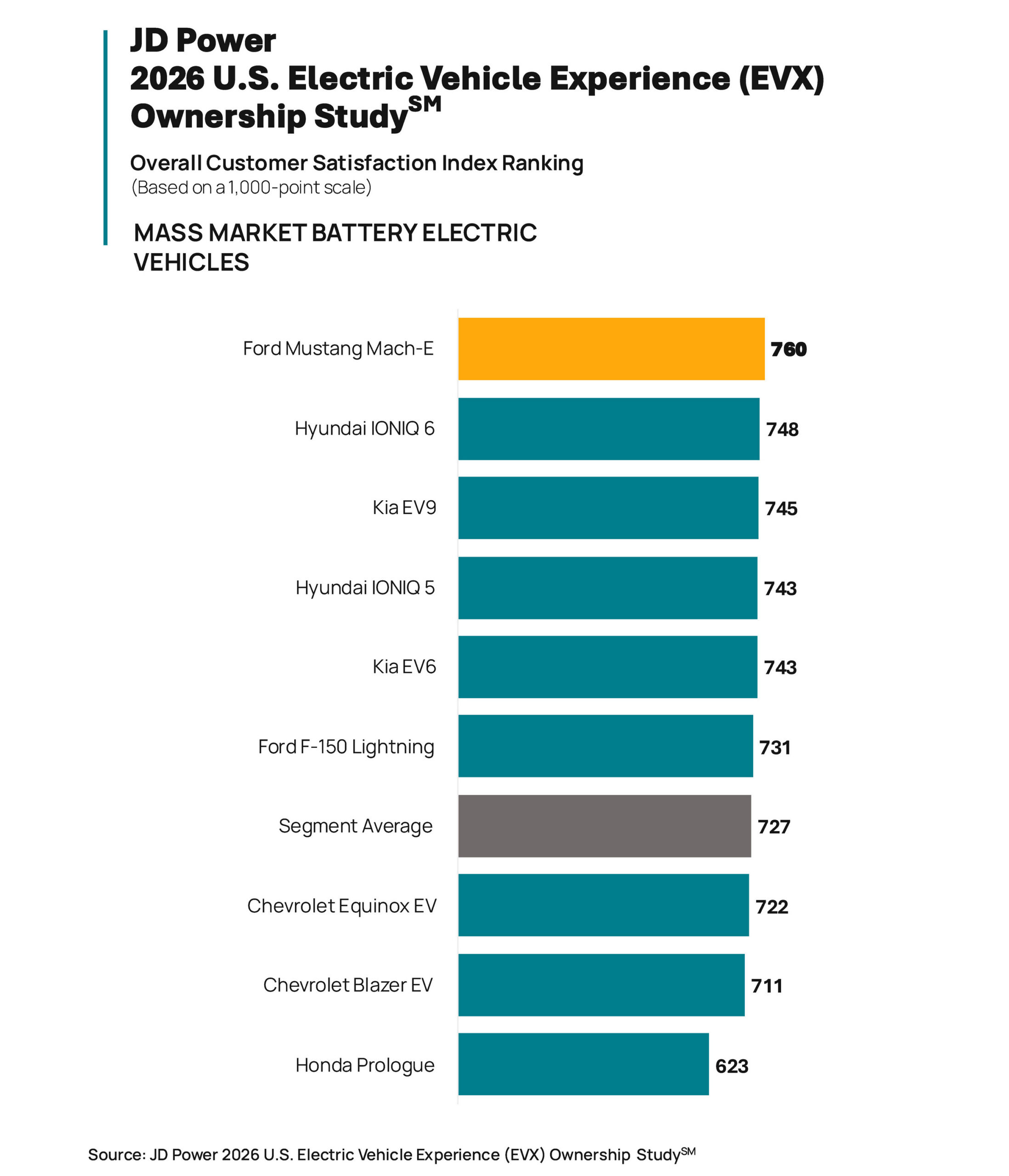
On the mass market side of the equation, the Ford Mustang Mach-E took top honors with a score of 760. The electric pony car was followed by the Hyundai Ioniq 6 (748) and Kia EV9 (745). Interestingly, the two lowest rated EVs were the Chevrolet Blazer EV (711) and Honda Prologue (623). That’s a huge point spread considering both models are built by GM and have a lot in common.
Of course, things aren’t completely straightforward as the study examined ten different factors. This includes the “accuracy of stated battery range, availability of public charging stations, battery range, cost of ownership, driving enjoyment, ease of charging at home, interior and exterior styling, safety and technology features, service experience, and vehicle quality and reliability.”
Encouragingly, 96 percent of EV owners said they would consider buying or leasing another one and the study also found quality has improved. That’s especially true of premium EVs, which had 15.9 fewer problems per 100 vehicles compared to last year. This brought the total down to 75 and JD Power said this was driven by noise improvements as well as fewer problems with driver assistance technology.
Is Charging Still A Concern?
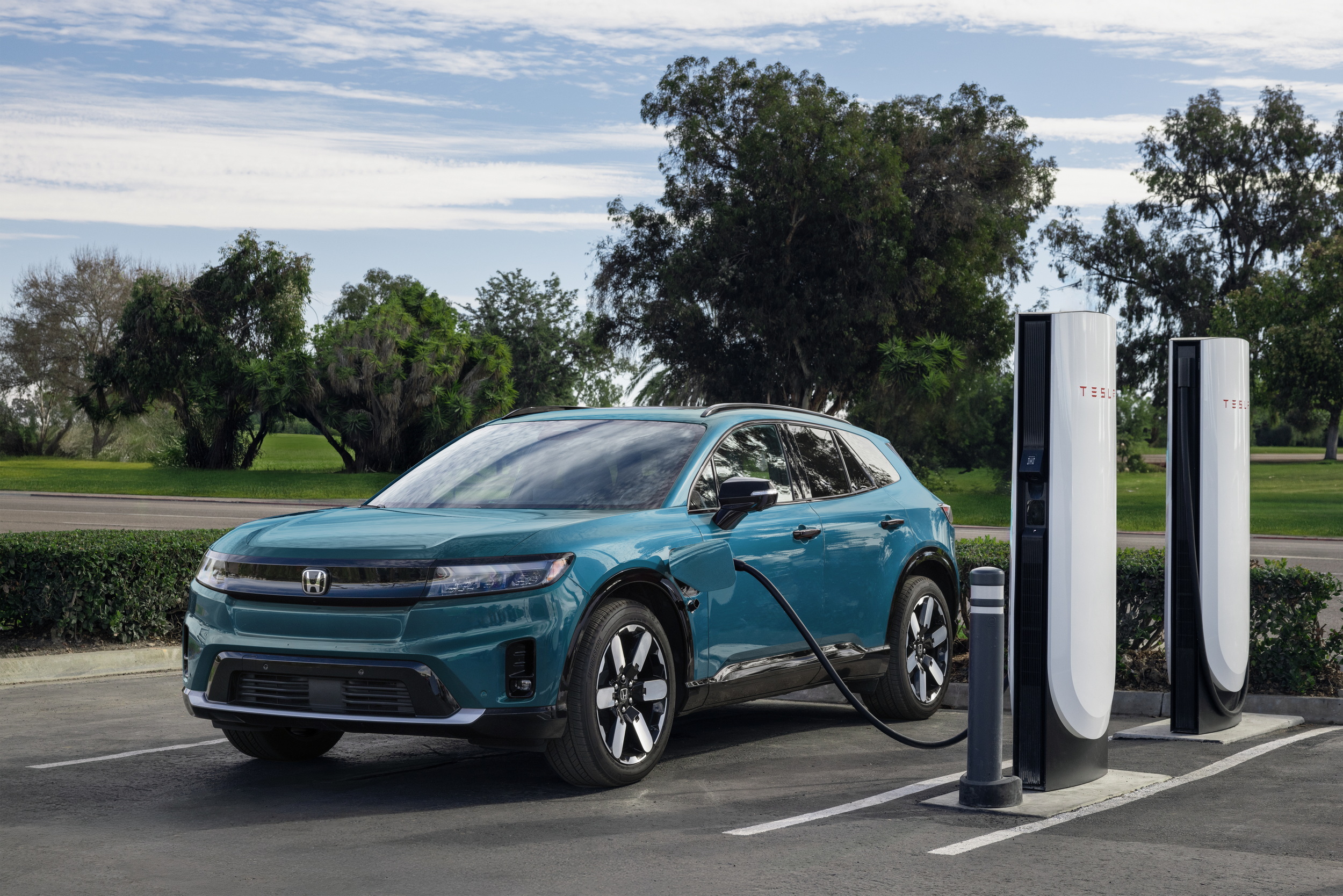
The study also found that EV drivers are becoming more satisfied with public charging. Scores climbed by over 100 points and this is being attributed to growing charging infrastructure as well as the opening of Tesla’s Supercharger network to other automakers.
Last but not least, EV drivers are more satisfied than those with plug-in hybrids. Premium EVs scored 114 points higher than their PHEV rivals, while mainstream electric vehicles had a 117 point advantage. Part of this can be chalked up to the cost of ownership as plug-in hybrid drivers have to deal with a more complex powertrain that involves gas and electricity.
In a statement, JD Power’s Brent Gruber said “Improvements in battery technology, charging infrastructure and overall vehicle performance have driven customer satisfaction to its highest level ever. What’s more, the vast majority of current EV owners say they will consider purchasing another EV for their next vehicle, regardless of whether they benefited from the now-expired federal tax credit.”
The spotlight on autonomous vehicle safety intensified in late 2025, when multiple Waymo robotaxis were caught illegally passing stopped school buses in Austin, Texas.
Footage from Austin Independent School District revealed at least 24 such violations since the start of the school year through the middle of January, with vehicles
ignoring flashing red lights and extended stop arms while children boarded or exited. Despite a software recall in December affecting over 3,000 vehicles, incidents persisted. Investigations by both the National Highway Traffic Safety Administration (NHTSA) and the National Transportation Safety Board (NTSB) followed suit last month.
Austin ISD asked Waymo to pause operations during school hours, but the company declined, citing ongoing improvements. Director of Transportation Kris Hafezizadeh will discuss the situation next month at STN EXPO East.
This saga underscores persistent challenges in AI-driven perception systems, where even advanced neural networks struggle with contextual cues like school zones, raising alarms among educators, parents and regulators about the risks to vulnerable road users.
Power disruptions have also exposed vulnerabilities in autonomous fleets. During San Francisco’s 2025 outages, hundreds of Waymo vehicles halted abruptly, creating gridlock and highlighting dependency on stable infrastructure. Similar events in other cities have fueled debates on redundancy measures, such as onboard backup power and enhanced telematics for real-time rerouting.
As technology matures, industry experts anticipate 2026 will bring more resilient systems, with AI algorithms trained on diverse failure scenarios to minimize disruptions. Optimism persists that real-world testing will refine these tools, but incidents like these remind us that innovation must prioritize safety, especially around
schools and school buses.
The consumer automotive market is evolving rapidly, with autonomous driving features projected to become standard in over 20 percent of new vehicles this year, according to industry forecasts. Tesla’s Full Self-Driving (FSD) supervised software, for instance, has seen significant patches in 2025 and early 2026, particularly for school bus interactions. Updates have improved detection of flashing lights and stop signs, with user videos demonstrating reliable stopping and waiting behaviors.
However, NHTSA’s ongoing probes into FSD including an October evaluation of traffic law violations covering nearly 2.9 million vehicles, reveals lingering issues like occasional failures in reduced visibility. Adversarial tests by The Dawn Project staged demos showing a Tesla Model Y ignoring bus signals and striking child dummies. Tesla extended its response deadline to this month amid scrutiny of over 8,000 potential incidents. A 2023 North Carolina case, where a 17-year-old was struck by a Tesla after exiting a bus, echoes these concerns. While software fixes addressed the bug, it illustrates how AI must evolve to anticipate unpredictable child movements.
As self-driving cars proliferate in urban areas, school bus drivers face added complexity. Children in loading zones demand split-second recognition yet early AV
systems have faltered. By this year, expect wider adoption of Level 3 and 4 autonomy, where minimal human input is needed in defined conditions, promising fewer crashes
through precise sensor fusion.
NHTSA’s early 2025 estimates show overall traffic fatalities dropping: 27,365 deaths in the first nine months, a 6.4 percent decline from 2024, with the rate per 100 million vehicle miles traveled falling to 1.10. The first half of 2025 saw 17,140 fatalities, down 8.2 percent, even as miles driven rose. While distracted driving specifics for 2025 remain preliminary, trends suggest AVs could further reduce human-error crashes, though flaws in software like those in Tesla and Waymo highlight the need for rigorous validation.
Emerging trends are transforming school transportation itself. AI and telematics are shifting from reactive to proactive safety, with predictive maintenance using data
analytics to forecast bus failures, reducing breakdowns. High-definition cameras, integrated with AI software, provide 360-degree views, detecting illegal passers and
alerting authorities. Automation extends to digital forms for route planning and incident reporting, streamlining operations via cloud platforms that unify GPS/Telematics, video and RFID for student tracking.
The growth of vehicle-to-everything (V2X) communication potentially enables school buses to signal AVs directly, which could prevent illegal passes.
The school transportation industry must adapt to these innovations to safeguard students. From apps providing real-time ETA alerts to parents, to HD cameras deterring
misconduct inside buses, technology enhances efficiency and accountability.
As we share roads with evolving AVs, collaboration between manufacturers, regulators and districts is crucial. Staying ahead of the curve ensures we don’t lag in safety, after all, the families our industry serves count on us daily to innovate for the best interest of kids.
Editor’s Note: As reprinted from the February 2026 issue of School Transportation News.
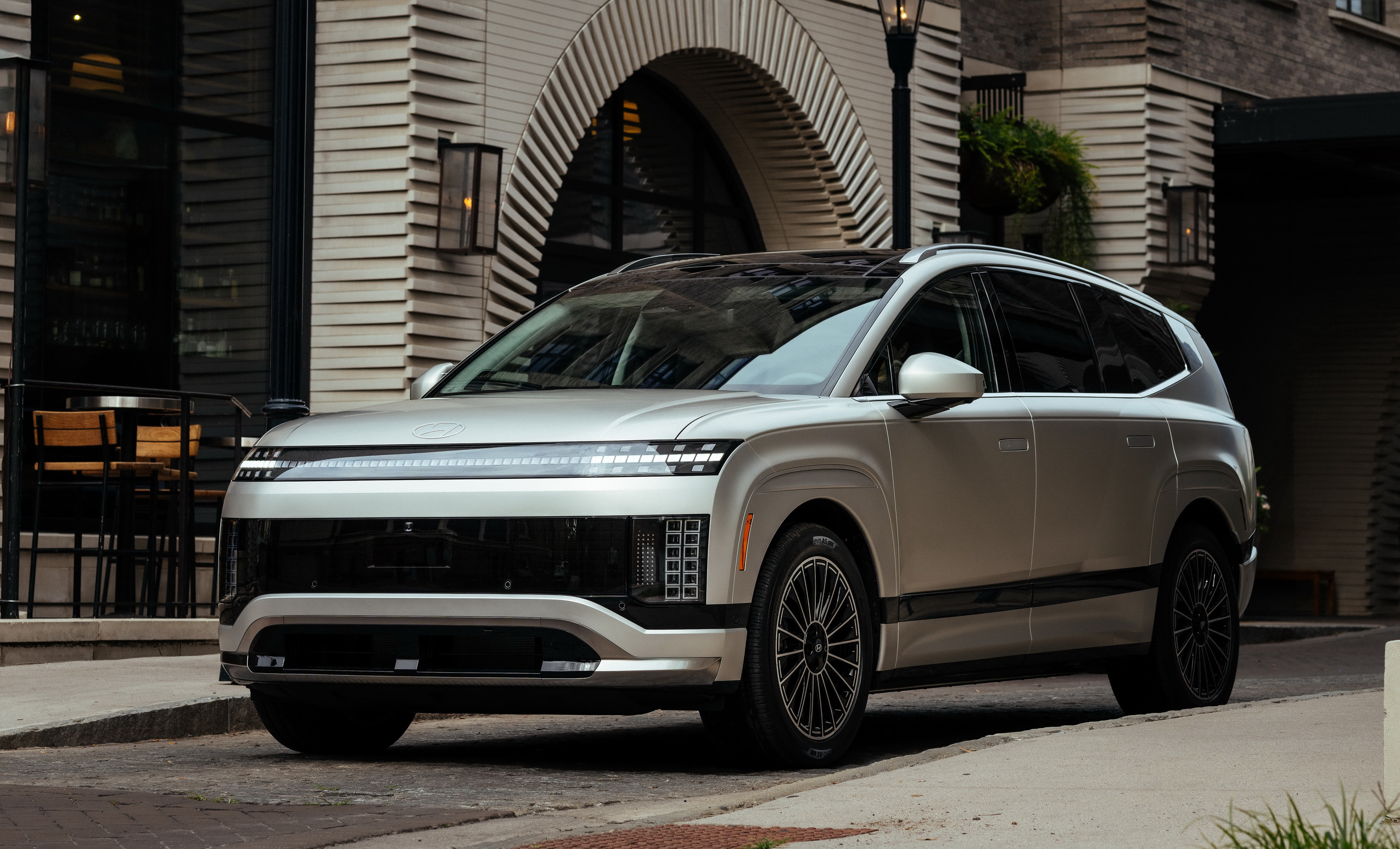
Hyundai recalled Ioniq 5 and 9 for a battery pack issue.
Some high-voltage busbars may not be torqued correctly.
Faulty bolts could lead to fire risk or fail-safe mode.
Hyundai is recalling two of its newest electric models, the Ioniq 5 and Ioniq 9, in the United States due to a potential fire risk stemming from a battery defect. Both models are currently produced at the company’s plant in Georgia.
According to Hyundai, the issue involves the battery pack’s internal components and could increase the risk of electrical fire if not addressed. Specifically, a recall notice points to improperly tightened high-voltage busbars during assembly.
If the retention bolts work loose over time, this could lead to electrical arcing within the battery pack, which in turn may trigger a fire. Hyundai also notes that these loose connections could disrupt voltage readings, pushing the vehicle into a fail-safe operating mode.
How Many Vehicles Are Affected?
The recall affects a very limited number of vehicles. Hyundai has identified 21 units of the Ioniq 5 from the 2025 to 2026 model years, built between January 24 and September 8, 2025. Additionally, just six Ioniq 9s produced from April 8 to September 12, 2025, are impacted.
The issue was first identified in November, when Mobis North America Electrified, Hyundai’s in-house battery supplier, discovered a battery system assembly unit that failed a quality test. The root cause was traced to under-torqued busbar bolts. By December, Hyundai had compiled a list of potentially affected VINs, and the recall decision followed in January.
Hyundai has confirmed that no related incidents have occurred in the field. So far, there have been no reports of crashes, fires, or injuries linked to the issue.
Starting April 6, Hyundai will notify both owners and dealers. The fix is straightforward. Dealers will inspect the busbar bolts in the battery system assembly and tighten them if necessary.
DETROIT, Mich. – Questar Auto Technologies’ predictive Total Fleet Health Management solution is now available on the Geotab Marketplace,a network of fleet-focused solutions for companies looking to increase productivity and compliance while lowering operating costs.
Questar’s AI-driven Total Fleet Health Management solution helps fleet operators to detect vehicle issues earlier, plan repairs proactively, and reduce unplanned downtime through predictive and prescriptive health insights.
Questar is one of the only fleet health solutions that shows the estimated cost of early intervention along with the estimated downstream cost of inaction; thereby helping fleets make confident, economics-driven maintenance decisions.
From easy implementation to higher revenues
Through a cloud-to-cloud integration with Geotab – which means there is no additional hardware to contend with — Questar analyzes vehicle telemetry, engine fault data, maintenance history, and environmental context to identify emerging issues before they become failures.
The Questar platform provides early-warning alerts (up to 30 days in advance), repair recommendations, and actionable insights tailored to each vehicle.
By combining Geotab high-quality data with Questar’s advanced analytics and industry-specific, patented AI Foundation models, fleet operators gain a proactive, data-driven approach to maintenance that drives measurable operational and financial impact. Vehicles stay on the road longer, generating more revenue.
“Fleets are looking for solutions that fit naturally into their existing technology environments,” says Aaron Howell, Vice President of Sales for Questar North America. “Through the Geotab Marketplace, fleets across North America can now access Questar’s advanced features.”
About Questar Auto Technologies:
Questar is a pioneer in vehicle health management, offering a comprehensive solution that includes both predictive and prescriptive VHM. Questar enables Tier 1 suppliers, OEMs, leasing companies, service providers and enterprise fleets to cut downtime, reduce maintenance costs, and maximize revenue through advanced AI-driven analytics. https://questarauto.com
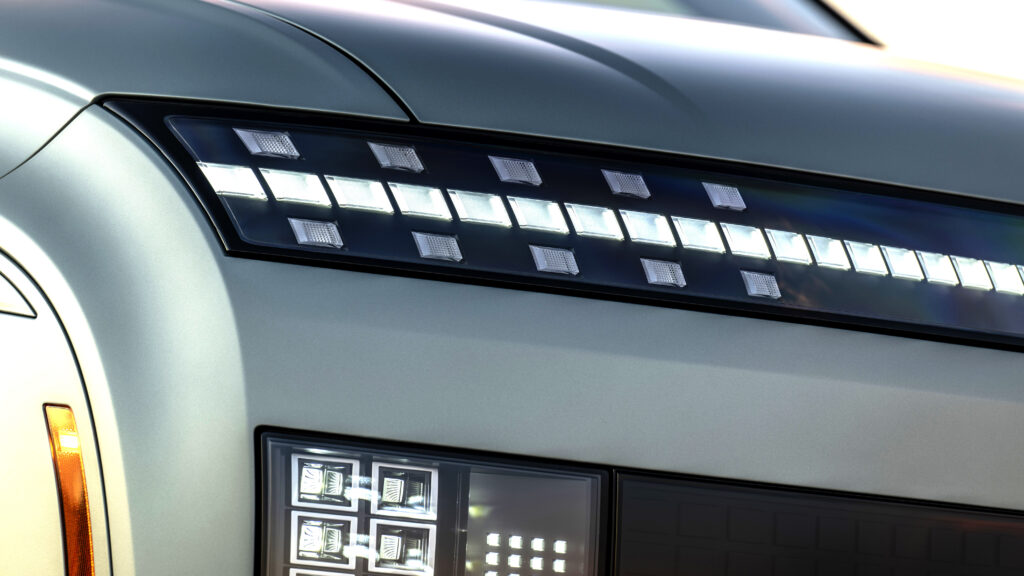
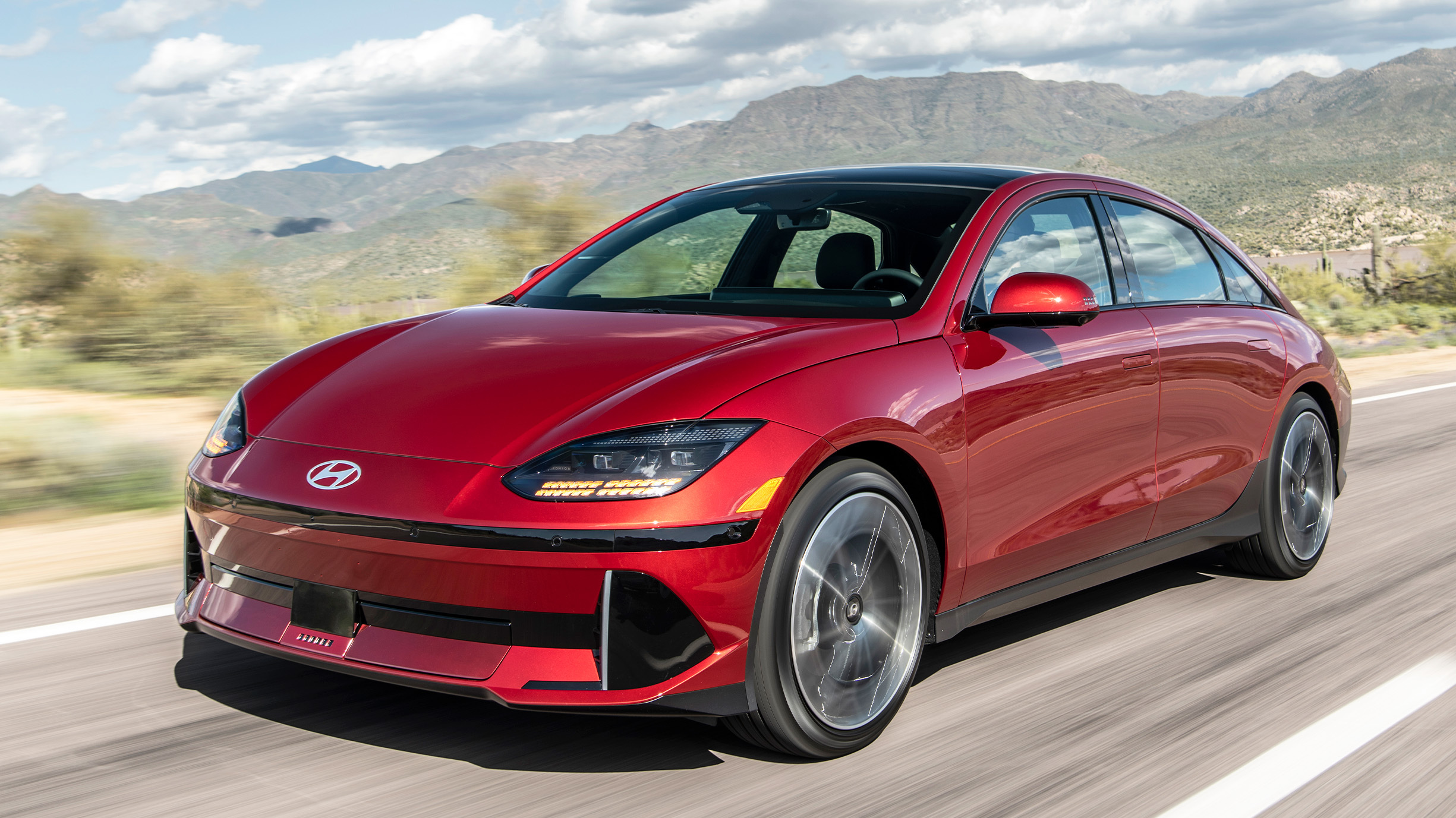
Ioniq 6 sales collapse 61% in January, while Ioniq 5 only dipped slightly.
Hyundai SUVs and hybrids deliver strong gains, carry sales performance.
Overall, Hyundai sales rise 2% despite sharp drop for electric sedan.
Hyundai just posted its best January ever in the US, but if you zoom in on the EV corner of the showroom, you’ll probably find salesmen consoling one particular electric model. Because while one Ioniq barely flinched in the face of EV market turmoil, the other faceplanted. Hard, really hard.
Let’s start with the good-ish news. The Hyundai Ioniq 5 slipped just 6 percent year over year in January, which in today’s EV market basically counts as holding steady while everyone else is struggling to keep the fire alive. Hyundai moved 2,126 of them, proving the retro-futuristic crossover still has plenty of fans.
Now for the ouch. The Ioniq 6 didn’t just dip, it fell off a statistical cliff, plunging 61 percent to just 344 units. That’s the kind of number that makes accountants quietly close the spreadsheet and go for a walk. Stylish and slippery though it is, the sedan is clearly having a much tougher time finding buyers.
SUVs Equals Sales Success
If Hyundai needs a reminder of what Americans really want, it only has to glance at the SUV side of the ledger. The combustion Palisade surged 29 percent off the back of a refresh, while the Santa Fe climbed 9 percent.
Even the smaller Kona jumped 22 percent. Big, practical, and family-friendly continues to beat low and sleek in the real world.
Hybrids are the real heroes here, though. Hyundai says petrol-electric sales shot up 60 percent, showing buyers still love the idea of electrification, just maybe not one that doesn’t come with a plan B. Models like the Santa Fe Hybrid are clearly hitting the sweet spot between fuel savings and banishing charging anxiety.
Combustion Losers
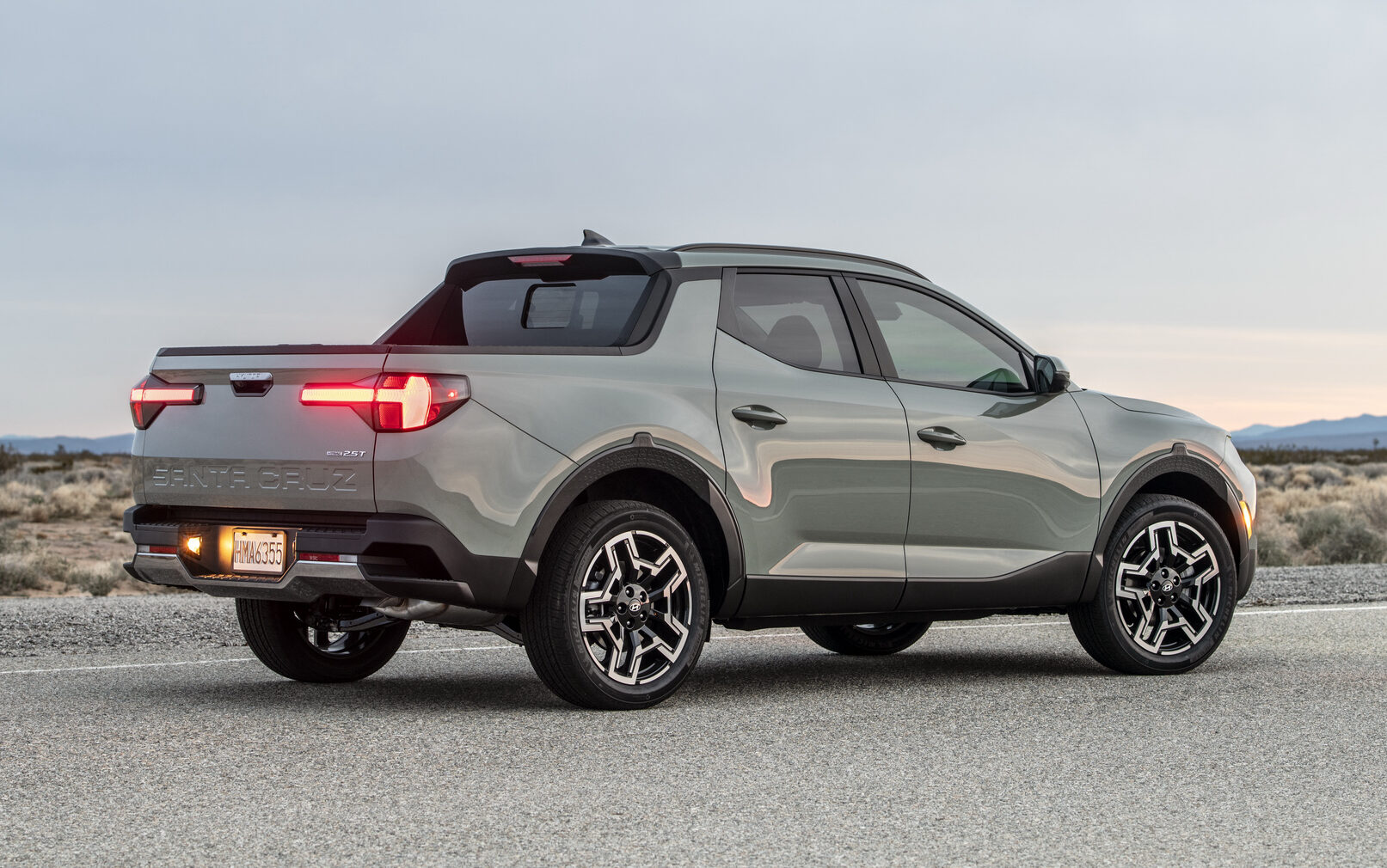
Not everything else was sunshine, though. The Sonata slid 34 percent, the dies-soon Santa Cruz dropped 32 percent, and Tucson eased back 4 percent. Still, with total Hyundai sales up 2 percent and SUVs making up the bulk of the action, the brand has a solid cushion.
We’ll be following the action closely to see if Hyundai can keep the good news flowing through 2026 – and what action it takes to turn the Ioniq 6’s dismal performance around.
All schools and districts that applied for funding for eligible safety features ranging from seatbelts to collision avoidance to additional lighting through the $10 million Ohio School Bus Safety Grant received an award.
An Ohio Department of Education spokesperson confirmed that it received 371 applications from schools, districts and county boards of developmental disabilities for the School Bus Safety Grant. Of those applications, 56 requested funds for “Occupant restraining devices that conform to the school bus seat belt requirements of 49 C.F.R. 571.”
The other authorized safety features are external school bus cameras, fully eliminated stop arms, crossing arms, illuminated school bus signs, lane departure warning systems, collision avoidance systems, and electronic stability control.
The school bus safety grant program was created in response to recommendations made by the Ohio School Bus Safety Working Group, which Gov. Mike DeWine convened to review all aspects of student transportation, following an August 2024 school bus crash that resulted in a student fatality.
Among its 17 recommendations made in January 2024, which did not include the use of lap/shoulder seatbelts — a main reason Gov. DeWine called together the working group — were strategies for improving bus safety features, driver training and emergency response.
Safety rant funding may be used for the repair, replacement or addition of the eight authorized safety features on school buses in active service or for safety enhancements on new school bus purchases.
Indian Hill EVSD in Ohio, applied for the safety grant. Diane Spurlock, transportation director, said they asked for collision avoidance systems and lane departure warning system.
“The program we selected is an AI camera that can notify the driver if either of the instances occurs while they are on the road,” she said. “The main reason is that we recently had an incident happen with a driver where this could have kept it from happening thus ensuring a safer drive. A secondary reason is that our current cameras are getting outdated quickly and I hope this opens the door to purchase more products from this company.”
Additionally, Indian Hill applied for the ground wash lights “because our district does not have street lights and some streets are very narrow. We have added the LED lights near the back tires but believe the ground wash lights will be especially helpful for turnarounds,” she continued.
Gov. DeWine, the Ohio Department of Education and Workforce Director Stephen D. Dackin announced via a press release that, “the grants will help ensure safer travel for Ohio students through safety upgrades to existing buses and the addition of advanced safety features on new buses.”
“Whether students are in the classroom or on the school bus, we owe it to parents and families to do everything we can to keep them safe,” said DeWine. “We’re raising the bar for student safety on Ohio’s buses, and these grant awards demonstrate our dedication to making school transportation safer.”
Dackin added, “Student safety is our top priority, and Ohio is investing in critical safety improvements to equip school buses with proven technology that keeps children safe.”
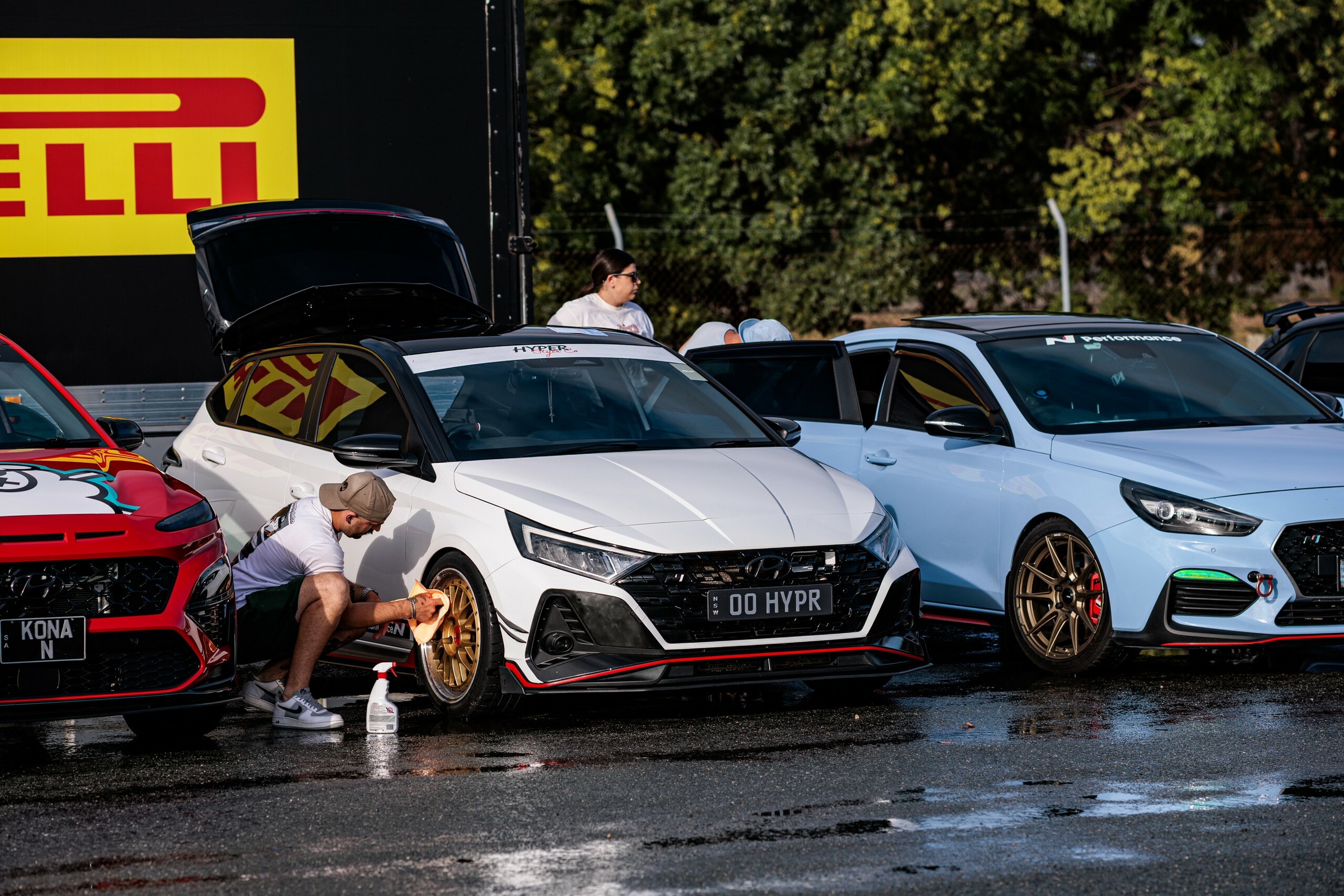
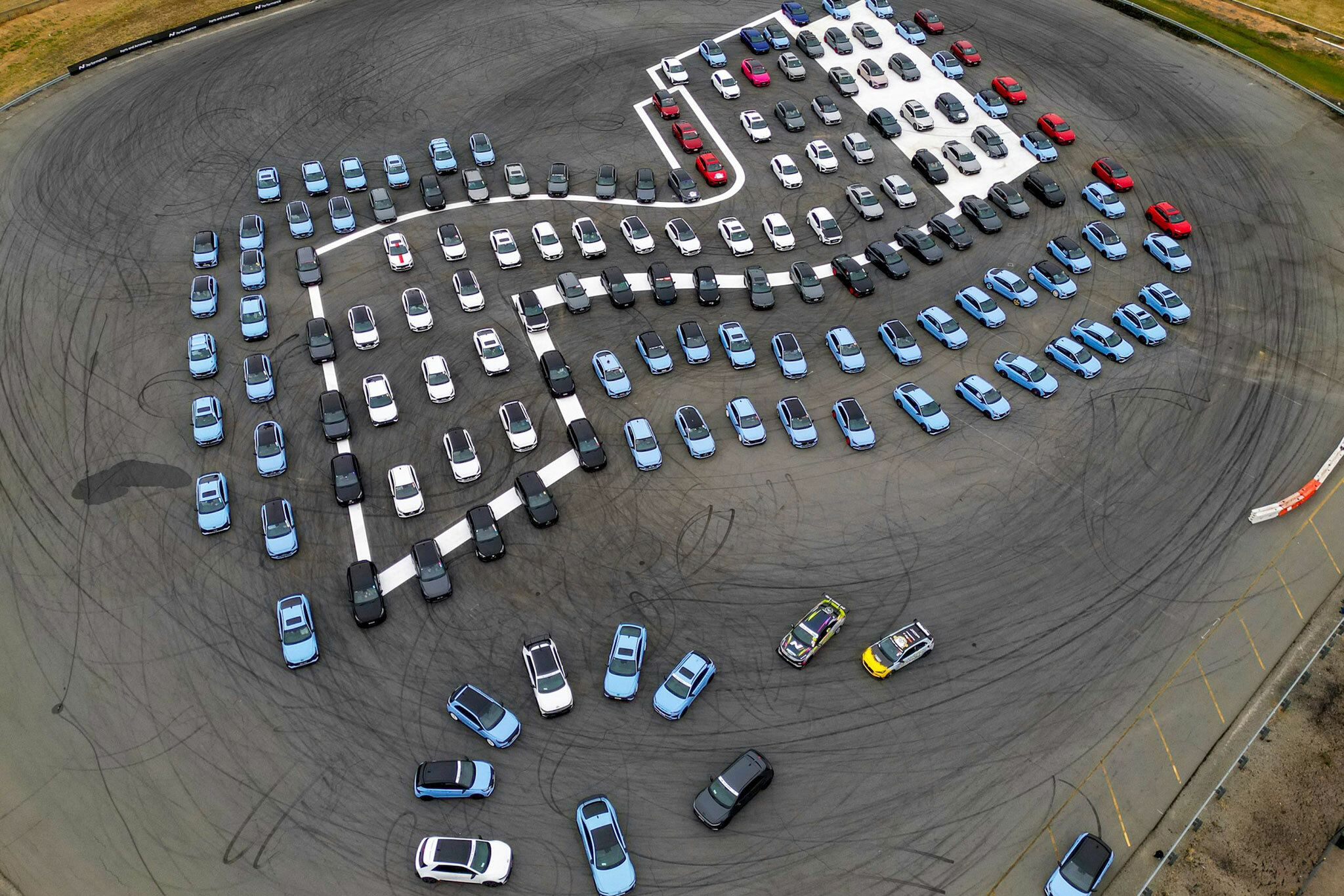
Hyundai’s N Festival in Australia drew more than 350 cars.
Entry was AU$60, including track time and instructor support.
Non-N owners can attend through the new Nvy Track Sessions.
Building a loyal enthusiast following from the ground up isn’t something carmakers typically pull off overnight. For Hyundai, a brand that wasn’t exactly on anyone’s radar for fun, driver-focused cars to begin with, establishing its N performance sub-brand was not just about creating engaging machines. It was about cultivating a culture, and that’s a far more elusive achievement.
However, thanks to a host of owner-focused events, Hyundai Australia has done just that. There are now thousands of tightly-knit N owners across the country, helping the company’s creations become among the nation’s best-selling hot hatches. Not only that, but cars like the i20 N and i30 N have become genuine benchmarks in their respective segments.
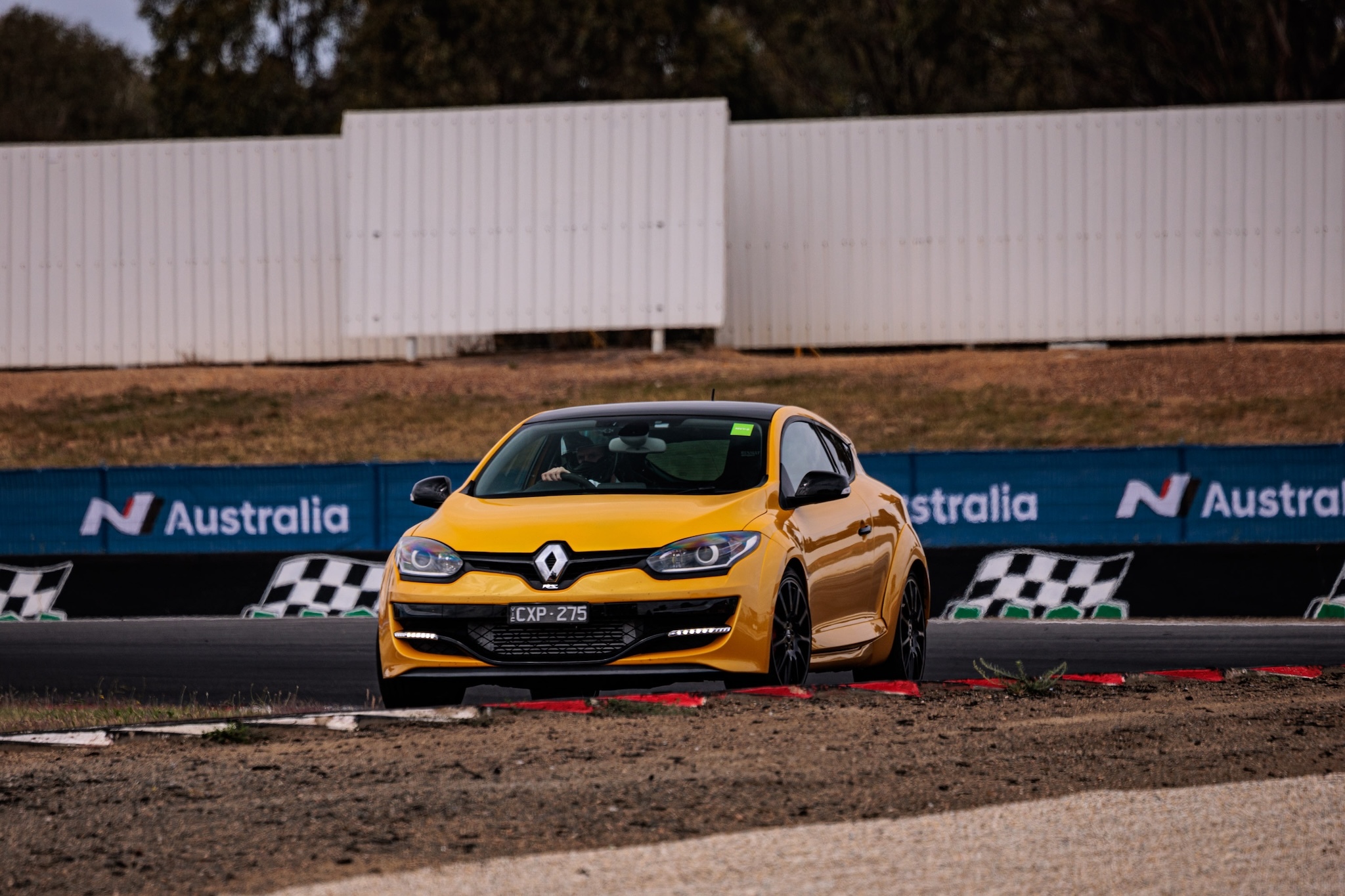
In late November, the annual N Festival returned for its seventh iteration, but with a twist. Not only was the event open to N owners, but also to a select number of owners from other brands, so we decided to join in with a bright yellow Renault.
Nvy
Hyundai N Australia
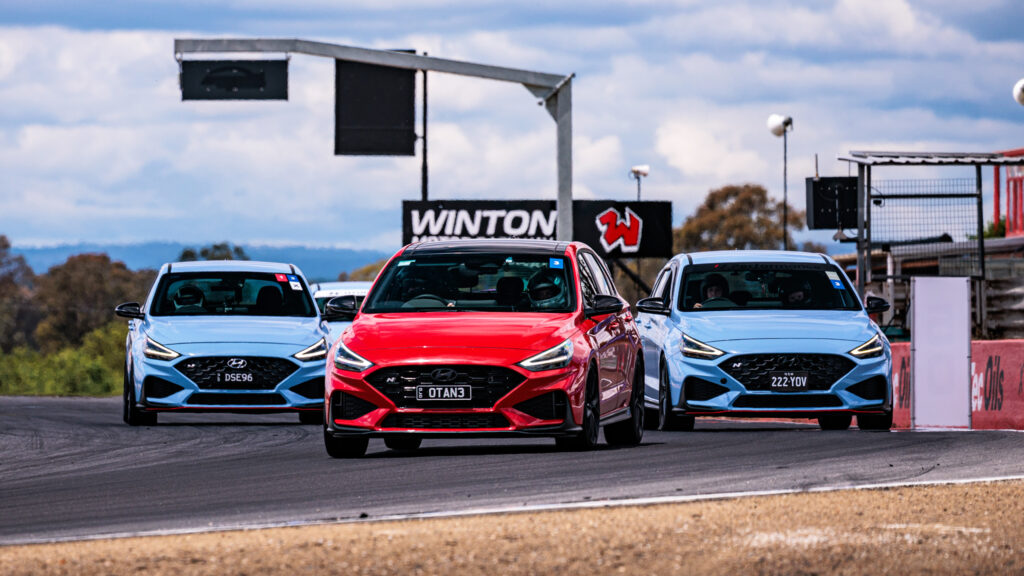
The 2025 event was held at Winton Raceway, roughly two hours north of Melbourne. As interest in the N Festival has increased in recent years, it’s no longer just an event run over Saturday and Sunday, but for the first time, it was extended to a three-day event. For eager owners wanting to get onto the track, there’s no better event.
More than 350 cars attended in December. To join in, all that was required was a AU$60 ($40) entrance fee. In return, owners get ample time on the track, a gift bag of N merchandise, and tutelage from experienced driving instructors. This makes it an absolute bargain, particularly since regular track days usually start at upwards of AU$300 ($200).
New to the 2025 N Festival were the ‘Nvy Track Sessions.’ These sessions were open to 20 non-N car owners each of the three days. To participate, you needed to receive an invitation from an N owner and to pay the same fee. I managed to secure a spot for my Renault Megane RS275.
On Friday, Saturday, and Sunday, participants were split into six groups of 20 cars, with one group for the non-N cars. Each group had five 15-minute sessions on the track, totaling 75 minutes across the day. For pretty much anyone not named Max Verstappen, that’s more than enough track time.
While I’ve done plenty of track days in the past, this was the first one in my Renault. The chassis and brakes are standard (for now…), although I have had it fitted with sticky Continental SportContact7 road tires, and the engine modified with a new intake, blow-off valve, intercooler, downpipe, and tune. It’s good for 219 kW (294 hp) and 445 Nm (328 lb-ft) of torque at the wheels, a healthy amount for the 2.0-liter turbo.
Hyundai N Australia
The temperatures were hot, pushing over 30° C (86° F) throughout my sessions, but my little French hot hatch performed flawlessly. There were some impressive cars in my sessions, like a new G80 BMW M3, an Audi RS5, a Porsche Cayman GT4, modified Toyota Supras, and a tuned Toyota GR Yaris, but I had no issue reeling each of them in and overtaking.
Just like the i30 N is considered among the best hot hatches on the market, the third-generation Megane RS275 was held in similarly high regard when it was launched. Honed on the Nurburgring, it felt right at home on the circuit, providing immense levels of grip, combined with superb stability under braking and great straight-line pace. Admittedly, my tires now look a little worse for wear.
Ns On The Track
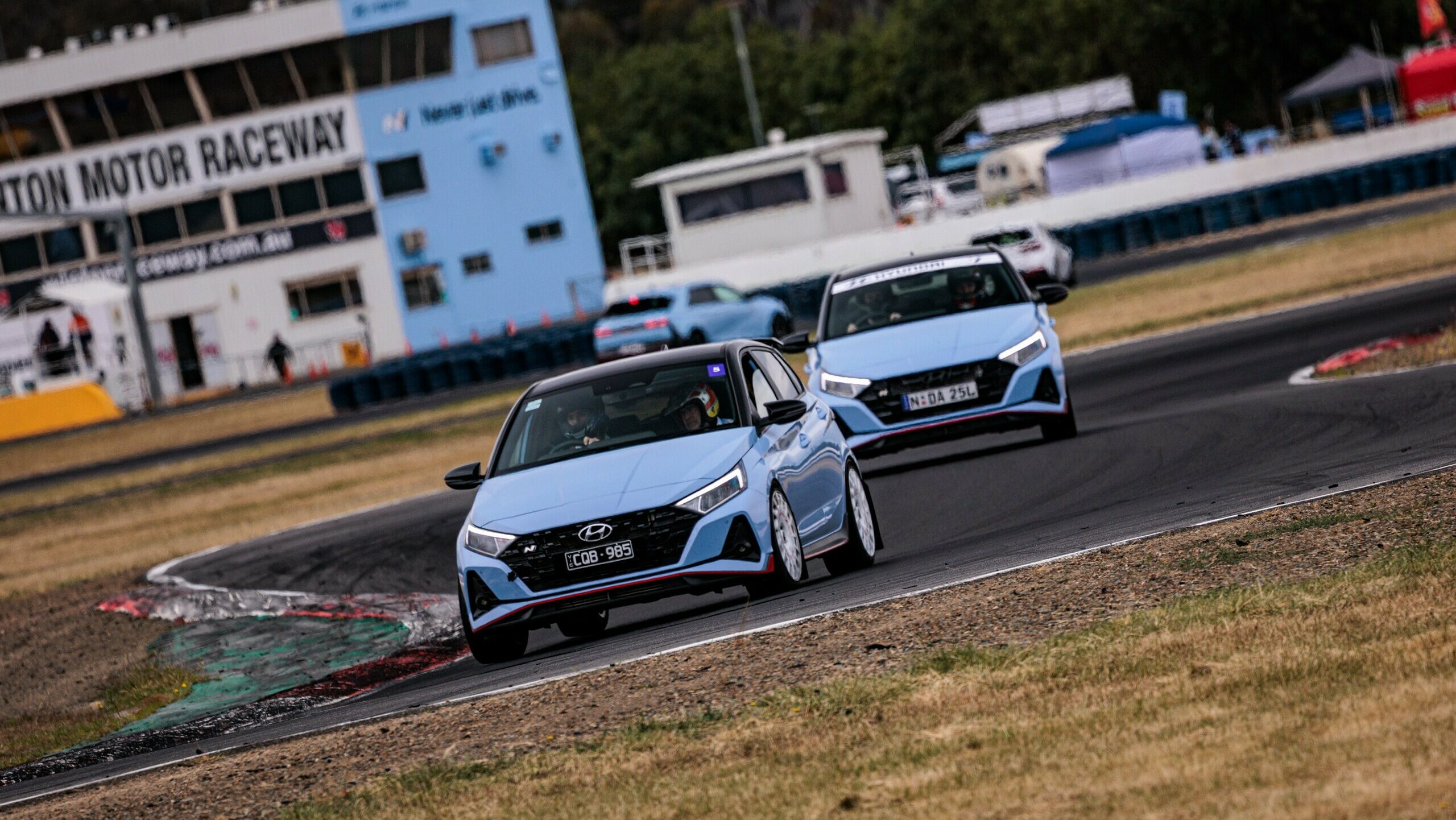
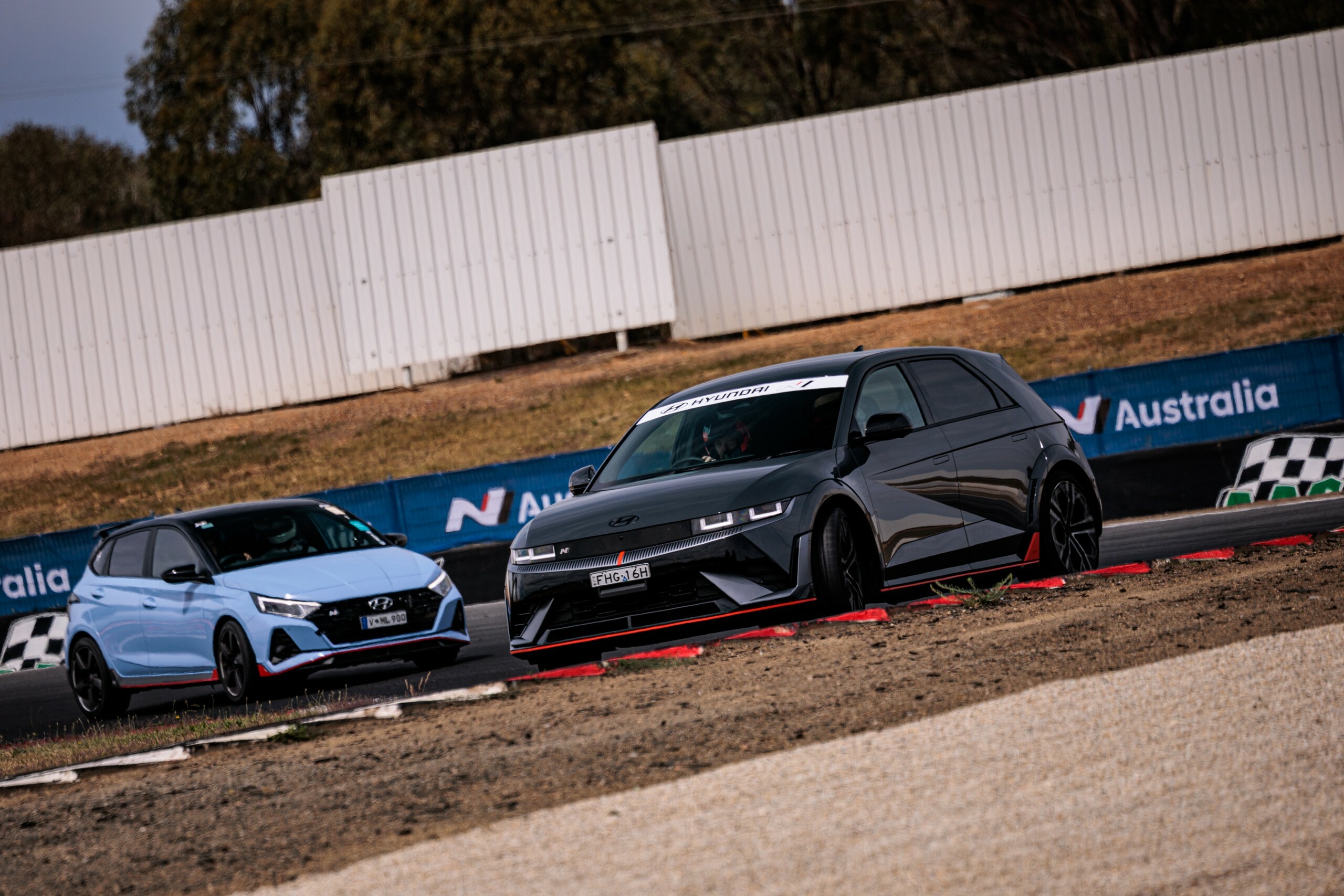
Of course, it was the Hyundais that were the real stars of the day. Hyundai Australia brought along a slew of press cars for journalists to test out. I managed to snag some seat time in each of the company’s current models, including the i20 N, i30 N hatch, i30 N Sedan, and the potent Ioniq 5 N.
Winton Raceway is quite a tight, short track, perfect for hot hatches like those from Hyundai rather than high-horsepower monsters. The pint-sized i20 N proved to be the perfect companion for the circuit.
While the i20 N only has a 1.6-liter turbocharged four-cylinder and is down more than 50 kW (67 hp) over the i30 N, it had no issue sticking with its bigger brothers on the circuit. It feels incredibly nimble and responsive, particularly around the circuit’s sweeping bends and tighter corners, often lifting one of its rear wheels as the front tires stick mercilessly to the track.
As standard, the i20 N comes with Pirelli P Zero NH tires, and they perform brilliantly on the track. As the day progressed, they did start to lose some grip, but importantly, they remained predictable despite the wear. The only issue I encountered was difficulties downshifting from 3rd to 2nd with the auto-rev match function enabled, something I also experienced at the N Festival back in 2022.
Extra Power, Extra Thrills
For those seeking superb on-track handling, combined with on-road comfort, and great straight-line speed, the i30 N hatch and i30 N Sedan remain among the best options on the market. While they may share a name, the i30 N Sedan has a longer wheelbase than the hatch and is based on a different chassis. In most of the world, it’s known as the Elantra.
In a straight line, the i30 N hatch is a little sprightlier. While both cars have the same 2.0-liter turbocharged four-cylinder and are advertised with the same 206 kW (276 hp) and 392 Nm (289 lb-ft), the hatch’s boost pressure peaks at 17 psi, whereas it usually sits around 14 psi in the Sedan. This is because the sedan has Hyundai’s controversial ‘Octane Learning Mode’.
To enable the full 17 psi, you’ll have to either drive in 8th gear between 109-159 km/h (68 -99 mph) for 5 minutes or more, or drive for 5 minutes or more in 44th or 5th gear at 40-70% throttle between 40-120 km/h (25 -75 mph). Obviously, this isn’t achievable on a track. Many owners I spoke to have had their cars tuned to unlock full boost without having to do this procedure.
The duo also feels quite different through the turns. Both stick extraordinarily well, providing enough grip to warp your face. However, the hatch is noticeably stiffer and feels a little lighter. By comparison, the i30 N Sedan feels more stable, owing to the longer wheelbase, and is easier to find the limits in. On the track, we prefer the hatch, but on the road, it’s the Sedan that stands out.
What the Ioniq 5 N Does Best
We also had the opportunity to do a few hot laps in Hyundai’s potent Ioniq 5 N. This is the performance car that has redefined what we thought was possible for an EV. Not only is it extraordinarily quick, but it’s also loads of fun to drive. It’s no surprise that Porsche and Lamborghini have benchmarked their EVs against it.
Obviously, the dual-motor powertrain makes the Ioniq 5 very quick in a straight line. However, because Winton’s straights are quite short, it doesn’t get much room to stretch its legs. Thankfully, it shines in other ways, particularly in its handling dynamics.
Thanks to some engineering trickery, it’s possible to shift the amount of power sent to the front and rear wheels. As such, the Ioniq 5 N can be driven effectively as a front-wheel-drive or rear-wheel-drive car. This means it is inherently more configurable and playful than Hyundai’s other N products. The downside? It’s electric, meaning it’s not so practical for track use unless a circuit has a DC fast charger.
Track Day Antics
The 2025 N Festival didn’t just include dozens of track sessions. This year, owners were also able to participate in a series of head-to-head rolling races to see who owns the quicker car in a straight line. There was also a Show’N Shine and an organized drive through some of the circuit’s neighboring country roads.
Australia’s N Festival has established itself as one of the best events on Australia’s track day calendar, and it’s easy to see why. It’s affordable, well organized, and welcoming. I’m sure it convinced some non-N owners to call up their local Hyundai dealership and place an order. As for me, used Ns remain out of my price range, so I’ll be keeping my French hot hatch.
Hyundai has introduced the Staria Camper concept at the CMT Show.
It features a pop-up roof, refrigerator, solar panel, and smart glass.
The company is considering production and is looking for feedback.
Hyundai has used the Caravan, Motor und Touristik Show to introduce a camper concept based on the Staria Electric. It’s designed to explore how the van could “evolve into a premium recreational vehicle tailored to the European market.”
Designed for off-grid travel, the Staria Camper concept has been equipped with a retractable canopy as well as a power pop-up roof. The latter has been fully integrated to reduce wind noise and buffeting while driving.
The roof is also notable for being covered by a 520W solar panel, which can generate up to 2.6 kWh of electricity per day. This can be used to power onboard equipment or to extend the vehicle’s range.
Another cool touch is the use of electronically adjustable smart glass for privacy. The rear windows are controlled by a dedicated touchscreen, which enables users to instantly adjust their transparency.
Besides keeping prying eyes at bay, the smart glass offers “significantly improved UV, thermal, and acoustic insulation compared with conventional glass.” Despite this, Hyundai also threw in traditional curtains.
The rest of the exterior largely carries over, but we can see water and electrical hookups located near one of the taillights.
Modular Comfort Inside
Moving inside, the second- and third-row seats fold flat to create an expansive sleeping area for two adults. The concept also sports a long counter that houses a sink, storage compartments, and a 1.3 cubic foot (36 liter) refrigerator. They’re joined by a folding interior table, a classy peg board, and special lights.
Rounding out the highlights are a swiveling front passenger seat and a climate control system that can keep you warm on chilly nights. Furthermore, the liftgate opens to reveal a deployable rear table as well as an outdoor shower setup.
Could It Actually Happen?
While the van is a concept, Hyundai wasn’t shy about the possibility of a production model. In fact, they’re actively seeking feedback from a “cross-section of camping, caravan, and adventure enthusiasts from across Europe and beyond.” The company said this will help them gauge interest in bringing the concept to life.
Hyundai went on to say the production model would echo the regular Staria Electric, which has an 84 kWh battery pack as well as a front-mounted motor producing 215 hp (160 kW / 218 PS).
This enables the van to have a WLTP range of approximately 249 miles (400 km). When the battery is low, a DC fast charger can take it from 10-80 percent in around 20 minutes.
SAN DIEGO, Calif. -Netradyne, a leader in AI-powered fleet safety and performance solutions, today announced the launch of Video LiveSearch, an industry-first technology that leverages real-time natural language search powered by on-device edge AI intelligence. Video LiveSearch enables fleet managers to proactively search across every vehicle in real-time and instantly uncover the most meaningful video to pull.
Delivering Faster Situational Awareness
Until now, fleets have had to rely on incidents being reported by other teams, wait through cloud processing delays, manually triangulate the vehicle and timeframes of interest to download, and then sift through hours of downloaded footage—slowing investigations and limiting fleets to a reactive approach to fleet safety and performance. Video LiveSearch provides a step-change improvement by enabling fleets to shift from a reactive to a proactive operational approach:
Empowering their teams to proactively improve safety and performance with virtually instant line-of-sight into where to look, instead of waiting for reports or digging through timelines. Enabling real-time, on-device search using a simple, natural language prompt for road-facing camera views across every vehicle in the fleet. Surfacing the most relevant before-during-after video clips, instead of guessing or manually triangulating video timestamps. “Video LiveSearch is the fleet industry’s first on device, real-time search capability—giving fleets faster situational awareness to proactively understand what’s happening across their operations,” said Avneesh Agrawal, CEO and co-founder of Netradyne. “Fleet operators can instantly find the exact moments of interest across their entire fleet in real time, enabling faster action and safer, more efficient operations. Using natural language and AI-powered search, fleets can proactively identify risks and inefficiencies across their operations, such as school bus stop-arm compliance, commercial proof of service, cracked-windshield maintenance, or claims support.”
Powered by On-Device Edge AI
Video LiveSearch is possible because of Netradyne’s advanced edge intelligence that brings together:
Real-Time Reasoning at the Edge
Netradyne creates searchable video for virtually 100% of road-facing drive time directly on the vehicle—so Video LiveSearch doesn’t have to wait on cloud downloads to start finding relevant video.
Every free-text search returns the top matches in seconds, whether across a single vehicle or the entire fleet, giving teams near-instant discovery of which clips to pull. Instead of chasing details like vehicle, date, or trip and hoping a video request hits the mark, fleets can immediately see the best matches and download only the footage they need.
Context-Aware Search that Learns Real-World Patterns
Netradyne’s edge intelligence learns patterns in real-world road scenes and driving behavior, enabling LiveSearch to instantly match a simple search prompt to the most relevant video footage and return the right clips to pull for before–during–after context.
“The enabling hardware for Video LiveSearch, the D-810 device, turns every vehicle into an intelligent multi-modal sensor for your fleet operations,” said David Julian, CTO and co-founder of Netradyne. “Video LiveSearch leverages that intelligence to deliver rapid insights, giving fleets the power to quickly search for what’s happening around their vehicles, drivers, and passengers in real time. This represents a foundational step in our Physical AI platform, where our technology continuously interprets the physical world to power both rapid discovery and precision operations.”
Two-Speed AI: Discover Fast, Operationalize with Precision
Netradyne views Video LiveSearch as a core pillar of its Two-Speed AI strategy.
Exploration: Broad semantic search enables rapid discovery without waiting on product development cycles. Operationalization: High-precision, domain-optimized models power real-time coaching and safety-critical workflows.
Video LiveSearch accelerates discovery while informing where deeper AI investment delivers the greatest operational impact.
Responsible AI by Design
Video LiveSearch embeds responsible AI governance directly into its architecture. An AI front-end screening layer evaluates natural-language prompts before they reach the edge reasoning engine, automatically rejecting requests outside approved operational intent—such as identifying individuals or tracking license plates.
This approach ensures Video LiveSearch remains focused on safety and operational use cases, preserves driver trust, and prevents misuse by design rather than policy.
Pioneering Physical AI for Fleets
Video LiveSearch represents a foundational step in Netradyne’s broader Physical AI vision, where AI continuously interprets multimodal data on the vehicle to understand the driver, vehicle, driving environment, and trip as an integrated system. By making this context instantly searchable, Video LiveSearch transforms how fleets gain situational awareness and take action across their operations.
About Netradyne:
Netradyne provides AI-powered technologies for smarter fleets and safer roads. An award-winning industry leader in fleet safety and video telematics solutions, Netradyne empowers thousands of commercial fleet customers across North America, Europe, and Asia to enhance their driver performance, reduce risk, and optimize operations. Netradyne sets the standard among fleet operating companies for enhancing and sustaining road safety. Using AI-vision technology to analyze 1.3+ trillion minutes and 27+ billion miles, Netradyne offers an industry-first driver and fleet scoring system that recognizes and rewards safe, efficient driving behaviors. Founded in 2015, Netradyne is headquartered in San Diego with offices in San Francisco, Nashville, and Bangalore.
It’s a new calendar year but school transportation leaders face the same challenges. As Albert Einstein famously said, “In the middle of every difficulty lies opportunity.”
This month’s articles highlight key areas where leaders can make impactful changes to improve safety, efficiency and equity for all students, especially those riders with
disabilities.
While all important, Linda Bluth’s column on addressing sexual assault on school transportation vehicles especially strikes a chord. The topic must be the most horrifying for student transporters to discuss, aside from a fatality. We know from research that students with disabilities are at a significantly higher risk of being targeted for sexual assault than their non-disabled peers. Bluth shares that one constant over her storied career has been the number of sexual assault cases she has been asked to serve as an expert witness on.
She underscores the urgent need for proactive measures to protect students by calling for an industry task force to address this sensitive yet essential topic, to confront it head-on and ensure the safety and well-being of students.
Ask yourself, what policies does your transportation department and school district have in place regarding sexual assaults occurring on or around school buses or other school transportation vehicles. Bluth writes it is vital to create clear, school board-approved policies that define and address sexual assault as well as bullying and harassment on school transportation vehicles. Training all transportation personnel and students on these policies is vital.
Supervision must also be enhanced. A growing trend is more attendants on routes to assist school bus drivers with behavior management. High-back seats, Bluth says, create a barrier to seeing what students are doing. I hear that concern often from readers, an unintended consequence of NHTSA’s 2009 update to FMVSS 222 that increased the minimum seatback height to 24 inches.
Providing adequate adult supervision on all vehicles used for school transportation is paramount to the safety of all students.
Technology is supplementing these efforts with state-of-the art video camera systems. Increasingly, AI-enhanced software is showing the promise of even predicting or identifying the risk of potential assaults, but these solutions are in their infancy. Never mind the expense. First and foremost, student transporters must have policies for regularly reviewing footage. Most camera systems come with alerts to notify supervisors
of incidents. But there remains no consistent solution better than, if you “see something, say something.”
Train your school bus drivers, monitors and other staff to trust their intuitions. If something feels “off” during a route, it probably is. Foster a culture where transportation personnel and students feel safe reporting inappropriate behavior without fear of retaliation.
There is plenty to think about when reading this month’s issue, which also looks at the importance of modern routing software, AI-powered tools and data-driven solutions to address driver shortages and training, route optimization, and Medicaid reimbursement challenges. Alternative vehicles also continue to gain ground in transporting students to and from school.
With them comes the need to train their drivers on proper child safety restraint and wheelchair securement. At the half-way point of the school year, consider how your operations are poised to tackle all these issues. As school transportation leaders, the responsibility to ensure the safety and well-being of students is paramount. By addressing critical safety issues, embracing technology, and fostering collaboration, we can drive meaningful change in the industry.
Let’s turn these insights into action, ensuring that every student’s journey is safe, efficient and supportive of their educational success.
Editor’s Note: As reprinted from the January 2026 issue of School Transportation News.
The most read School Transportation News magazine articles in 2025 explored AI and other emerging technology, leadership, workforce development and evolving student transportation models.
Specific topics included illegal school bus passing prevention, routing optimization, artificial intelligence and future-focused fleet technology, to reflect a transportation industry actively adapting to new challenges and opportunities. At the same time, human-centered stories, highlighting leadership, recognition and professional growth continued to resonate strongly with readers.
Together, these articles underscore the industry’s dual focus on innovation and culture as transportation departments prepare for the future.
STN reports below on the top-viewed article from each monthly magazine issue in 2025, organized by publication month.
This article examined nontraditional student transportation scenarios that fall outside standard home-to-school routes on school buses. It explored how districts are adapting to serve students with disabilities and special needs who need alternative schedules and specialized programs. The piece emphasized flexibility, collaboration and policy considerations required to safely and effectively manage atypical transportation models.
February – Combatting Illegal Passing with Awareness, Technology Focusing on one of the most persistent safety threats in pupil transportation, this article addresses strategies to reduce illegal passing of stopped school buses. It highlighted the role of public awareness campaigns, stop-arm cameras, and enforcement partnerships, reinforcing the importance of both education and technology in protecting students at bus stops.
Procurement and decision-making challenges faced by transportation departments, particularly as districts evaluate new vehicles, services and technologies, underscore the importance of planning, transparency and stakeholder input when making large-scale transportation investments.
One of the most-read magazine articles of the year looked at emerging AI trends shaping student transportation. Topics include predictive maintenance technologies, data-driven operations and forward-thinking approaches to safety and efficiency. The article encouraged readers to view innovation as a proactive tool rather than a reactive solution.
This Q&A featured leadership insights from Blue Bird President and CEO John Wyskiel, focusing on the company’s vision as it moves into its second century. The discussion touched on innovation, electrification, manufacturing priorities and the evolving needs of school districts.
Routing remains one of the most complex aspects of school transportation, and this article took a deep dive into the many variables that influence route design. From staffing shortages to bell times to special needs transportation, the piece highlighted how layered decision-making and technology tools can help districts improve efficiency and service reliability.
This article examines how AI may shape the future of student transportation. Industry leaders share perspectives on potential applications, from routing and predictive maintenance to training and operations, while also addressing concerns around implementation, data, and workforce readiness.
Celebrating a decade of recognizing excellence, this article highlights the critical role maintenance professionals play in student transportation. It honored the dedication, expertise and behind-the-scenes work of garage staff who keep fleets safe, reliable and road-ready every day.
This article explores technology solutions designed to support long-term transportation goals rather than short-term fixes. Topics included vehicle systems, software integration and tools that improve safety, accountability, and operational visibility for transportation departments.
Providing data-driven insight into compensation trends, this top-viewed article breaks down transportation director salaries by region across the contiguous U.S. It offers valuable benchmarking information amid ongoing workforce recruitment and retention challenges.
The most-viewed magazine article of 2025 spotlighted emerging leaders in the student transportation industry. By recognizing rising professionals making meaningful contributions, the article reflects the industry’s focus on mentorship, succession planning and cultivating the next generation of transportation leadership.
The landscape of student transportation is constantly evolving, but are your district’s strategies adapting with it? Get powerful takeaways to keep pace with the industry’s changes and stay resilient by attending this webinar.
Across four trends, you’ll learn:
How to get a 360-degree view of operations by integrating on-bus technology.
Tech-driven methods to overcome the driver shortage, empower your team and cut turnover.
Budget-friendly strategies to navigate differing electric school bus priorities.
Practical ways to implement AI for safer, more efficient student transportation.
Save your spot now.
Brought to you by Geotab
REGISTER BELOW:
Presenters:
Alfred Karam
Former Director of Transportation (Retired)
Shenendehowa Central School District
Alfred is a Master Gunnery Sergeant of Marines (retired), an award-winning Director of Transportation and a published author. Following 25 years of service in the U.S. Marine Corps, he led transportation operations for two of New York’s largest school districts for 24 years. His leadership has been recognized with multiple top honors, including the School Bus Fleet Magazine Administrator of the Year (2013) and the National Association for Pupil Transportation Larson Quality Award (2017).
Keba Baldwin
Director of Transportation and Central Garage
Prince George’s County Public Schools
Keba Baldwin serves as the Director of Transportation & Central Garage for Prince George’s County Public Schools, one of the nation’s largest school districts. He leads operations for more than 1,200 school buses and 700 fleet vehicles, ensuring safe and reliable service for over 85,000 students each day.
Mr. Baldwin brings a unique perspective that bridges the classroom and operations. His scientific background has shaped his analytical approach, while his educator’s mindset informs his commitment to equity, safety and service. He has led initiatives in routing optimization, safety training for transporting students with disabilities and the adoption of clean-energy fleets.
Craig Berndt
Business Segment Manager, People Transportation
Geotab
With 15 years in telematics, Craig brings to the table extensive experience in passenger transportation, public works and vehicle sharing. In his current role at Geotab as the Business Segment Manager for People Transportation, Craig is responsible for leading a cross-functional team to ensure success in this rapidly growing area of the business. He earned an MBA in 2020 and his community engagement includes volunteering with Scouting America (formerly BSA) and his non-profit animal rescue.
AUSTIN, Texas- BusPatrol, the leader in school bus safety technology, has been named to both the 2025 Deloitte Technology Fast 500etch and the Inc. 5000 lists in recognition of its rapid growth and impact on student and community safety nationwide. This dual recognition reflects BusPatrol’s leadership in modernizing student transportation safety through cutting-edge AI, machine learning, and vision safety solutions adopted by communities across the country.
This marks BusPatrol’s second consecutive year on the Deloitte Technology Fast 500, which honors the most innovative technology companies in North America. BusPatrol also earned a place on the Inc. 5000, the definitive ranking of America’s most resilient and high-impact private companies.
These recognitions reflect the growing national adoption of BusPatrol’s industry-leading technology solution and its proven impact on road safety. Communities using BusPatrol’s end-to-end stop-arm enforcement program see meaningful behavior change — more than 90% of first-time violators do not reoffend after receiving a citation. Through partnerships with school districts, municipalities, and law enforcement agencies, BusPatrol modernizes student transportation with cloud-connected, AI-powered stop-arm cameras and interior safety technology that help make roads safer for students and families.
“Our growth speaks to our team’s deep commitment to student safety and the mission that drives us,” said Karoon Monfared, CEO of BusPatrol. “Our strong community partnerships, paired with our deep know-how in building programs that communities trust and the technology behind our safety platform, make us a trusted safety partner to the communities we serve. As more communities adopt our turnkey technology solution, we remain focused on setting the standard for innovation in this space and delivering real safety gains where they’re needed most.”
BusPatrol is currently contracted on over 40,000 buses across 24 states, with new regions coming online each year. As the industry leader, BusPatrol is positioned for continued growth, driven by advanced technology, trusted partnerships, and a mission to improve public safety across the communities it serves.
The 2025 Transporting Students with Disabilities and Special Needs (TSD) Conference buzzed with energy as hundreds of school transportation professionals converged on the Frisco Convention Center. Amid packed breakout sessions and exhibit halls, one experience stood out: Transfinder’s Technology Demo Ride Along aboard Type C school bus.
School Transportation News Publisher & President Tony Corpin caught up with John Daniels, Transfinder’s Vice President of Marketing to learn more.
“This isn’t a static demo,” Daniels said, gesturing toward the large video display onboard the school bus. “Attendees will board an operational school bus from Garland ISD and experience our solutions in motion—exactly as drivers and dispatchers use them every day.”
The 20-minute loop around Frisco, Texas showcased Transfinder’s flagship platform RouteFinder Plus and WayFinder. Riders watched live routing adjustments respond to simulated traffic, AI-powered stop-arm violation alerts trigger instant notifications, and tablet-based driver workflows streamline pre-trip inspections. GPS precision down to the curb ensured every scenario felt authentic.
CAMPBELL, Calif. – ChargePoint (NYSE: CHPT), a global leader in electric vehicle (EV) charging solutions, has released a new generation of the ChargePoint Platform, a flexible software solution designed to redefine EV charging. Re-engineered from the ground up, the ChargePoint Platform empowers operators to optimize any charging infrastructure, from a single site to a global network, while ensuring seamless integration with evolving energy systems.
“The new ChargePoint Platform is more than just modernized software, it is a catalyst for an electrified future,” said Rick Wilmer, Chief Executive Officer at ChargePoint. “ChargePoint has manifested our deep expertise in EV charging to deliver the industry’s most advanced software platform, which is complemented by a robust hardware integration to enable our customers to accelerate the transition to sustainable mobility, regardless of what charger models they are operating in the field.”
The ChargePoint Platform was developed for leading fleet operators, commercial customers, vehicle OEMs, charge point operators (CPOs), and energy providers. Early adopters have already deployed the ChargePoint Platform in diverse environments, from urban transit depots to highway charging corridors, ensuring its flexibility and performance in real world scenarios.
“The ChargePoint Platform has transformed how we manage our EV charging operation. Features like the AI data assistant, enhanced search and instant session details have made data analysis faster and more intuitive,” said Mitch Johnson, Sr. Manger of Global Real Estate, Energy and Sustainability at Verizon. “The ChargePoint Platform is helping us achieve our energy management goals more efficiently than ever before.”
ChargePoint Platform Highlights: Intelligence and Integration
AI-Driven Optimization: Leveraging advanced artificial intelligence, the ChargePoint Platform continuously analyzes usage patterns, energy supply conditions, charging station health and vehicle context to optimize charging schedules, predict maintenance needs, enable dynamic pricing strategies and enhance the overall driver experience. AI-powered insights enable proactive decision-making, reduce downtime, and drive operational excellence across the network.
Maximize charging station utilization with Waitlist: Waitlist intelligently manages EV charging demand, ensuring every available charging spot is used efficiently. By placing drivers in virtual queues and notifying them when a station frees up, Waitlist enhances driver satisfaction, reduces congestion at your site, and ultimately maximizes the value of your charging infrastructure – all without requiring constant attention.
Frictionless Station Activation: Robust integration between the ChargePoint Platform and ChargePoint’s Installer App powers a dramatically simplified onboarding experience. Station activation is now faster and more reliable, even for deployments with multiple station types across multiple sites. This seamless process not only accelerates deployment for installers; charging providers can deliver a consistent, high-quality charging experience from day one.
Intelligent Monitoring and Control: Operators receive comprehensive access to their data through pre-configured or customizable dashboards, scheduled reporting capabilities or a user can simply ask the AI-powered Data Assistant for information. These capabilities make it easier to track performance, troubleshoot issues, and make data-driven decisions across a wide range of operational goals. Whether optimizing fleet schedules, managing energy usage or evaluating pricing strategies; operators can surface the insights that matter most on-demand.
Dynamic Energy Management: Designed to intelligently balance energy distribution, the ChargePoint Platform optimizes energy use with the goal to reduce infrastructure costs. With capabilities like real-time load balancing, reducing energy consumption when demand is high, demand response integration, support for renewable energy sources and seamless integration with utility pricing signals, the platform helps customers minimize energy costs.
Smarter Pricing: Flexible pricing tools adjust charging rates in real time based on demand, energy costs, congestion or business objectives. Designed with trust as a core product tenet, the system ensures pricing is transparent, explainable, and fully customizable. This offers station hosts complete control to optimize revenue with a wide range of pricing strategies.
Driver Experience Optimization: Charge point operators can proactively monitor and shape positive driver experiences. Through advanced analytics, real-time alerts, intelligent issue detection, operators can address issues before they impact drivers, fostering long-term loyalty. A robust set of driver administration tools enables operators to define and manage a wide range of policies, ensuring consistent and personalized experiences across every touch point.
Tailored Software Packages: The ChargePoint Platform is offered in two forms. The first, CMS Suite, is a selection of turn-key feature licenses tailored for specific use cases. The second, CMS Studio, is a fully customizable set of modules upon which a CPO can tailor a unique solution to fit their business requirements.
Manage any charger you want: The ChargePoint Platform enables true plug-and-play management of any OCPP compliant chargers, regardless of make or model. Operators can seamlessly onboard, monitor, and control chargers from different manufacturers, simplifying operations and maximizing network reliability.
Scalable, Modular and Secure Cloud Architecture: The ChargePoint Platform delivers best-of-breed feature integration by unifying the most advanced capabilities from ChargePoint’s turnkey Charger Management System (CMS), modular CMS for advanced charge point Operators (CPOs), and fleet telematics, offering customers a powerful, unified solution that blends proven reliability with next-generation flexibility. With security by design at its core, it incorporates end-to-end encryption and continuous monitoring to safeguard data and infrastructure integrity. Built as a true cloud native solution, the platform ensures unmatched scalability, resilience, and agility, enabling seamless updates and rapid innovation.
All-New User Interface: The ChargePoint Platform introduces a redesigned, intuitive user interface that streamlines every aspect of EV charging management. The new UI features:
Personalized Dashboards: Customizable views that surface the most relevant data for each user – whether managing operations, fleets, facilities, finance, and beyond – providing enhanced visibility, and empowering faster, more informed decision-making across the charging operation.
Real-Time Insights: Live monitoring of charger status, energy usage, and session analytics, all visualized through interactive graphics.
Simplified Workflows: Guided setup, automated alerts, and one-click access to key actions reduce operational complexity.
Mobile-First Experience: Responsive design ensures seamless control from any device—desktop, tablet, or smartphone.
Accessibility and Localization: Built-in support for accessibility standards multiple languages, making the platform usable for diverse teams worldwide.
ChargePoint’s mission is to make electric mobility accessible, reliable, and sustainable for everyone. The ChargePoint Platform reaffirms this commitment and is rolling out to customers now. To see a demo of the ChargePoint Platform, please visit: https://www.chargepoint.com/resources/cp-platform-demo.
About ChargePoint Holdings, Inc.
ChargePoint has established itself as the leader in electric vehicle (EV) charging innovation since its inception in 2007, long before EVs became widely available. The company provides comprehensive solutions tailored to the entire EV ecosystem, from the grid to the dashboard of the vehicle. The company serves EV drivers, charging station owners, vehicle manufacturers, and similar types of stakeholders. With a commitment to accessibility and reliability, ChargePoint’s extensive portfolio of software, hardware, and services ensures a seamless charging experience for drivers across North America and Europe. ChargePoint empowers every driver in need of charging access, connecting them to over 1.25 million charging ports worldwide. ChargePoint has facilitated the powering of more than 16 billion electric miles, underscoring its dedication to reducing greenhouse gas emissions and electrifying the future of transportation. For further information, please visit the ChargePoint pressroom or the ChargePoint Investor Relations site. For media inquiries, contact the ChargePoint press office.
Registration is now open for the 2026 ACT Expo, which returns to Las Vegas, Nevada, in the spring.
The 16th ACT Expo, held May 4-7 at the Las Vegas Convention Center, will feature sessions on AI and autonomy as well as zero-emission vehicles. Originally called the Advanced Clean Transportation, ACT Expo for short, will now be known solely as ACT Expo, which event producers TRC Companies, said reflects the “expanded scope across advanced, autonomous, connected, and clean transportation technologies.”
TRC noted that ACT Expo can no longer “be simply defined as the clean or advanced technology show — it has become so much more.”
The event, which annually attracts over 12,000 attendees and 500 exhibitors, “offers end-users the most current insight into the key technology trends driving the market today and in the years ahead, practical lessons from peers, direct access to every major OEM and industry supplier in the market, strategies to boost competitiveness and accelerate the use of high-tech and clean vehicles and fuel, and the relationships that drive long-term success,” a press release on the event states.
The ACT Expo traditionally has hosted one school-bus-specific session each year and features school buses on the trade floor from various manufacturers. This year, however, TRC Companies said ACT Expo will place a greater emphasis on the digital frontier, reflecting industry investment in software-defined vehicles, real-time data collection and analysis via the use of AI and autonomy.
“Through end-user case studies, the event will highlight how these cutting-edge technologies are improving performance, safety, and ROI, while giving attendees a clear view of where and how they are scaling,” the release states.
In addition to the technologies, the conference will continue to highlight ultra-clean vehicles and low-carbon fuels, spotlighting infrastructure.
“The pace of change and acceleration of advanced technologies in commercial transportation is phenomenal; it’s unlike anything we have seen before,” stated Erik Neandross, president of Clean Transportation Solutions at TRC. “From the boardroom to the show floor, ACT Expo is the one place where C-suite representatives from fleets, OEMs, and infrastructure partners engage directly to shape real-world progress and the future of their businesses. It’s where fleet leaders learn what’s actually working in the field, what’s just around the corner, and where they can better understand proven strategies that can deliver both economic and environmental results.”
School Transportation News is a media sponsor of the event.
As the school transportation industry wrestles with complex challenges—driver shortages, safety concerns and operational inefficiencies—artificial intelligence (AI) is often positioned as a silver bullet. Fleet management systems tout data optimization. Dash cams promise incident reduction. Digital platforms claim to centralize and simplify operations.
But in the rush to innovate, we risk forgetting what matters most: People. Specifically, the drivers, dispatchers and front-line staff who make student transportation possible every day. If AI is to truly move this industry forward, it must be rooted in empathy—not just algorithms.
Coaching, Not Surveillance
Take the growing adoption of AI-powered dash cameras. When framed solely as surveillance tools, these systems can alienate drivers. No one wants to feel like they’re being watched without context or support. However, when implemented with a focus on coaching rather than punishment, these same tools can become allies. Cameras that detect risky behaviors—such as distracted driving, hard-braking or rolling stops—can deliver real-time feedback and personalized training opportunities. This helps drivers improve their performance without feeling policed.
It’s a shift in mindset from compliance to confidence-building. Drivers begin to feel supported, not scrutinized. And fleets often see measurable improvements in safety outcomes and morale as a result.
Retention Through Respect
The transportation industry has a retention problem. Nationally, school bus operators report chronic shortages, with turnover rates frequently exceeding 50 percent. Recruitment incentives and signing bonuses help, but they rarely address the deeper issue: How drivers feel on the job.
This is where AI can play a powerful role, if used thoughtfully. Integrated platforms that
offer real-time route data, reliable communication and automated scheduling aren’t just operational tools. They’re stress reducers. When a school bus driver knows their route will be accurate, when help is one tap away, and that their feedback is acknowledged and
acted upon, it builds trust. And trust builds tenure. In some operations, these changes have reduced driver turnover by double digits. Not because of gimmicks or grand gestures but because the technology made drivers feel valued and protected.
The Quiet Power of Automation AI’s most human impact may come behind the scenes. The administrative burdens on drivers and staff, from payroll questions to incident reporting, can erode time, focus and job satisfaction. Enter virtual assistants, workflow automations and smart self-service tools. When designed well, they give employees 24/7 access to the information they need, cut response times and free up staff to focus on meaningful, person-to-person support.
This isn’t just about operational efficiency, it’s about respect. Respect for employees’ time. Respect for their need to focus on their core responsibilities. Respect for their mental bandwidth. It’s tempting to think of automation as impersonal. But when deployed with the employee experience in mind, it can be one of the most empathetic forms of technology.
Start With the End User Too often, transportation tech is built from the top down and optimized for operations managers, IT leaders, or compliance teams. But the most successful implementations flip that script. They ask, what do drivers actually need? What do dispatchers struggle with? Where do mechanics waste the most time? Empathy, in this sense, becomes a design principle. And when it is, adoption skyrockets. Engagement rises. Feedback loops get shorter. And frontline staff begin to see technology not as a burden—but as a partner.
The Bigger Opportunity We’re at a crossroads. AI and automation are poised to reshape school transportation over the next decade. But the question isn’t whether we’ll adopt these tools. It’s how we’ll use them. Will we chase efficiency at the cost of human connection? Or will we use technology to elevate the people who make the system work? The path forward requires us to recognize a simple truth: Buses don’t move students—people do. And when we center those people in our digital transformation efforts, everyone wins: the organization, the employees and most importantly, the children we’re entrusted to transport safely every day.
Editor’s Note: As reprinted from the September 2025 issue of School Transportation News.
Gaurav Sharda is the chief technology officer for Beacon Mobility companies and in July won the SchoolTransportation News Innovator of the Year Award for his direction of new human-focused AI solutions.
SAN DIEGO, Calif. -Netradyne, a global leader in AI-powered fleet safety and performance solutions, today announced the launch of the Driver•i D-810. Built to deliver peak safety and efficiency in fleet operations, the D-810 is the first platform to combine 360 AI capabilities with edge intelligence across up to eight cameras. Extending Netradyne’s leadership in fleet safety and performance, the D-810 gives fleets greater visibility into driver behavior and vehicle activity, enabling smarter decision-making and proactive risk management.
With 360° video visibility and collision management, the D-810 strengthens Netradyne’s approach to overcoming the challenges of modern fleet operations—with an integrated platform for fleet operations that enables safety, fuel efficiency, compliance, and vehicle health management.
“At Netradyne, our mission has always been to push the boundaries of what’s possible in fleet safety and performance,” said Avneesh Agrawal, CEO and co-founder of Netradyne. “With the launch of the Driver•i D-810 product, we’re not only advancing innovation through edge intelligence technologies and 360 AI solutions, but we’re also setting a new standard for how fleets can operate safer, smarter, and more efficiently. This launch reflects our commitment to giving drivers the confidence they need, managers the visibility they demand, and the industry a future built on intelligent, comprehensive fleet solutions.”
Next generation of visibility and confidence on the road.
The Driver•i D-810 introduces a new generation of design and driver support. Dual- and quad-lens windshield cameras are over 80% smaller than previous models, reducing obstruction while preserving AI accuracy. A powerful processing hub supports multiple configurations, giving fleets the scalability they need. For drivers, an optional in-cab monitor streams blind spot views during turns, lane changes, and reversing. Paired with automated AI audio alerts, the system functions as a real-time co-pilot—building safer habits and greater confidence behind the wheel.
From real-time alerts to data protection, edge intelligence delivers.
Advanced edge processing delivers instant AI analysis without relying on cloud connectivity, ensuring critical safety alerts are continuously operational, while reducing bandwidth costs and protecting sensitive fleet data with on-device intelligence. This powerful on-device processing means fleets can maintain peak safety performance even in areas with poor connectivity, while sensitive video data remains secure within the vehicle. The result is faster response times, lower operational costs, and enhanced data privacy—giving fleet managers the confidence that their safety systems work reliably anywhere their drivers travel.
Minimum blind spots, maximum safety.
Powered by the D-810, Driver•i 360 AI delivers real-time, edge-based intelligence across up to eight cameras, eliminating blind spots around the cab, sides, rear, and trailer without relying on the cloud. This complete visibility gives drivers confidence through blind spot alerts, real-time recognition, and in-cab coaching. Managers gain instant, searchable video evidence to simplify reviews and investigations, while also benefiting from stronger safety culture, reduced litigation risk, and measurable operational savings.
“The Driver•i D-810 brings together years of AI advancement into a single, fleet-ready platform that delivers real-time intelligence at the edge,” said David Julian, CTO and co-founder of Netradyne. “At the same time, it’s designed to protect our customers’ existing Driver•i investments, following Netradyne’s roadmap that enables current devices to adopt new capabilities and benefit from ongoing innovation without replacement. This approach balances continuous innovation with long-term value for every fleet Netradyne serves.”
About Netradyne
Netradyne provides AI-powered technologies for fleet management and safer roads. An award-winning industry leader in fleet safety and video telematics solutions, Netradyne empowers thousands of commercial fleet customers across North America, Europe, and Asia to enhance their driver performance, reduce risk, and optimize operations. Netradyne sets the standard among transportation technology companies for enhancing and sustaining road safety, with an industry-leading 25+ billion miles vision-analyzed for risk and an industry-first driver scoring system that recognizes, reinforces, and rewards safe behaviors. Founded in 2015, Netradyne is headquartered in San Diego with offices in San Francisco, Nashville, and Bangalore.
Safety has always been the top priority in student transportation, but for special education, it carries added weight. These buses serve students who require closer supervision and stronger family communication, making safety more important. Radios and reports still help, but new technologies are giving transportation leaders the ability to act in real time.
At Royse City ISD (RCISD) in Texas, that shift has meant embracing AI-powered cameras and live video to provide the extra layer of support their riders with disabilities need.
Royse City ISD: A District on the Rise
Royse City ISD transports over 8,000 students each week across three rapidly growing counties near Dallas, including more than 800 with special needs. Executive Director of Transportation Cody Cox, a lifelong student transportation professional who started as a bus driver, leads the operation.
As the district grows, so will its transportation needs. The district grows by about 1,000 students annually, forcing the purchase of new vehicles to meet both growth and replacement needs. The challenge with such rapid expansion is maintaining the same quality of safety for every student while also meeting the area’s transportation demands. This remains especially true for RCISD’s special education vehicle fleet, and is what prompted Cox to search for an effective solution.
Turning to Technology for Support
Transporting students with special needs requires extra care. These riders may need closer supervision, and drivers must balance safe operations with clear communication and visibility into what happens on board. For districts, the challenge is finding ways to provide that extra support while maintaining efficiency across the fleet.
For Royse City ISD, rapid growth made this challenge even more pressing. To strengthen safety protocols across its special education fleet, which includes SUVs, vans, and buses, Cody Cox began looking for technology that was versatile, reliable, and cost-effective.
“I was looking for a solution that was more cost-effective without losing any of the features of our larger DVRs,” Cox explained.
Earlier this year, the district piloted Safety Vision’s SafeDrive-AI 2, pairing its dual-camera driver system with four additional interior and exterior cameras to provide real-time awareness and added coverage across its diverse fleet of special education vehicles.
For Cox’s team, live-streaming from vehicles carrying high-needs students provided critical reassurance. Dispatchers could monitor in real time, step in quickly, and support onboard staff when needed. At the same time, AI-powered alerts from SafeDrive-AI 2 added another layer of protection, helping drivers identify potential risks on the road. Recorded video also proved essential, giving the district an objective account of incidents and concerns.
“Footage is very important to investigate situations and concerns,” Cox said. “It often gives us a better understanding of what was going on so we can provide better support to staff and students.”
(Article continues after video.)
Advice for Districts Considering Safety Technology
Looking ahead, RCISD has committed to outfitting its new special education vehicles and white fleet vehicles with the SafeDrive AI 2 system piloted earlier this year. For Cox, the decision reflects not only the benefits his team has already seen but also the long-term value of proactive safety tools. His advice to other districts is straightforward: “I would recommend they try them on new vehicles or retrofit some vehicles to see just how great the coverage is for the cost.”
By starting small, he suggests districts can experience firsthand how live video, AI alerts, and recorded footage work together to enhance safety without a major upfront investment. The system’s flexibility is another advantage because it can be customized and scaled to fit any fleet size. For a growing district like RCISD, partnering with a provider that can expand with their needs is key to ensuring lasting safety across all student transportation vehicles.
Technology as a Long-Term Safety Partner
Student safety will always be the cornerstone of school transportation, but for special education fleets, that responsibility comes with unique requirements. Royse City ISD’s experience shows how technology can play a pivotal role in meeting those requirements. By giving dispatchers real-time visibility and providing drivers with timely support they can be proactive, rather than reactive, when it comes to the safety of all students and staff.
As districts of all sizes continue to face growth, tighter budgets, and increasing expectations from parents and communities, tools like live video and AI-powered alerts are helping transportation teams move from reacting to incidents to preventing them. For leaders like Cody Cox, the message is clear: scalable, customizable solutions aren’t just add-ons, they’re becoming essential partners in ensuring safe, reliable transportation for every student, every day.
First Student will equip its 46,000 school buses across North America with Samsara’s AI-powered technology platform — video-based safety, telematics, commercial navigation, door monitors, and student ridership insights — to help predict risk, prevent incidents and ensure student well-being.
The announcement Tuesday comes as part of a new partnership between the two companies. Samsara’s technology will integrate into First Student’s Halo platform that rolled out earlier this year. The companies said school districts will have a unified system that combines telematics, video-based safety and monitoring, fleet tracking and ridership insights.
“By leveraging real-time data collected from Samsara’s Connected Operations Platform, First Student will build the most advanced safety and performance ecosystem in the student transportation industry,” a press release states, noting that the companies aim to set a new standard for how drivers, districts, families and students experience pupil transportation.
“This partnership between two industry leaders enables us to leverage advanced technology to deliver safer, smarter, and more connected student transportation,” said John Kenning, CEO and president of First Student in a statement. “By integrating Samsara’s AI insights into HALO, we are living out our value of setting the highest standards and redefining what student transportation can be. With Samsara’s AI capabilities, predictive analytics, and real-time safety monitoring, we are taking HALO to the next level, anticipating risks, preventing incidents, enhancing driver satisfaction, and advancing our mission to provide every student with the best possible transportation experience so they arrive at school ready to achieve their full potential.”
Samsara said it AI-powered platform will further unlock key safety features in HALO across all vehicles, including the use of AI cameras with in-cab alerts; collision avoidance and hazard detection alerts for drivers and pedestrians; and predictive safety analytics that combine data from vehicle sensors and AI cameras to generate insights. It also integrates post-trip insights, giving supervisors visibility into coachable driver trends. Samsara said its models learn from billions of minutes of video footage to help identify and address risks proactively.
“We are proud to partner with First Student, which operates at an unmatched scale, serving millions of students daily across North America,” said Sanjit Biswas, CEO and co-founder of Samsara in a press release. “By integrating our AI-powered platform with First Student’s HALO, we are taking innovation to the next level to create a safer, more efficient experience. Together, we’re bringing students the best possible transportation experience, powered by data-driven insights.”

 Login
Login



 This article examined nontraditional student transportation scenarios that fall outside standard home-to-school routes on school buses. It explored how districts are adapting to serve students with disabilities and special needs who need alternative schedules and specialized programs. The piece emphasized flexibility, collaboration and policy considerations required to safely and effectively manage atypical transportation models.
 Focusing on one of the most persistent safety threats in pupil transportation, this article addresses strategies to reduce illegal passing of stopped school buses. It highlighted the role of public awareness campaigns, stop-arm cameras, and enforcement partnerships, reinforcing the importance of both education and technology in protecting students at bus stops.
 Procurement and decision-making challenges faced by transportation departments, particularly as districts evaluate new vehicles, services and technologies, underscore the importance of planning, transparency and stakeholder input when making large-scale transportation investments.
 One of the most-read magazine articles of the year looked at emerging AI trends shaping student transportation. Topics include predictive maintenance technologies, data-driven operations and forward-thinking approaches to safety and efficiency. The article encouraged readers to view innovation as a proactive tool rather than a reactive solution.


 Celebrating a decade of recognizing excellence, this article highlights the critical role maintenance professionals play in student transportation. It honored the dedication, expertise and behind-the-scenes work of garage staff who keep fleets safe, reliable and road-ready every day.
 This article explores technology solutions designed to support long-term transportation goals rather than short-term fixes. Topics included vehicle systems, software integration and tools that improve safety, accountability, and operational visibility for transportation departments.
 The most-viewed magazine article of 2025 spotlighted emerging leaders in the student transportation industry. By recognizing rising professionals making meaningful contributions, the article reflects the industry’s focus on mentorship, succession planning and cultivating the next generation of transportation leadership.
 Alfred is a Master Gunnery Sergeant of Marines (retired), an award-winning Director of Transportation and a published author. Following 25 years of service in the U.S. Marine Corps, he led transportation operations for two of New York’s largest school districts for 24 years. His leadership has been recognized with multiple top honors, including the School Bus Fleet Magazine Administrator of the Year (2013) and the National Association for Pupil Transportation Larson Quality Award (2017).
 Keba Baldwin serves as the Director of Transportation & Central Garage for Prince George’s County Public Schools, one of the nation’s largest school districts. He leads operations for more than 1,200 school buses and 700 fleet vehicles, ensuring safe and reliable service for over 85,000 students each day.
 With 15 years in telematics, Craig brings to the table extensive experience in passenger transportation, public works and vehicle sharing. In his current role at Geotab as the Business Segment Manager for People Transportation, Craig is responsible for leading a cross-functional team to ensure success in this rapidly growing area of the business. He earned an MBA in 2020 and his community engagement includes volunteering with Scouting America (formerly BSA) and his non-profit animal rescue.
 , which honors the most innovative technology companies in North America. BusPatrol also earned a place on the Inc. 5000, the definitive ranking of America’s most resilient and high-impact private companies.